


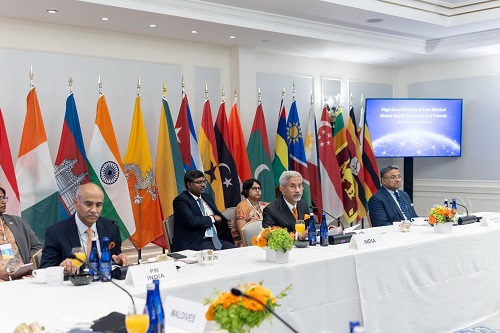
External Affairs Minister Dr S Jaishankar has urged countries of the Global South to deepen cooperation as geopolitical conflicts, economic uncertainties, climate-related disruptions and weaknesses in the multilateral system create new challenges for developing nations. Speaking in New York on the sidelines of the 81st United Nations General Assembly, he stressed the need for collective action on trade, finance, connectivity, energy, food security and emerging technologies.
Dr S Jaishankar, speaking in New York on the sidelines of the 81st United Nations General Assembly, said the international environment was facing multiple pressures, including prolonged conflicts, disruptions to supply chains, fragmented investment flows, rising debt vulnerabilities and a shortage of development finance. Against this backdrop, he called for stronger coordination among Global South countries to tackle bottlenecks affecting supply chains, financing and connectivity.
The External Affairs Minister also underlined the importance of protecting energy security and preventing the manipulation of energy availability and prices. He called for coordinated efforts to safeguard food supplies, particularly grain and fertiliser availability, while advocating fairer economic and trade practices.
Jaishankar further highlighted the need to strengthen industrialisation and production capacities in developing countries. He said securing maritime commons and ensuring the safety of seafarers and commercial shipping were also important for maintaining stable global trade.
The growing impact of Artificial Intelligence figured prominently in his remarks. Jaishankar said the transformation brought about by AI needed to be managed in a way that prevented new divisions between countries and societies. He also called for greater representation of Global South nations in decision-making structures dealing with issues that directly affect them.
On the sidelines of the UN General Assembly, Jaishankar also held talks with Italy's Deputy Prime Minister and Foreign Minister Antonio Tajani. Their discussions covered the situation in the Gulf, the India-Middle East-Europe Economic Corridor (IMEC) and the Ukraine conflict. Jaishankar said the two countries were looking to expand cooperation and strengthen trade ties.
India's engagement with the wider developing world was also highlighted at the India-CELAC Foreign Ministers' Meeting during the UN High-Level Week. Jaishankar called for stronger economic and development partnerships between India and the Community of Latin American and Caribbean States (CELAC), noting that bilateral trade had crossed $50 billion annually.
He said India's economic transformation over the past decade had been marked by a more than doubling of its GDP and continued robust growth. According to Jaishankar, India's expanding economy combines a large and increasingly skilled workforce with a growing domestic market, strong digital infrastructure and rising technological capabilities.
The Minister said India's engagement with the Global South was not limited to immediate national interests but reflected a broader commitment to shared prosperity. He pointed to India's development cooperation in the Caribbean and Latin America, including livelihood-related projects, assistance following Hurricane Melissa, military hospitals deployed to Venezuela after an earthquake and supplies of medicines to countries in the region.
Jaishankar described India and CELAC as possessing complementary strengths. India can contribute technology, pharmaceuticals, skilled manpower and digital capabilities, while Latin American and Caribbean countries offer opportunities in critical minerals, sustainable energy, agriculture and food resources.
He also proposed that India and CELAC consider upgrading the Annual Business Summit from next year, with the aim of giving greater momentum to commercial and economic engagement.
The discussions in New York underline India's push for a more coordinated Global South voice at a time when disruptions to trade, finance, energy and technology are reshaping the global economic and strategic landscape.





















Leave Your Comment