


The Mohan Bhagwat U.S. Visit, USCIRF's Sanctions Push and the Emerging Battle Over Hindu India's Cultural Sovereignty
Nothing in the roughly forty clauses of India's Foreign Contribution (Regulation) Amendment Bill, 2026, names a religion. Introduced in the Lok Sabha on 25 March 2026, the bill tightens custody rules for foreign-funded assets once an organisation's FCRA registration lapses or is cancelled (LawStreet 2026). Within five months, a US congressman had called it "a clear attack against Christians" (Moore, quoted in Free Press Journal 2026), the newly elected Pakistani-American chair of a federal religious-freedom commission had endorsed sanctions against a Hindu volunteer organisation with no formal link to the bill, and more than a hundred Canadian civil-society groups were writing to Prime Minister Mark Carney to defend that organisation's chief ahead of his first visit to the country. The RSS — founded in 1925, banned three times, never once outlawed, and now marking its centenary — has become the fulcrum of an argument about who gets to police religious freedom in the world's largest democracy.
Three explanations compete for that sequence: coincidence, in which an unrelated Indian law and an unrelated American commission simply overlapped in a news cycle; internationalisation, in which India's long-running domestic argument over minority rights has finally found an audience in Washington and Ottawa; and coordination, in which American and Canadian advocacy has been organised and aimed at the RSS. The evidence available as of 20 August 2026 supports the second explanation far more securely than the third, and the distinction matters: one story is about hostile political engineering, the other about the difficulty of insulating sovereignty from a genuinely global religious-freedom apparatus.
FCRA 2026: Law versus Narrative
The FCRA dates to 1976 and was rewritten in 2010 to bar foreign funds for "activities detrimental to the national interest," language broad enough that legal scholars have flagged it for years as an instrument of executive discretion (Khaitan 2020). The 2026 amendment adds one narrow mechanism: a "Designated Authority" empowered to manage and, eventually, dispose of the assets of an organisation whose registration is cancelled, surrendered, or simply allowed to lapse. Officials maintain that any place of worship among those assets retains its religious character, and the maximum prison term for a violation actually falls, from five years to one (LawStreet 2026; Deccan Mirror 2026). Read on its face, the bill governs custody of money and property, not the practice of any faith.
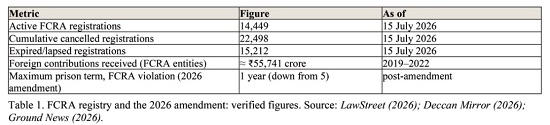
That reading did not survive contact with Washington. Congressman Riley Moore, invoking Christianity's roots on the Malabar Coast, warned that the bill would let New Delhi take over churches and religious charities and called it a clear attack on Christians (Free Press Journal 2026). India's Ministry of External Affairs answered that foreign-funding regulation is an ordinary sovereign instrument, implicitly pointing to comparable disclosure regimes in the United States, Britain, Australia and Canada (The Quint 2026). Facing sustained church protest, particularly in Kerala and Mizoram, the government referred the bill to a joint parliamentary committee rather than force it through the monsoon session (Christianity Today 2026) — itself evidence against any reading of the episode as an unstoppable majoritarian steamroller.
From FCRA to USCIRF: Chronology, Not Conspiracy
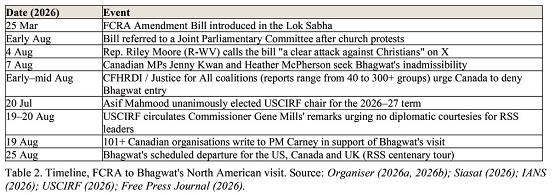
Three features of that sequence cut against the simplest version of the story. First, Mahmood's elevation was not itself a response to FCRA: he had been renominated by House Minority Leader Hakeem Jeffries and had already served as USCIRF vice-chair before FCRA 2026 existed as a bill (USCIRF 2026; Dawn 2026). Second, USCIRF's institutional criticism of India's religious-freedom record predates this controversy by years; the commission has recommended a Country of Particular Concern designation for India since at least 2021 (Dawn 2026). Third, nothing in the public record links Moore's post, USCIRF's recommendation and the Canadian letters into a single organised chain. The claim that American Christian advocacy engineered the USCIRF push against the RSS is an inference, not a documented fact, and this analysis does not treat it as proven. What is demonstrable is escalation along parallel, mutually reinforcing tracks — not one hidden hand pulling all three.
Why the RSS?
The RSS was founded in Nagpur in 1925 by Dr K. B. Hedgewar, against the backdrop of Hindu-Muslim rioting and the freedom movement, as a network of daily shakha meetings built around discipline, physical training and what the organisation calls character formation. Independent India's own governments have banned it three times — after Gandhi's assassination in 1948, during the Emergency in 1975, and after the Babri Masjid demolition in 1992 — and each ban was eventually lifted, a fact Bhagwat himself cites as proof of the state's tacit recognition rather than rejection of the organisation (The Federal 2025; Scroll 2025). The RSS describes itself as a cultural and social body distinct from the BJP, which grew out of the Jana Sangh of 1951 and became the BJP only in 1980. Critics counter that the ideological kinship, and the RSS's role as a training ground for BJP and government personnel including Prime Minister Modi, makes a strict cultural-not-political claim hard to sustain in practice (Organiser 2026a). Both things are true at once, and a serious analysis should hold them together rather than pick one.
Bhagwat's Registration Argument
Answering critics in Bengaluru on 9 November 2025, Bhagwat said plainly that many things are not registered, that even Hindu Dharma is not registered, and that the RSS's three bans were themselves proof the state recognised its existence (The Federal 2025; India TV News 2025). Legally, this is a partial defence, not a complete one. Indian law does not compel every voluntary association to register, and income-tax authorities and courts have accepted the RSS's status as an unincorporated body of individuals, exempting its guru dakshina donations from tax (Tribune 2025). But that status is a legal default rather than an exemption won specifically on cultural or religious grounds, and Bhagwat's rhetorical move — equating an organisational choice with the unregistered nature of a religion itself — folds a legal category into a civilisational one. It is a strong political answer to a partisan attack; it is a weaker legal argument than the RSS's defenders sometimes present it as.
Canada: Two Letters, One Country
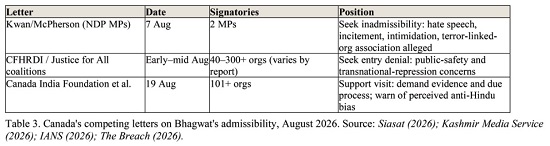
Canada compressed the entire dispute into three weeks. On 7 August, NDP MPs Kwan and McPherson wrote to three federal ministers asking that Bhagwat be ruled inadmissible over alleged hate speech, incitement, intimidation of critics and association with listed terrorist organisations (Siasat 2026). Coalitions including the Canadian Forum for Human Rights and Democracy in India and Justice for All followed with letters of their own (Kashmir Media Service 2026; The Breach 2026). On 19 August, more than 101 Canadian organisations — among them the Canada India Foundation and Hindu Swayam Sewak Canada — answered with a joint letter to Prime Minister Carney insisting that any admissibility decision rest on evidence and due process rather than speculation, and warning that the campaign risked being read by many Canadian Hindus as prejudice against a community of more than a million (IANS 2026; India New England News 2026). Both sides invoke Canadian law rather than reject it — this is not, on either side, an argument against regulating foreign political influence, but an argument over whether the specific allegations against one man meet that law's evidentiary bar.
Cultural Sovereignty
Strip away the acronyms and an old argument remains in new institutional clothing: who has standing to define religious freedom for a billion-person, multi-faith democracy that has regulated foreign money since 1976, decades before USCIRF existed. India's position, articulated consistently across the FCRA and USCIRF episodes, is that foreign-funding law is generically available to every sovereign state and that a domestic organisation's legal status is a domestic question (The Quint 2026). USCIRF's position is that a bipartisan federal commission, created by the same Congress that regulates America's own foreign agents, has standing to comment on any state's treatment of religion, India included. Both positions carry genuine institutional logic. What the FCRA–USCIRF–Bhagwat sequence exposes is that they were bound to collide once an American commission's mandate and an Indian civilisational organisation's centenary calendar overlapped — which, in 2026, they did.
Conclusion
The confrontation was never only about foreign money. FCRA 2026 is India asserting the ordinary sovereign prerogative to know who funds activity inside its borders; USCIRF is asserting the ordinary prerogative of a US statutory body to comment on religious freedom abroad; and the RSS — banned three times, now navigating its own centenary alongside a chair of Pakistani origin at the American commission judging it — has become the point where those two sovereignties visibly grind against each other. Neither institutional logic is illegitimate on its face. What the episode shows is how thin the evidentiary basis for coordination narratives actually is next to how confidently they circulate, and how much more defensible the internationalisation account becomes once that coordination claim is set aside.




















Leave Your Comment