


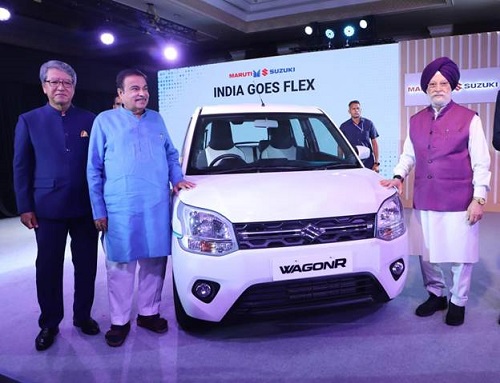
Union Minister for Petroleum and Natural Gas Shri Hardeep Singh Puri today launched India’s first flex-fuel passenger vehicle by Maruti Suzuki in New Delhi, fuelling the vision of Aatma Nirbhar Bharat. Union Minister for Road, Transport and Highways, Sh. Nitin Gadkari was also present during the event. Flex-fuel vehicles can operate on a range of ethanol–petrol blends, from E20 up to E100.
Speaking at the launch, the Minister said the entry of flex-fuel technology into the passenger vehicle segment is not merely a product launch, but also the beginning of a new chapter in India's energy transition. Shri Puri noted that India has nearly 37 lakh passenger vehicles representing the aspirations of middle-class India and the future of personal mobility. Large-scale adoption of flex-fuel technology in this segment can significantly multiply the impact of ethanol-based mobility.
The minister said that before military hostilities began on February 28th, nearly 60% of India’s LPG imports were passing through the Strait of Hormuz . As a country with 1.4 billion people and energy demand growth at three times the global average, India ensured uninterrupted availability of petroleum products across the country. “There was not a single dry-out anywhere in the country. People continued travelling normally by road and air. India maintained near-normalcy despite global disruptions,” the Minister said.
He added that while some attempts were made to spread misinformation and create artificial shortages, the situation remained fully under control due to timely policy interventions and effective management.
Sh. Puri credited the leadership of Prime Minister Shri Narendra Modi for balancing the three key pillars of India’s energy strategy — availability, affordability and sustainability. On availability, Shri Puri highlighted that India maintained uninterrupted supplies of crude oil, LPG and natural gas despite global volatility. India increased domestic LPG production from 32 TMT per day pre crisis to nearly 52 TMT per day, while also expanding the transition towards piped natural gas and CNG.
On affordability, the Minister said India recorded one of the lowest increases in fuel prices globally. He recalled the Prime Minister’s decision to reduce central excise duties on petrol and diesel by ₹10 per litre to provide relief to consumers.
Talking about Sustainability, Sh. Puri recalled his earlier experience in Brazil and the USA where ethanol blending based on sugar and maize had already demonstrated success. He said India’s ethanol blending program has become one of the most successful energy transition initiatives. He noted that India’s ethanol success story was built through a whole-of-government approach and creation of a strong ecosystem involving farmers, ethanol producers, oil marketing companies, vehicle manufacturers, scientists and financial institutions.
India now has the capability to produce ethanol from multiple feedstock sources such as broken grains, agricultural waste, bamboo and sea weed.
Ethanol blending has increased from less than 1.5% in 2013-14 to 20% in 2025-26, achieving the target 5 yrs ahead of the schedule. Ethanol procurement has risen from about 38 crore litres in ESY 2013-14 to more than 1,040 crore litres today, while ethanol production capacity expanded nearly five fold from 421 crore litres in 2014 to ~2000 crore litres in 2026. This shift has reduced crude oil imports, saved foreign exchange, lowered emissions, and increased farmer’s income.
Sh. Puri noted that if 50% of the new two and four wheelers sales eventually shift to flex fuel compliant vehicles, it will create additional demand for 311.8 crore litres of ethanol and provide ₹12,403 crore additional income for farmers. This would also lead to 66.4 lakh metric tonnes less CO₂ emissions
NITI Aayog officially classifies ethanol-based Flex-Fuel Vehicles (FFVs), including vehicles running on high ethanol blends such as E85, as Zero-Emission Vehicles. E85 fuel also produces near-zero particulate matter (PM) emissions, making flex-fuel vehicles a promising solution for addressing the country’s growing air pollution challenge.
The Minister also outlined the Government’s roadmap for creating a nationwide flex-fuel ecosystem. Under the proposed roadmap, E85 has been identified as the mono-fuel standard for Flex-Fuel Vehicles under BIS specifications. The plan proposes an initial roll out of 50–100 FFV-ready fuel retail outlets in the Delhi-NCR and Mumbai–Pune–Nagpur corridors, expanding to nearly 500 outlets by December 2026 and approximately 5,000 outlets across major cities by end-2027.
The Government is also working on supportive measures such as pricing support, road tax concessions, availability of E85 testing fuel, special identifiers for FFVs and retail outlets, consumer awareness initiatives, and development of storage and dispensing infrastructure to increase adoption. Sh. Puri said that this is not merely a transition in fuel, but it is the creation of a complete ecosystem for cleaner mobility, stronger energy security, and greater self-reliance.
Referring to the recent launch of Flex fuel motorcycles by Hero MotoCorp and today’s launch of a flex-fuel passenger vehicle by Maruti Suzuki, the Minister said the country is entering a new phase in clean mobility.
Congratulating Maruti Suzuki for its contribution to India’s clean mobility transition, Shri Puri said India’s energy transition will be built in India, powered by Indian innovation, supported by Indian farmers and driven by Indian consumers. He urged automobile manufacturers to accelerate the introduction of flex fuel models across vehicle segments, and Oil Marketing Companies to rapidly expand E85 availability across the country.



















Leave Your Comment