



Rakesh Kumar
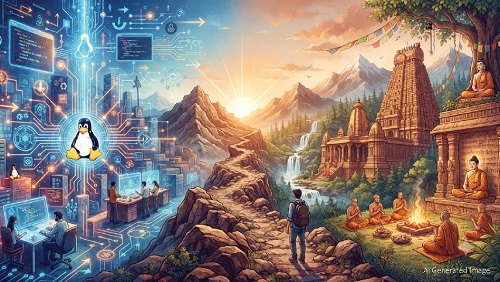
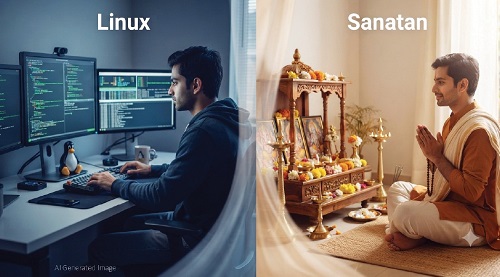
Twenty years ago, while working as a senior executive in the corporate sector, I witnessed my organisation's transition to Linux, an open-source operating system. As I explored its underlying philosophy and principles, an interesting thought occurred to me: Linux seemed to reflect, in many ways, the ethos of Sanatan Dharma.
Linux and Sanatan Dharma: Both appeared to share a remarkable characteristic: openness. Neither was confined to a single, rigid approach. Both allowed diversity, multiple interpretations and different ways of functioning. They provided space for experimentation, adaptation and continuous evolution.
Yet, two decades later, an intriguing contrast deserves attention. Linux has grown into one of the most influential technological ecosystems in the world, powering servers, supercomputers, cloud infrastructure and countless digital devices. Sanatan Dharma, despite its ancient philosophical depth and extraordinary diversity, continues to face challenges in preserving awareness of its traditions, communicating its ideas and sustaining its cultural confidence.
The Paradox of Openness — Why One Flourishes While the Other Faces Challenges.
Is the difference in their philosophies, or in the way their followers practise, protect and promote them? Let’s explore every aspect of this issue.
1. The philosophy of openness
Linux is built on open-source development,
Sanatan Dharma reflects a similar spirit of intellectual openness. It does not prescribe one exclusive path to spiritual understanding. Bhakti (devotion), Karma (action), Jnana (knowledge) and Yoga (disciplined practice) offer different paths towards self-realisation. Its diverse philosophical schools, including Vedanta, Samkhya, Nyaya and Mimamsa, further demonstrate its tradition of debate and enquiry.
The Rig Vedic expression Ekam Sat Vipra Bahudha Vadanti — truth is one, the wise describe it in many ways — captures this pluralistic outlook.
There is, of course, a distinction: Linux is an engineered system governed by technical licences and protocols, while Sanatan Dharma is a diverse civilisational and spiritual tradition without a single central authority. The comparison is philosophical, not literal.
An open system can become a source of extraordinary strength, but only when openness is accompanied by awareness, active participation and the responsibility to protect its foundations.
2. Freedom to evolve:
One of Linux's greatest strengths is that it never treats its existing version as the final destination.
Sanatan Dharma once followed a similar process. Rishis and scholars questioned established ideas, debated through Shastrarth, identified weaknesses and developed new interpretations. This intellectual evolution is reflected in its journey from the Vedas to the Upanishads, Smritis and Puranas.
However, successive invasions and prolonged periods of foreign rule severely disrupted many of its institutions and knowledge traditions. India's tradition of openness was also exploited by invaders who, after seeking surrender when defeated, often returned with greater force. Victories were frequently followed by killings, the violation of women, and the plunder and destruction of temples and cities.
While the tradition of openness survived, its institutional framework for debate, verification and preservation weakened leading to unverified interpretations. Today, some storytellers, reformers, authors and filmmakers present historical and religious narratives with considerable distortion, often blurring the distinction between fact and fiction.
Future generations may struggle to distinguish authentic knowledge from convenient interpretations.
Openness without discipline can create confusion; openness supported by a framework creates innovation.
Sanatan Dharma has demonstrated an extraordinary capacity to evolve. It has accommodated different schools of thought, regional traditions, languages, rituals and forms of worship. It is the only religion which accommodates a non-believer even. There is no threat to life for acts like blasphemy. Many Hindu saints and common man have cursed the gods and it has not impacted respect for them.
However, this diversity has not always been accompanied by equally strong mechanisms to preserve, document and communicate its knowledge.
3. Decentralisation: Strength or weakness?
Decentralisation does not mean the absence of coordination. The Linux kernel has a recognised development and maintenance structure.
Sanatan Dharma, on the other hand, has historically developed through numerous institutions, monasteries, temples, spiritual teachers, philosophical schools and community traditions.
But decentralisation has its limitations.
There is no universally accepted institution responsible for presenting Sanatan philosophy to the younger generationresponding to misconceptions or coordinating its cultural outreach.
The result is a paradox: a tradition with enormous intellectual resources can sometimes struggle to communicate its collective strength.
The lesson from Linux is not that Sanatan Dharma needs a central authority. Rather, it needs stronger networks of collaboration without sacrificing its diversity.
4. Knowledge sharing versus knowledge isolation
Linux became powerful because knowledge was shared.
Sanatan Dharma possesses an equally extraordinary intellectual inheritance. The Vedas, Upanishads, Bhagavad Gita, Ramayana, Mahabharata, Puranas and numerous philosophical texts contain insights into human nature, ethics, leadership, duty, relationships and the pursuit of knowledge.
Yet, how effectively are these resources reaching the younger generation?
Knowledge that remains confined to a limited circle gradually loses its influence.
There is a need to translate, interpret and communicate these ideas in contemporary languages and formats. Digital platforms, podcasts, short videos, interactive learning and academic research can make this heritage accessible to people who may never open a traditional scripture.
The objective should not be to simplify the philosophy to the point of distortion, but to make its depth understandable.
A civilisation cannot depend indefinitely on the greatness of its inherited knowledge. It must ensure that every generation discovers, understands and contributes to it.
5. Inclusiveness: An advantage that needs to be understood
Similar to Linux Sanatan Dharma also contains traditions that recognise multiple approaches to spiritual enquiry. Its philosophical and cultural diversity allows individuals to relate to the tradition in different ways.
However, inclusiveness should not be confused with the absence of identity.
Linux does not abandon its essential architecture every time someone proposes a new feature. Its openness operates within an identifiable framework. It is painful to see how easily Ramayan an important scripture of Sanatan has been manipulated by film makers. As a result, Adi Purush and Ramyan by Nitesh Tivari has many variations from the original text yet neither the censor board nor the spiritual leaders objected to distortions.
6. The importance of documentation and communication
Knowledge does not have to be rediscovered by every new generation.
For centuries, Indian knowledge systems depended substantially on oral traditions, teachers, family practices and specialised institutions. These methods created barriers to wider access.
We need accessible translations, authentic commentaries, well-researched historical material and credible digital archives. We need teachers who can explain ancient concepts without either blind glorification or casual dismissal.
We must also learn to communicate in the language of the present generation.
leaving the interpretation of our intellectual heritage entirely to others, has led to incomplete or distorted versions become more widely known than the original ideas. Most of the commentaries on our scriptures are from western scholars who failed to grasped the truth yet modern Indian are learning from these books only. Nehru discovered India reading such literature and hindered restoration of destroyed heritage like Somnath temple.
7. The challenge of criticism and internal reform
An important feature of the open-source ecosystem is its willingness to identify and correct weaknesses.
Sanatan Dharma already had a rich history of debate, questioning and reform. Its philosophical traditions have not always agreed with one another. Reformers and thinkers have challenged social practices, questioned established interpretations and sought to restore ethical and spiritual values.
Not every practice deserves protection merely because it is old. Equally, not every criticism should be accepted without examining its historical context, evidence and underlying assumptions.
Defensiveness is not the same as preservation. Reform, when rooted in knowledge and ethical values, can strengthen continuity rather than weaken it.
8. Why does Linux attract contributors while cultural traditions struggle to engage the young?
Perhaps the most important difference lies in participation.
Linux offers a clear opportunity to contribute. A young programmer can identify a problem, write code, submit an improvement and see the result incorporated into a product used around the world.
The contribution is visible. The achievement is measurable. The participant feels a sense of ownership.
Can we create similar opportunities for younger generations to participate in the preservation and development of Sanatan knowledge?
Can a student develop an engaging digital interpretation of the Bhagavad Gita? Can a technology professional create an accessible archive of ancient Indian literature? Can a management student explore the principles of leadership in the Mahabharata? Can researchers examine the relevance of Indian philosophical traditions to contemporary ethical dilemmas?
These are not merely cultural activities. They are opportunities to make an ancient intellectual tradition relevant to contemporary life.
A tradition survives not simply because people admire its past, but because they find meaning in participating in its present.
9. The real threat: Losing the ability to communicate our own story
Sanatan Dharma has survived centuries of political changes, social transformations and external challenges. Its philosophical traditions, festivals, languages, art forms and spiritual practices continue to influence millions of people.
Therefore, it would be inaccurate to suggest that it is simply declining or disappearing.
Nevertheless, challenges exist.
These include the weakening of intergenerational transmission of traditional knowledge, inadequate public understanding of its philosophical diversity, the loss of some local traditions, the influence of superficial interpretations and the growing gap between inherited wisdom and contemporary education.
In the digital age, visibility often determines influence. An idea that is not communicated effectively may remain unknown, regardless of its intellectual merit.
We cannot expect the world to understand our heritage if we do not invest in explaining it ourselves.
The strength of Sanatan Dharma can be demonstrated through knowledge, intellectual engagement, ethical conduct and the ability to coexist with differences.
The objective should be to strengthen understanding, not to manufacture confrontation.
First, build communities rather than isolated institutions.
Second, make knowledge accessible. Our scriptures, philosophical texts and traditional knowledge need credible translations, digital archives and contemporary interpretations.
Third, encourage questioning. Young people should be encouraged to ask difficult questions.
Fourth, invest in the next generationwe must explain the philosophy, values and reasoning behind them. Understanding creates a deeper and more enduring connection.
Fifth, embrace technology. Artificial intelligence, digital libraries, online education and social media offer unprecedented opportunities to make India's intellectual heritage accessible across geographical and linguistic boundaries.
Finally, develop a sense of collective responsibility. We cannot leave the preservation and communication of our heritage entirely to religious leaders, scholars or a few organisations. Every informed individual has a role to play.
Who will fund this mission.
A secular government cannot initiate such mission and there is no single authority responsible for protecting promoting Santan dharma. Elected legislatures, ministers and pseudo reformers have objection to calling it Sanatan even. Daring few have expressed intentions to destroy it while comparing it with dengue. Sanatan was made Hindu dharma and the same is being condemned indirectly by questioning Hindutva as if these are two different identities.
Role of government.
As discussed above government is not supposed to protect Hindu dharma but it has the responsibility to provide level playing field. At present by controlling temples and making laws that are applicable to Hindus only. The present system has inadvertently become anti Hindu. Appeasement oriented policies have helped Waqf and similar institutions in promoting malpractices. Controlling temples and siphoning money for other purposes is killing Hindu culture silently. Let there be a level playing field and a commission to monitor that no religion promotes divisive, discriminatory practices or hatred.
At present it took decades in making the law to curb the mal practices. Hindus have to fight hundreds of cases individually. Had the temples been free from the clutches of state governments it would not have taken years in seeking permission to lit a ceremonial lamp in front of a temple in Tamil Nadu where a discriminatory government decided against it. A free temple can preach dharma, promote research, provide support to Hindu victims in form of shelter and legal recourse against atrocities and discrimination. Had the temples been free Kashmiri pandits would not have suffered so much, free temples would have countered the hate campaign being sponsored from mosques by filing PIL as done by other religious bodies.
Stop controlling temple regulate them as being done for gurdwara’s through SGPC act.
Why a Commission to Regulate Religious Institutions Is Necessary
Religious institutions and practices have often been treated differently, raising questions about equality and secular governance. A common, independent commission to oversee religious institutions, with due respect for constitutional freedoms, could serve the nation in several ways:
The objective should not be to regulate faith or dictate religious beliefs, but to ensure that religious institutions, like all other institutions, remain accountable to the Constitution, equality and the rule of law.
Conclusion: Openness must be accompanied by ownership
The Linux–Sanatan Dharma comparison offers a larger lesson: openness and diversity become strengths when supported by organisation, knowledge-sharing and active participation. Sanatan Dharma need not compromise its inclusiveness; it must strengthen awareness, communication and engagement among younger generations.
A tradition survives not merely by celebrating its glorious past, but by ensuring that every generation understands, contributes to and enriches it.
Keep the doors open, but never abandon the responsibility to strengthen the house.
(The content of this article reflects the views of writer and contributor, not necessarily those of the publisher and editor. All disputes are subject to the exclusive jurisdiction of competent courts and forums in Delhi/New Delhi only)






















Leave Your Comment