


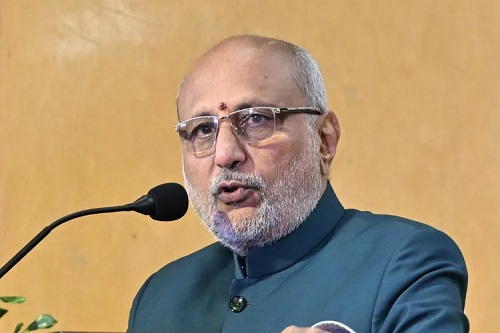
At a time when geopolitical shifts, economic uncertainties and rapid technological changes are reshaping the global order, Vice-President C. P. Radhakrishnan has called for economic policies that are resilient, inclusive and responsive to changing realities. Addressing the 5th Kautilya Economic Conclave in New Delhi, he underlined that India’s strength lies not merely in its economic growth, but in its ability to combine democratic consensus with reforms, social inclusion and institutional capacity.
The Vice-President’s address at the conclave, organised around the theme “Resilience in an Age of Flux,” placed the idea of resilience at the centre of India’s development strategy. His message was clear: in a rapidly changing world, economic policies cannot remain static. They must evolve with circumstances while remaining rooted in the realities faced by citizens, businesses and communities.
Reflecting on the legacy of the Institute of Economic Growth (IEG), C. P. Radhakrishnan recalled that the institution has been associated with India’s development journey since its establishment in 1952 under Professor V. K. R. V. Rao. He stressed that effective policymaking requires a close understanding of ground realities. Policies, he said, must have the flexibility to respond to changing conditions rather than operate within rigid frameworks.
An equally important theme of his address was the relationship between consensus and decisive policymaking. According to the Vice-President, uncertainty demands decisiveness, but such decisiveness must emerge from consensus. Debate and disagreement are natural components of a democracy, but discussions should ultimately facilitate decisions capable of securing wider acceptance.
Speaking in his capacity as Chairman of the Rajya Sabha, he underlined the importance of free and transparent debate in strengthening democratic institutions. At the same time, he stressed that rights and duties must move together. The broader message was that democratic institutions and economic governance reinforce each other when dialogue leads to constructive decision-making.
Radhakrishnan highlighted India’s experience of pursuing economic development within a democratic framework. India’s growth story, he noted, demonstrates that democracy and development can progress together. Consensus-building, he argued, also gives reforms greater durability by creating broader ownership of the changes being undertaken.
This experience assumes particular significance in the context of the vision of Viksit Bharat by 2047. The objective of becoming a developed nation, the Vice-President suggested, cannot be achieved only through headline economic numbers. It requires stronger institutions, wider participation in economic activity and the creation of opportunities across regions and sections of society.
He particularly highlighted the link between economic resilience and social resilience. Initiatives such as the JAM trinity, Direct Benefit Transfer and GST have contributed to financial inclusion, transparency and the formalisation of economic activity.
The scale of this transformation was reflected in the figures cited by him. More than 590 million Jan Dhan accounts had been opened by August 2026, while GST registrations increased from approximately 6.65 million in 2017 to 16.5 million in May 2026. These developments indicate the widening footprint of the formal economy and the growing integration of citizens and businesses into formal financial and taxation systems.
But the Vice-President emphasised that inclusion should not stop at bringing people into the formal economy. The next stage, he said, must enable people to create value, earn sustainable incomes and become entrepreneurs.
This approach was particularly evident in his reference to women-led economic participation. Around 9.2 million Self-Help Groups, involving more than 100 million rural women, have emerged as an important component of grassroots economic activity. The emergence of more than 34.6 million Lakhpati Didis, he noted, reflects the growing ability of rural women to move beyond livelihood support towards enterprise and income generation.
The changing role of women in education and economic activity, he said, represents a broader transition from merely discussing women’s empowerment to building an era of women-led development.
For the Vice-President, resilience is not created exclusively in financial markets, corporate boardrooms or government offices. Its real foundations can often be found in everyday economic participation at the grassroots.
A woman opening a bank account, receiving government benefits directly, entering the formal economy and eventually transforming a Self-Help Group into an enterprise represents, in his view, the practical meaning of economic resilience. Such individual transformations collectively strengthen the resilience of the national economy.
He also pointed to the reported reduction in extreme poverty, noting that more than 250 million Indians have moved out of extreme poverty. He described this as a historic achievement while emphasising that development must remain geographically broad-based.
Every State, district and village, he said, must become an equal partner in India's development journey. This emphasis on distributed development reflects the larger challenge of ensuring that economic expansion translates into opportunities beyond major metropolitan and industrial centres.






















Leave Your Comment