


India’s defence self-reliance drive is entering a new phase, with the focus shifting from manufacturing indigenous equipment to developing advanced technologies that can strengthen military capabilities and reduce strategic dependence on foreign suppliers. Defence Minister Rajnath Singh has called for an ambitious ‘Aatmanirbharta 2.0’, emphasising cutting-edge research, resilient domestic supply chains, greater private-sector participation and stronger collaboration between industry and academia. Addressing the fifth edition of SWAVLAMBAN, the Indian Navy’s Naval Innovation and Indigenisation Seminar in New Delhi, he underlined that technological superiority will be essential to safeguarding national security and advancing the vision of Viksit Bharat@2047.
India’s defence indigenisation programme has made considerable progress over the past decade, creating a foundation for more ambitious technological goals. However, the next stage requires a shift in priorities. Domestic production alone will not be sufficient unless Indian-made equipment is cost-effective, operationally superior, reliable and competitive in global markets. The challenge is to move beyond assembling or manufacturing existing technologies towards designing, developing and producing sophisticated systems that can meet the demands of future warfare.
Singh stressed that Indian innovators must now pursue technological objectives that may appear difficult but are essential for long-term strategic independence. He expressed confidence in the country’s scientific talent and entrepreneurial capabilities, while calling for sustained investment and a more supportive environment for high-risk research. His message reflects an emerging understanding that defence preparedness depends not merely on the size of military inventories but also on a nation’s ability to innovate, adapt and manufacture critical technologies independently.
A major element of this transformation is the development of resilient supply chains. Singh described supply chain management as a strategic necessity rather than a purely technical concern, pointing to vulnerabilities arising from dependence on imported raw materials, including rare earth elements, and technologies that are not yet available domestically. Such dependencies can become serious liabilities during geopolitical tensions, international conflicts or disruptions to maritime trade routes.
He called for a dynamic roadmap that establishes clear timelines for indigenisation, identifies priority technologies, assigns responsibilities to industries and determines the resources needed to achieve specific targets. Advance planning for buffer stocks and domestic production capacity, he emphasised, is essential to ensure that supply disruptions do not undermine defence operations during a crisis. While some foreign dependencies may continue until viable domestic alternatives emerge, critical technologies and strategically important components must receive priority.
Research and development will consequently determine the pace and depth of India’s next phase of defence modernisation. Singh acknowledged that innovation inevitably involves failures and argued that excessive risk aversion can prevent promising ideas from reaching maturity. Countries with advanced research ecosystems have demonstrated the importance of treating unsuccessful experiments as opportunities to learn and improve.
India, therefore, needs funding mechanisms capable of supporting high-risk, high-reward projects. Greater private-sector participation could help expand the capacity for experimentation, while low-cost technological solutions would allow innovators to test ideas without requiring prohibitively expensive infrastructure. Stronger partnerships between universities, research institutions, defence establishments and private companies can create a more productive environment for scientific discovery and technological application.
The defence minister also called for a stronger research culture in educational institutions and more opportunities for young people to pursue careers in science and engineering. Building such an ecosystem requires long-term commitment, because advanced capabilities cannot be developed merely through short-term procurement decisions. They depend on the steady accumulation of expertise, research infrastructure, intellectual property and manufacturing experience.
The progress of the Innovations for Defence Excellence (iDEX) initiative illustrates the potential of India’s start-up and micro, small and medium enterprise ecosystem. According to Singh, more than 4,000 proposals have been submitted against 229 challenges issued by the Indian Navy. Start-ups and MSMEs have developed solutions in areas such as naval systems, sensors and communications, helping convert operational requirements into opportunities for indigenous innovation.
The initiative is also producing tangible procurement outcomes. Naval Chief Admiral Krishna Swaminathan stated that 41 Acceptance of Necessity cases, worth more than Rs 3,500 crore, had been accorded, while 25 contracts valued at over Rs 1,900 crore had been signed. The figures indicate a growing effort to connect innovation with the actual requirements of the armed forces rather than allowing promising technologies to remain confined to research laboratories or demonstration projects.
Nevertheless, moving from a successful prototype to operational deployment remains a complex process. Technologies must undergo rigorous testing, meet military performance standards, receive procurement approvals and demonstrate reliability throughout their service life. Swaminathan identified ideation, prototyping, testing, contracting, induction and life-cycle support as crucial stages in accelerating capability development. Better coordination among the Navy, industry, start-ups and MSMEs will be necessary to shorten development timelines without compromising operational effectiveness.
The growing demand for naval vessels in the Indian Ocean Region makes this transition particularly important. Warship construction requires substantial financial and industrial resources, and rising operational requirements make affordability a major consideration. Singh emphasised that the next phase of self-reliance must focus not only on increasing indigenous production but also on improving quality, efficiency and cost-effectiveness. He also highlighted the need to address residual import dependence, particularly in Buyer Nominated Equipment.
Another significant proposal is the development of a ‘Dual Technology Roadmap’ covering technologies with both civilian and military applications. Such an approach could widen the market for indigenous innovations, encourage greater private investment and allow technological advances to benefit multiple sectors. Singh also called for identifying technologies that could be used across the Army, Navy, Air Force and Indian Coast Guard, strengthening cooperation between the services and reducing duplication of effort.
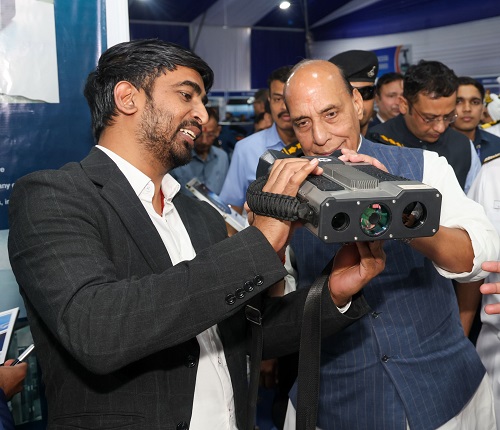
Emerging fields such as artificial intelligence, quantum technologies, autonomous platforms, robotics, resilient navigation, advanced communications, persistent surveillance and counter-drone systems are expected to influence future military operations. The technology exhibition at SWAVLAMBAN 5.0, featuring more than 100 stalls by start-ups and MSMEs, demonstrated the range of indigenous solutions being developed to address these challenges. Hypersonic technologies also featured among the seminar’s areas of deliberation.
The broader significance of SWAVLAMBAN lies in its effort to bring military users, scientists, entrepreneurs, investors and academic institutions onto a common platform. Organised by the Indian Navy in collaboration with the Defence Innovation Organisation and the Society of Indian Defence Manufacturers, the October 26–27 seminar is themed ‘Strength and Power through Innovation and Indigenisation’. Its discussions are intended to strengthen domestic supply chains, encourage academic entrepreneurship and help promising enterprises secure funding and scale up their technologies.
India’s defence ambitions will ultimately be measured by its ability to convert these initiatives into dependable operational capabilities. Aatmanirbharta 2.0 requires more than higher domestic production figures: it demands technological depth, consistent investment, skilled manpower, competitive manufacturing and a willingness to accept calculated risks in research. By combining indigenous innovation with disciplined procurement and cross-sector collaboration, India can reduce critical vulnerabilities while creating technologies suited to its own strategic requirements.
The transition will not be immediate, particularly in areas involving sophisticated components, specialised materials and complex research. Yet a sustained commitment to innovation can gradually expand domestic capabilities and strengthen the industrial foundations of national security. As India advances towards Viksit Bharat@2047, the objective is clear: to build a defence ecosystem capable not only of meeting present military needs but also of anticipating future threats and developing the technologies required to address them.



















Leave Your Comment