


RSN SINGH
No sooner had the Honourable Chief Justice of India made a comment describing certain individuals whose only preoccupation is attacking institutions as cockroaches, the so-called Gen Z lapped it up, and in a flash the Cockroach Janta Party (CJP) was born. Within a matter of days, protestors congregated at the Jantar Mantar. Are we in an era of flash public mobilisation? Do flash mobs have an overwhelming impact on the administration, judiciary and the Constitution? What is the character of a flash mob and its leadership? These are some questions that this article seeks to answer.
SPLIT IN THE CJP
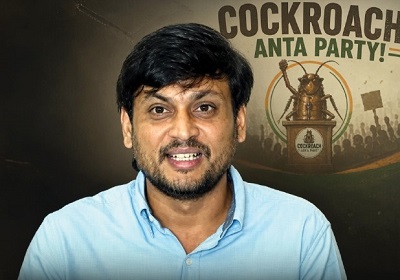
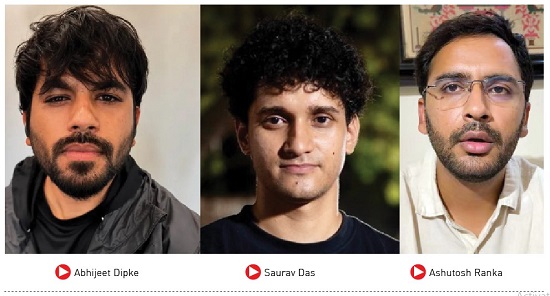
The CJP staged hunger strikes at Jantar Mantar against the government with an anti-national overtone in the first week of August this year. Ironically, within a matter of days, the CJP has split. The leader of the new group, Manish Barhambhat, has accused the CJP leader, Abhijit Dipke, of turning the national movement into a personal one.
This split in the so-called Gen Z is not because of ideological reasons, but over the financial and political spoils of the movement, which was organised in a flash and induced by huge dubious funding. This was in line with the Aam Aadmi Party (AAP), which had split because Kejriwal, the mafia guru of the CJP, had appropriated most of the spoils of the Anna movement. Prominent figures who split from the AAP comprised a lawyer, a journalist, a poet and a psephologist. The poet went on to become a "kathawachak" and is known to charge astronomical amounts in his new avatar. The love for money of these political mafia groups is best illustrated by Kejriwal's Sheesh Mahal. Following the protests at Jantar Mantar, the CJP's dance party in an upscale hotel goes to show that it is equally afflicted by the Sheesh Mahal syndrome.
AAP - CJP SIMILARITIES
The seed funding for both AAP and the CJP came from foreign sources. In the case of the CJP, or so-called Gen Z, money was directly sent to the savings accounts of individuals through NGOs in instalments, to secure their future involvement and participation. Compelled, and in a very unusual move, the government has frozen a large number of these accounts for security reasons. In addition, these protests were also funded through proceeds of cybercrime and 'gaming.'
To begin with, both used mascots for their agitation for the sake of credibility, only to dispense with them in the most ignominious manner. The AAP and CJP availed themselves of the services of Anna Hazare and Sonam Wangchuk respectively. They deliberately built an environment for them to die so that they could exploit their martyrdom for unleashing mayhem in the country, particularly in the nerve centre of the national capital. The government shared the intelligence inputs with Mr Wangchuk regarding the CJP plan to eliminate him. Mrs Wangchuk was also made aware. Mr Wangchuk had to be literally rescued from Jantar Mantar.
Both the AAP and the CJP are imbued with the same culture of mobilising India-baiters and anti-national slogans. Even as CM of Delhi, Kejriwal proudly proclaimed that he was essentially an anarchist. Again, during his protest at Rail Bhavan in 2013, he debunked the idea of the Indian Republic and the Republic Day Parade. The CJP, on the other hand, castigated the government for the removal of Article 370, the hanging of Afzal Guru, and the incarceration of Sharjeel Imam and Umar Khalid. They even abused the Indian Army.
Both the AAP and the CJP targeted nerve centres. In 2013, Kejriwal had declared his intention of capturing North Block, South Block and the Rashtrapati Bhavan, and 13 years later the CJP declared its objective of assaulting Parliament. The so-called farmers' agitation in 2021 led to an attempted assault on the Red Fort. In 2021, it was majorly facilitated by Arvind Kejriwal as Chief Minister of Delhi. So was the case with the Shaheen Bagh protests. They seem to have taken a cue from Ukraine, wherein a duly elected President, Yanukovych, was forced to abandon his presidential palace in 2017 and eventually take shelter in Russia. This pattern was later applied in Sri Lanka, Bangladesh and Nepal as well. The ultimate objective is 'regime change' by mass invasion.
Crowds are gathered in the garb of 'democratic rights' and then weaponised. This methodology, in effect, paralyses the security forces.
In the Indian context, however, the impetus of such anti-national, foreign-funded forces is not regime change but the purge of Mr Modi. Initially, it was to prevent Modi from coming to power, and now the agenda is to depose him. Various methods have been devised to depose him, i.e. political killing, judicial killing and assassination. It was in this vein that foreign forces deployed Kejriwal to electorally stop Modi at Varanasi in 2014. Some two dozen foreign-funded NGOs had descended on Varanasi in support of Kejriwal. The desperation of foreign forces to halt Modi in his tracks was such that Kejriwal was made to resign as CM of Delhi to electorally pit him against Mr Modi. Before this, such was the desperation to prevent Modi from becoming PM that Kejriwal, with tacit support of the Congress, tried to capture power through mass mobilisation at Jantar Mantar in 2013.
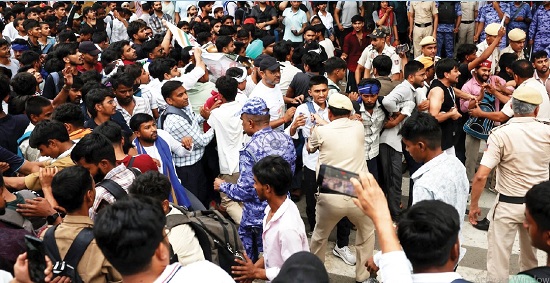
This coup failed. Then another was attempted via the Shaheen Bagh protests in 2020, the farmers' protest in 2021 and, last but not the least, the CJP protest at Jantar Mantar. Therefore, the CJP protests should be seen in this chain.
EXCUSES NOT CAUSES
Kejriwal's protest at Rail Bhavan was on the issue of corruption, but the slogans that dominated the scene were against the Indian Republic and the Republic Day Parade. He also declared that he favours anarchy over democracy. How do these anti-national slogans square with corruption?
Similarly, how do slogans in favour of Article 370, Afzal Guru, Sharjeel Imam, Omar Khalid and an anti-India, anti-Army rant square up with the NEET paper leak? Once the leak came to light, promptly a re-test was held and the issue was addressed. Yet the CJP persisted with its protest because it was part of a pre-planned and premeditated toolkit timeline.
SAME INGREDIENTS
The ingredients of the protests near Rail Bhavan, Shaheen Bagh and Singur border have been rather the same, i.e. Maoists, Jihadis, Urban Naxals, criminals, Kejriwal and the Church. It may be recalled that in 2012, during the Delhi elections, there was a calibrated attack on churches to whip up international support for Kejriwal. In the latest CJP protest, pastors from the Church were seen at Jantar Mantar in support of the CJP.
The primary reason attributed to Kejriwal's political focus on Punjab is to facilitate the conversion of Sikhs into Christianity. This has now acquired epidemic proportions. The Church is known for its devious ways in its conversion drive. Their activities certainly undermine Indian nationhood and nation-building.
The two main ingredients, Maoism and Jihadism, are in perfect harmony as far as their ideologies are concerned. Both strive to acquire power by force. Both are murderous. In fact, they love blood. Both are totalitarian and consider opposition their enemy.
Recently, on the orders of the new Chief Minister of Bengal, Mr Suvendu Adhikari, all graffiti on university walls were removed, but very soon, in defiance, the graffiti on Jadavpur University on freshly painted walls reappeared. One of them, by AISA, read: "We have no compassion and ask no compassion from you. When our time comes, we shall make no excuses for terror."
Apart from the ingredients as listed above, there is, of course, the patronage by Mrs Sonia Gandhi and her son, which appears to be her personal agenda and not that of the Congress party as such. Rather, it would not be wrong to say that the CJP is the B team of Kejriwal, just as Kejriwal is the B team of Sonia Gandhi. Their common agenda is Modi-specific.
There is nothing Gen Z about it. Such western terminologies are poor adaptations in the Indian context because of its civilisational moorings.
THE CRIMINAL INGREDIENT
Apart from Maoists, both Kejriwal and the CJP have deployed criminals of the same ilk in their protests and agitations. Kejriwal even went to the extent of inducting criminals into his cabinet and rewarded them with education and finance portfolios.
His education minister Tomar was arrested on charges of running a fake certificate industry, and his finance minister Satyendra Jain went to Tihar Jail for financial fraud. His don-like status amongst the Tihar convicts was widely televised.
In respect of the CJP, the Supreme Court has quashed the FIRs of those whom it deemed to be genuine protesters on the NEET issue, but did not quash FIRs in respect of 2,873 individuals. These have previous records of crime, i.e. murder charges - 62, attempt to murder - 289, dacoity - 61, rape - 06, POCSO - 25, molestation - 185, snatching - 67, under the NDPS Act and other crimes - 184.
The lingering suspicion is whether those spared were genuine NEET protesters. If they were not colluders, they should have walked out when anti-national slogans were being raised by the criminal elements. They could have shut up those abusing the Prime
Minister, his mother and the Indian Army. They could have urged the leadership to restore order and dignity. Instead, they chose to be accomplices.
POLICE BOYS ASSOCIATION
This association comprises family members of police personnel. In Maharashtra, they recently protested against the ill-treatment meted out to one Sub-Inspector, Suresh Sangli, who was deployed for providing protection to Dipke. Further, they also threatened to carry out a chakka jam. The President of the association, Rahul Dubale, said that police personnel on official duty cannot be subjected to humiliation and intimidation.
This doesn't bode well for the future. The families of police personnel are now being pitted against the system. This was coming. There has been a growing tendency to ignore the human rights of police personnel. Police personnel, after all, aren't dummy robots? Are they expected to be mute spectators when the security forces are mocked, when anti-national flags are hoisted on the Red Fort, when anti-India slogans are raised, when there is an attempt to invade Parliament, or when somebody tries to snatch their weapons?
Well, they may remain quiet as they are under orders to do so. We cannot expect their families to quietly go through this humiliation. They too have their human rights and right to dignity.
Hypothetically, if the Police Boys Association had been pitted against those arguing in favour of quashing of FIRs of the CJP members, what stand would the Honourable Supreme Court have taken?
If a police personnel, for the sake of the security of the nation and for restoring law and order, uses a legitimate anti-riot weapon, how can there be an FIR against him?
Retired Delhi police officer Rajender Singh filed a petition in the Supreme Court for prohibiting large-scale demonstrations in sensitive areas in Delhi, especially in view of the upcoming BRICS summit. The court, in its ruling, maintained: "Right now there is no compelling circumstance to assume that any untoward thing will happen." But if one may submit to their Lordships, going by the precedence, leave alone untoward happenings, there is every chance of a coup attempt.
Crowds are being mobilised to cause mayhem and invade centres of power, an invasion.
Several times New Delhi has extricated itself from this brink. Hence, there may be no compelling circumstances, but definitely there is compelling precedence, which cannot be facilitated any further on the plea of 'democratic rights'.
CONCLUSION
The Indian Constitution was framed in a different technological era. Mobility and communications since then have developed at an unimaginable pace, which the framers could not have envisaged. We have arrived in an era of flash mobs capable of executing flash coups. The speed of mass mobilisation and weaponisation must weigh heavily on decision-making by the courts. Even minor concessions and small latitudes in this regard can prove to be disastrous.
(The content of this article reflects the views of writer and contributor, not necessarily those of the publisher and editor. All disputes are subject to the exclusive jurisdiction of competent courts and forums in Delhi/New Delhi only)




















Leave Your Comment