



DR. PADMALOCHAN DASH
How Dependency-Oriented Freebie Politics Is Eroding Productive Citizenship, Self-Reliance, Civic Autonomy, Democratic Agency, and National Productivity
Across many democracies, freebies have travelled a considerable distance from their origins. What began as limited relief, targeted, temporary, directed at genuine distress, has migrated into the larger theatre of electoral strategy, political communication, and governance management. The tools have multiplied too: direct cash transfers, utility waivers, subsidised consumer goods, benefit schemes calibrated not only to address poverty but to cultivate support, consolidate legitimacy, and keep voters psychologically tethered to those in power.
The relationship between the state and its citizens shifts in this transition. Subtly, but consequentially. Welfare becomes entangled with political calculation. And what was once a protective mechanism beginning to serve a different function altogether.
The larger purpose of welfare, in any democratic, developmental society, was never this. It was supposed to strengthen human capability. Expand opportunity. Encourage entrepreneurship. Produce citizens capable of standing on their own feet and contributing meaningfully to national life. Not keep them permanently dependent on political distribution systems.
The expansion of freebie politics is closely tied to competitive populism. Politicians have discovered that immediate material gratification works better electorally than the slow, unglamorous labour of structural reform, building employment, investing in education, expanding industry. So, the scales tip. Welfare distribution drifts into political patronage. The logic of empowerment is quietly replaced by the logic of retention.
In the digital era, this has become more precise. Biometric databases, algorithmic targeting, direct-benefit platforms, all capable of integrating political messaging with benefit delivery at scale. The machinery has never been more sophisticated. Which is exactly why the anxiety has never been more justified.
Philosophy, Freedom, and the Moral Debate on Freebies
This debate cannot be confined to fiscal policy or economic efficiency. It reaches deeper. It touches questions about human dignity, labour ethics, individual freedom, democratic consciousness, and the moral purpose of governance itself.
Welfare, in a democratic society, is expected to uplift. Through capability. Through productive participation. Through the kind of self-reliance that makes a person a citizen rather than a subject. The problem begins when assistance shifts from empowerment to prolonged dependency, when passive economic existence is normalised, when initiative and responsibility slowly drain out of the picture.
Gandhi saw this clearly. For him, excessive dependence on state support was incompatible with self-sufficiency, productive labour, and decentralised social organisation. Work was not merely economic necessity, it was discipline, dignity, moral responsibility, civilisational balance. Societies detached from labour and local self-reliance, he feared, would eventually weaken both character and collective resilience.
Bentham's utilitarianism would judge welfare not by its immediate popularity but by its broader consequences. Mill's emphasis on liberty and autonomous self-development raises serious questions about welfare structures that weaken civic independence under the guise of benevolence. Tocqueville was perhaps the most prescient: he warned against democratic societies surrendering autonomy gradually, through dependency and administrative paternalism, not by force, but by slow drift.
The ideological concern, taken together, is not about welfare as such. It is about the possibility that dependency-driven governance quietly weakens productive citizenship, entrepreneurial spirit, democratic participation, and civic autonomy, all while wearing the face of generosity.
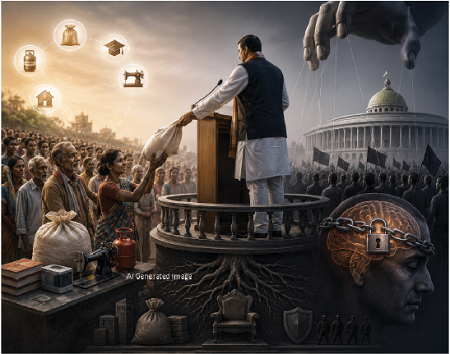
When Welfare Weakens Work Culture: Freebies and the Decline of Productive Citizenship
The growing culture of freebies raises hard questions about work ethic, individual initiative, and the future of productive citizenship. Questions that mainstream political discourse is reluctant to ask aloud.
Welfare is supposed to protect the vulnerable while simultaneously enabling people to become skilled, economically productive, and capable of meaningful participation in national development. The difficulty emerges when it shifts, gradually, almost imperceptibly, from temporary support to permanent political mechanism. When that happens, the relationship between citizens and productive labour begins to change in ways that are subtle but profound.
Continuous dependence on state support can weaken self-reliance. It can reduce the incentive for self-driven advancement. It creates environments where entitlement begins to replace contribution. Where the expectation of receiving displaces the impulse to build.
This is not purely an economic concern. It reaches into the moral and civilisational foundations of society, where the inherent urge to work, innovate, and contribute toward collective advancement begins to erode.
When welfare distribution increasingly functions as political management, the damage compounds. Citizens structurally dependent on state-provided benefits experience reduced autonomy, in economic decisions, in civic participation, in political behaviour. The labour ethics historically associated with dignity, self-respect, and community contribution begin to fade. Entrepreneurial aspiration weakens. Local economic resilience thins. Innovation within communities decline.
The anxiety is not about welfare. It is about normalising the conditions that steadily weaken labour dignity, entrepreneurial spirit, civic independence, the self-reliant foundations without which no national development is truly sustainable.
Social Erosion and the Decline of Civic Responsibility in the Age of Freebies
The consequences of entrenched freebie politics extend well beyond economics. They reach into social behaviour, civic culture, and collective responsibility. And they are slow enough that they are easy to miss until the damage is done.
Welfare in a democratic society is meant to strengthen human capability, encourage productive participation, and create citizens who contribute to community advancement. But when material assistance is continuously normalised without corresponding emphasis on work, skill, and productive engagement, societies shift. Not all at once. Gradually. From contribution-oriented citizenship toward entitlement-oriented dependency.
Volunteerism weakens. Educational aspiration softens. Entrepreneurial initiative retreats. Active civic participation, the kind that holds power accountable, that builds communities from within, gives way to passive expectation from above.
Communities historically sustained through cooperation, local problem-solving, decentralised participation, and productive self-sufficiency lose their adaptive resilience. The social energy necessary for long-term national progress thins. Prolonged dependency reduces civic autonomy itself, citizens become less willing to question institutional failures, less inclined to challenge governance, less engaged in democratic accountability.
The risk, over time, is a condition of social stagnation. Declining productivity. Weakening cohesion. A passive democratic culture that goes through the motions but has lost its animating purpose.
Electoral Dependency and the Consolidation of Political Power
Freebies have become more than welfare instruments. In many democracies, they now function as sophisticated tools of political consolidation, shaping electoral behaviour, managing public perception, sustaining long-term dominance.
The concern starts when political legitimacy becomes tied not to institutional performance, structural reform, or developmental vision, but to continuous material distribution. When economic security becomes psychologically associated with the continuity of the ruling party. At that point, welfare ceases to be social protection. It becomes a mechanism of electro-political stabilisation.
The effects on democratic culture are corrosive. Public attention shifts away from institutional weaknesses, governance failures, fiscal vulnerabilities. Electoral politics reorients around distributive benefits. Short-term calculations crowd out long-term investments in entrepreneurship, technology, infrastructure, and industrial competitiveness.
Dependent populations become less inclined to challenge political authority. Democratic opposition loses its edge. Institutional accountability erodes. Over time, political authority insulates itself, not through repression, but through gratitude, or through fear of losing what the state provides.
This is the quiet transformation that should alarm us most. Not the dramatic collapse of democratic norms, but their slow hollowing out through dependency-mediated political allegiance.
Dependency, Coercion, and the Expansion of Political Control
There is a coercive dimension to dependency that is rarely named directly. When distributive politics transforms into a permanent political instrument, welfare can evolve into something far less benign, a mechanism where authority is reinforced through material dependency, behavioural conditioning, and electoral influence.
Citizens increasingly reliant on state support may lose independent civic agency. The capacity to critically evaluate governance, influence policy, or participate meaningfully in democratic accountability structures quietly diminishes. Distributive authority becomes concentrated. Societal sovereignty weakens. Active democratic participants become passive beneficiaries.
Governance increasingly driven by political preservation becomes detached from transparency, ethical accountability, and long-term developmental vision. Decision-making shaped primarily by electoral calculations weakens structural reforms, fiscal prudence, institutional strengthening, entrepreneurial expansion, and sustainable national planning.
Selective patronage and politically targeted welfare allocation intensify social divisions. Public trust in governance neutrality erodes. Civic participation weakens. Institutional legitimacy declines. And the whole edifice, still formally democratic in structure, hollows from within.
Freebies, Corporate Concentration, and the New Political Economy of Dependency
The consequences of freebie politics are not confined to the relationship between state and citizen. They reshape market structures, industrial power, and the distribution of economic opportunity in ways that deserve closer scrutiny.
Welfare and economic assistance, in a developmental state, are supposed to widen productive participation, strengthen entrepreneurship, and build self-reliant populations capable of contributing to national growth. The trouble emerges when subsidies and distributive mechanisms become increasingly aligned with politically connected industries or concentrated corporate interests, rather than broad-based productive empowerment.
In such environments, the convergence between political authority and concentrated industrial power distorts developmental priorities. Select economic actors gain disproportionate influence over policy direction, regulatory frameworks, and resource allocation. The result is an uneven political economy where the gains of state-backed growth remain concentrated while broader productive participation weakens.
Industries continuously sustained through state incentives crowd out smaller enterprises, discourage local entrepreneurship, and reduce the diversity necessary for resilient economic systems. Labour becomes more vulnerable, wages suppressed, protections weakened, bargaining capacity diminished. Industrial expansion detached from ecological accountability intensifies environmental pressures.
Excessive distributive commitments further strain public finances, diverting resources away from education, healthcare, technological innovation, and community development. The interconnected result: deepening inequality, reinforcing dependency, weakening local resilience, and creating systems of structural exploitation driven by concentrated power rather than decentralised, inclusive growth.
Cultural Decline, Civilisational Distortion, and the Erosion of National Confidence
The long-term expansion of dependency-oriented welfare politics ultimately reaches questions that no budget spreadsheet can capture: cultural continuity, civilisational ethics, national identity.
Welfare, properly conceived, strengthens self-reliance, productive participation, collective responsibility, and community resilience. But when distributive populism becomes deeply embedded in governance, societies risk weakening values that are difficult to rebuild once lost: labour ethics, self-discipline, decentralised productivity, intergenerational responsibility. Entitlement-oriented political culture shifts social behaviour away from contribution toward passive expectation, and the moral foundations that sustain cohesive civilisations begin to crack.
Communities historically shaped through cooperation, civic participation, productive labour, and decentralised problem-solving increasingly become dependent on external political systems for basic socio-economic functioning. The capacity of communities to independently respond to crises, developmental challenges, and social fragmentation weakens. Social cohesion thins. Participatory civic culture fades.
This is the pauperism that freebies beget: not the poverty of empty hands, but the poverty of extinguished agency. A democracy that sustains political loyalty through permanent material distribution does not merely weaken its fiscal foundations. It gradually produces a citizenry unfit for self-governance, incapable of self-reliance, and deeply dependent on the very system that claims to serve it.
(The content of this article reflects the views of writer and contributor, not necessarily those of the publisher and editor. All disputes are subject to the exclusive jurisdiction of competent courts and forums in Delhi/New Delhi only)



















Leave Your Comment