



Nilabh Krishna
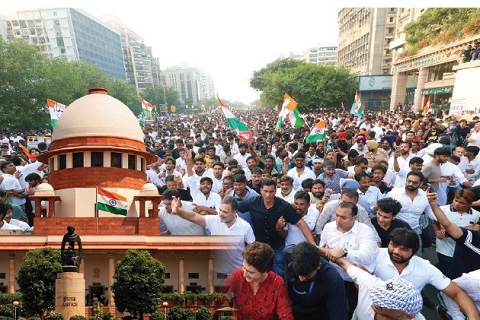
India’s democratic institutions are being drawn into an increasingly confrontational political battle. What began as a campaign against the Election Commission of India over alleged “vote chori” has expanded into a confrontation involving the Supreme Court. The Opposition’s demands to halt the Special Intensive Revision (SIR) of electoral rolls, remove Chief Election Commissioner Gyanesh Kumar and challenge the electoral process have now been accompanied by a march towards the country’s highest court. On October 12, 2026, Rahul Gandhi and other Opposition leaders marched towards the Supreme Court and subsequently filed a joint petition raising their concerns.
The central question is no longer simply whether the Opposition has legitimate concerns about voter registration or electoral administration. Such concerns are entirely capable of being examined through constitutional procedures. The more fundamental question is whether political leaders are willing to accept those procedures when they do not receive the immediate institutional response they demand. A democracy cannot function if every disagreement with an authority becomes a campaign to discredit that authority, and every judicial process is treated as an obstacle to a political mobilisation.
The expression “anarchists” is often used loosely in political debate. Here, the more useful test is conduct: are political actors seeking remedies within the constitutional framework, or attempting to make institutions respond through public pressure? The distinction matters because the right to protest is fundamental to democratic life, but it does not confer a right to dictate judicial outcomes, bypass established procedure or treat the courts as an extension of a party’s political campaign.
The Election Commission as the First Battleground
For months, the Opposition has made the Election Commission a central target of its campaign. Rahul Gandhi and other leaders have questioned the integrity of electoral rolls, challenged the SIR exercise and demanded the resignation of the Chief Election Commissioner. The Opposition maintains that changes to voter lists could disenfranchise citizens and compromise electoral fairness. Those are serious allegations, and a constitutional democracy should neither dismiss them automatically nor accept them without scrutiny.
But an allegation of electoral manipulation is not itself proof of electoral manipulation. The public deserves specifics: which voters were wrongly removed, which legally eligible citizens were denied registration, what procedures were violated, what evidence establishes deliberate wrongdoing, and what remedy is sought under the law? These are the questions that distinguish an evidence-based challenge from a political slogan.
The Opposition has every right to challenge the Election Commission. But demanding an official’s resignation before a judicial or statutory process has established wrongdoing risks reversing the presumption that allegations require examination. It converts accountability from a process of determining facts into a contest of political pressure.
When the Court Refuses to Play Politics
The events of October 12 brought this institutional confrontation to a new stage. Before the march, Rahul Gandhi and Congress president Mallikarjun Kharge had sought an appointment with Chief Justice of India Surya Kant to submit a memorandum concerning the Election Commission, the arrests of students and restrictions on transport, among other matters. The Chief Justice declined the meeting, explaining that the issues were already before the Court and that discussing pending cases through an administrative meeting would be inconsistent with the separation of powers and judicial propriety. Crucially, he did not shut the doors of justice. He indicated that the leaders could approach the Court through the prescribed judicial process.
That distinction should have settled the procedural question. The Supreme Court was not refusing to hear allegations; it was insisting that allegations be brought before it in the constitutionally appropriate manner. A Chief Justice cannot be expected to conduct a parallel political hearing simply because a group of prominent anarchist politicians wants to present a memorandum before cameras and supporters. The judiciary is bound by law, precedent, procedure and fairness to all parties. It cannot dispense with these safeguards because a political leader claims to speak on behalf of the nation.
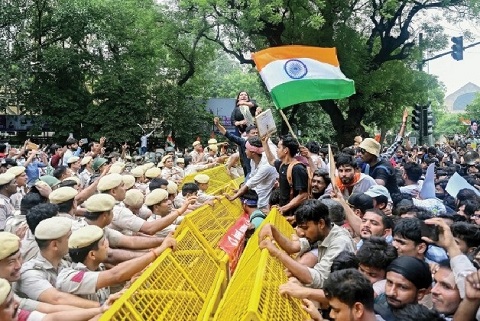
Yet the Opposition proceeded with its march. The spectacle raised an uncomfortable question: was the objective simply to invoke a legal remedy, or was the march also intended to create a public demonstration around the Court itself? Political demonstrations are not inherently improper, and the presence of politicians near a judicial institution does not automatically establish intimidation. But when a procession converges on the country’s highest court amid demands for action against a constitutional authority, the organisers must consider the institutional implications of their conduct.
A court is not a rally ground. Its authority does not arise from the number of people gathered outside its gates, the volume of slogans or the political standing of the petitioners. It arises from the Constitution and the law. A citizen with a genuine grievance and a properly constituted petition must receive the same consideration as a senior political leader. Conversely, a leader cannot claim a privileged route to judicial attention by mobilising a crowd.
The Supreme Court's response on October 15 made the principle explicit. A bench led by Chief Justice Surya Kant observed that nobody could browbeat the judiciary and issued notices to Rahul Gandhi, Akhilesh Yadav and other Opposition figures in proceedings challenging the march. The Court also sought responses from the Election Commission and its senior officials on the separate petition alleging irregularities in the SIR exercise.
The two developments are important precisely because they concern different questions. The Court is examining the Opposition's electoral allegations while also examining the circumstances of the political procession. Taking up the electoral petition does not validate every allegation made by its authors. Issuing notices over the march does not establish that the leaders are guilty of contempt or any other offence. Both matters must be decided through due process.
This is what a functioning constitutional system looks like. It allows allegations against powerful institutions to be heard without allowing the institutions themselves to be subjected to political coercion.
The Supreme Court Is Not a Political Headquarters
The judiciary occupies a distinctive position in India's constitutional architecture. Its role is neither to protect the government from criticism nor to rescue the Opposition from political difficulties. Its responsibility is to interpret the law, protect fundamental rights, review executive action where warranted and decide disputes independently.
That independence requires restraint from every side. Ministers cannot demand favourable judgments. Opposition leaders cannot demand that judges endorse their allegations. Activists cannot claim that a court has lost legitimacy merely because it declines their preferred procedure. And no political organisation can treat the physical presence of a crowd as a substitute for legal argument.
The Chief Justice's refusal to hold an administrative meeting with political leaders over matters already pending before the Court was therefore a reminder of institutional boundaries, not a declaration that the Opposition's concerns were unworthy of consideration. The prescribed judicial route remained available. Indeed, the subsequent proceedings demonstrate that the Court was prepared to examine the allegations through that route.
If a petition identifies wrongful voter deletions, the Court can seek records, examine safeguards and issue appropriate directions under the law. If eligible citizens have been excluded, they deserve effective remedies. If the Election Commission has failed to comply with statutory requirements, it must answer for that failure. None of these objectives requires a political procession to become an instrument of pressure on the judiciary.
Equally, if conduct within or around judicial premises raises legitimate questions about the administration of justice, those questions must be addressed fairly. The Supreme Court has sought responses concerning the October 12 march and directed the preservation of relevant CCTV footage and digital evidence. Those steps establish that the issue is under examination; they do not predetermine its outcome.
The principle is straightforward: the law must judge the evidence, not the political identity of the people involved. A supporter of the ruling party should receive no special protection, and a leader of the Opposition should receive no special exemption. The same rules must govern both.
Protest Is a Right, Not a Licence to Override Procedure
India's democratic history includes protests, marches, civil disobedience and fierce opposition to those in power. These have sometimes played an indispensable role in exposing injustice. It would therefore be both inaccurate and dangerous to equate protest itself with anarchy. The Constitution protects peaceful assembly, and citizens must remain free to question institutions without fear of retaliation.
However, the right to assemble does not erase all other legal obligations. Demonstrations must operate within applicable law, and restrictions on them must themselves be lawful, proportionate and open to challenge. Access to court premises cannot be treated as an unlimited extension of the right to protest. Judicial proceedings require an environment in which litigants, lawyers, judges and court staff can perform their duties without disruption.
There is also a difference between protesting against an institution's decision and attempting to influence the institution while it is considering a live dispute. The first is a normal feature of democratic accountability. The second raises questions about judicial independence, especially when the participants are influential political figures capable of generating extensive public mobilisation.
This is why the Supreme Court's warning against browbeating the judiciary carries significance beyond the personalities involved. It establishes a principle that applies to every political party and every future dispute. If a party can turn the approach to a court into an extension of its campaign, others may attempt the same. If each group believes that a sufficiently large gathering can compel a judicial response, the independence of the judicial process will become harder to protect.
The danger is not that judges are necessarily susceptible to such pressure. The danger is that repeated attempts to convert legal disputes into street confrontations can weaken public confidence in the idea that justice must be decided by law rather than by political force.
Accountability Must Begin With Evidence
The demand for proof is not a defence of any particular government or constitutional official. It is the minimum requirement of a credible allegation. Those who claim that votes have been stolen must identify the alleged irregularities and substantiate them. Those who defend the electoral process must provide transparent explanations and correct any established errors. Those who approach the Supreme Court must follow its procedures. And those who organise demonstrations must respect the rights of other citizens and the functioning of judicial institutions.
The Opposition's petition concerning the SIR deserves examination on its merits. But the existence of a petition does not establish the truth of every claim it contains. Nor does the Court's decision to seek responses from the Election Commission establish that the Commission has committed the alleged wrongdoing. These distinctions are essential in a country where political rhetoric often races ahead of adjudicated facts.
Democracy is not merely the freedom to make accusations. It is also the discipline to substantiate them, the willingness to accept scrutiny and the maturity to respect outcomes reached through lawful procedures.
A Constitutional Republic Cannot Run on Slogans
India's institutions belong to the people, not to any political party. The Election Commission is not the private property of the government, just as the Supreme Court is not the political headquarters of the Opposition. Both must remain independent, answerable within the constitutional framework and protected from attempts to substitute public pressure for lawful decision-making.
Rahul Gandhi and the INDIA bloc have a legitimate political role as the Opposition. They can question the government, challenge the Election Commission, mobilise public opinion and seek judicial remedies. But their constitutional standing does not place them above the procedures that govern every other citizen.
The message from the Supreme Court is therefore worth taking seriously: no institution should be beyond scrutiny, but no institution should be compelled to act according to the demands of a political crowd. The right to challenge authority is fundamental; the right to dictate its decisions is not.
The real strength of Indian democracy will be measured not by how loudly its political leaders accuse one another, but by whether they are willing to submit those accusations to impartial scrutiny—and accept that, in a constitutional republic, the final word belongs to the law, not to the loudest crowd.
(The content of this article reflects the views of writer and contributor, not necessarily those of the publisher and editor. All disputes are subject to the exclusive jurisdiction of competent courts and forums in Delhi/New Delhi only)




















Leave Your Comment