


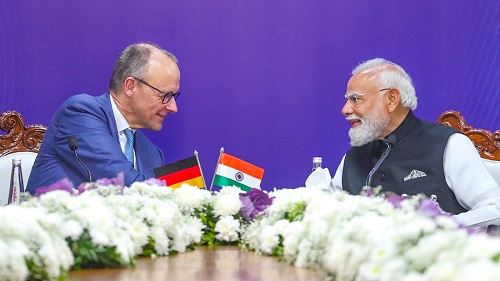
At a time when geopolitical uncertainties, technological competition and economic realignments are reshaping the international order, India and Germany are looking to give their longstanding partnership a more ambitious and strategic direction. Prime Minister Narendra Modi and German Chancellor Friedrich Merz have reaffirmed their commitment to expanding bilateral cooperation, placing particular emphasis on defence, advanced technologies, trade and investment. Their latest telephone conversation carries added significance as the two countries celebrate 75 years of diplomatic relations, marking an important milestone in a relationship that has steadily evolved from traditional economic engagement into a comprehensive strategic partnership.
The telephone conversation between the two leaders reflects a shared recognition that the India-Germany relationship needs to respond to the changing economic, technological and security environment. Both countries have considerable complementary strengths. Germany possesses advanced industrial capabilities, engineering expertise and technological innovation, while India offers a rapidly expanding market, a skilled workforce, a growing manufacturing ecosystem and significant opportunities for investment.
Defence cooperation is emerging as an important pillar of this evolving relationship. India has been seeking to strengthen its domestic defence manufacturing capabilities and diversify its international partnerships. Germany, with its sophisticated defence industry and technological expertise, can become an important partner in this endeavour. The two countries have already taken steps in this direction. During Chancellor Merz's visit to India on January 12-13, 2026, both governments agreed to strengthen bilateral defence industrial cooperation and develop a more structured framework for collaboration. This creates possibilities for joint production, technology partnerships and closer industrial engagement, while supporting India's broader ambition of achieving self-reliance in defence manufacturing.
Advanced technologies represent another promising area of cooperation. Semiconductors, telecommunications, artificial intelligence, critical minerals and emerging digital technologies are increasingly central to economic competitiveness and national security. India is making substantial investments in developing its technological ecosystem, while Germany is keen to strengthen resilient supply chains and maintain its leadership in advanced manufacturing. Their cooperation could facilitate research partnerships, industrial innovation and the development of reliable technology supply networks. The agreements and declarations signed during Merz's January visit, particularly those concerning semiconductors, critical minerals and telecommunications, provide an institutional foundation for this ambition.
India-EU Trade Agreement Opens a New Economic Chapter
Trade and investment are likely to receive a fresh impetus from the India-European Union Free Trade Agreement. The agreement is expected to create new opportunities for businesses by improving market access and strengthening economic engagement between India and European countries, including Germany. As Europe's largest economy and one of its leading industrial powers, Germany has considerable potential to benefit from India's expanding consumer market and manufacturing ambitions.
For India, deeper economic engagement with Germany could bring greater access to advanced machinery, industrial technology, specialised engineering capabilities and investment. German companies, meanwhile, can explore opportunities in India's infrastructure, renewable energy, automobile manufacturing, electronics, logistics and emerging technology sectors.
The January 2026 India-Germany joint statement also highlighted the importance of strengthening economic cooperation through institutional mechanisms, including a proposed chief executives' forum integrated with the joint economic and investment framework. Such arrangements can help businesses identify opportunities, address investment-related concerns and translate diplomatic commitments into tangible commercial outcomes.
75 Years of Diplomatic Relations: A Partnership for the Future
The 75th anniversary of diplomatic relations provides an opportunity to assess how far India and Germany have travelled together. Diplomatic ties were established on March 7, 1951, and the relationship has progressively expanded across commerce, education, science, technology, renewable energy and people-to-people exchanges. The establishment of the India-Germany Strategic Partnership in 2000 further elevated bilateral engagement, while the Inter-Governmental Consultations mechanism introduced in 2011 created a platform for regular discussions between the two governments.
Beyond bilateral interests, the two countries also recognise the importance of coordinating their positions on international developments. Their latest conversation included an exchange of views on regional and global issues, with both leaders emphasising the need to promote peace, stability and a rules-based international order. Their commitment to working together at multilateral forums is particularly relevant at a time when geopolitical tensions, conflicts, economic uncertainties and challenges to established international institutions demand greater cooperation among major democratic economies.
For India, Germany is an important gateway to deeper engagement with Europe and a valuable partner in its pursuit of technological advancement, industrial modernisation and strategic autonomy. For Germany, India represents an increasingly important partner in the Indo-Pacific, offering economic opportunities and a reliable relationship in a rapidly changing global environment.
The latest conversation between Modi and Merz therefore goes beyond the customary exchange between two heads of government. It reinforces the political commitment to transform a relationship built over seven decades into a forward-looking partnership capable of addressing the economic, technological and strategic challenges of the coming decades. The real measure of this renewed commitment, however, will lie in how effectively both governments translate their shared vision into concrete projects, investments, technological collaboration and mutually beneficial outcomes.





















Leave Your Comment