


PRADEEP KRISHNAN
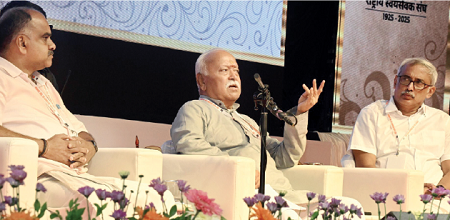
When Rashtriya Swayamsevak Sangh (RSS) Sarsanghchalak Dr Mohan Bhagwat arrived in Kerala in June 2026 to address two centenary lecture meetings in Thiruvananthapuram and Thrissur, the expectation was that the visit would primarily focus on the Sangh's hundred-year journey and its vision for India's future. Instead, the visit triggered an unnecessary political debate in Kerala.
The controversy was not caused by any provocative statement from the RSS chief. Rather, it arose from the presence of three vice-chancellors of state universities at the programme. Their attendance transformed what was intended as a centenary outreach event into a wider discussion on academic freedom, ideological pluralism and the place of the RSS in Kerala's public sphere.
Yet the controversy did not overshadow the larger significance of Bhagwat's visit. The RSS is entering its second century at a time when India is witnessing rapid social, economic, and geopolitical transformation and progress. Despite having a shakha in nearly every village of the state, Kerala was long regarded as one of the most ideologically challenging regions for the Sangh. It has now emerged as an important arena for the organisation's social and intellectual engagement. Bhagwat's speeches in Thiruvananthapuram and Thrissur therefore deserve careful attention, not merely as political events but as statements outlining the direction in which the RSS seeks to move during its next hundred years.
Why Kerala Matters
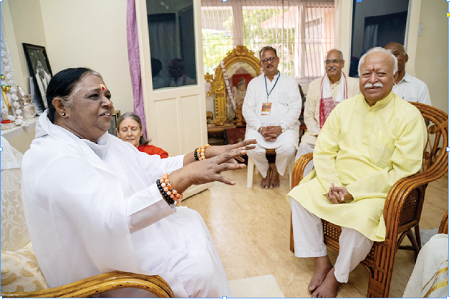
The RSS began its activities in Kerala in the 1940s and, over the decades, has evolved into one of the state's prominent cultural organisations. Through thousands of daily shakhas and an extensive network of affiliated institutions, it has been active in education, service initiatives, labour and tribal welfare, rural development, and cultural programmes. Its activities have also contributed to strengthening social cohesion, promoting awareness of India's shared civilisational heritage, and fostering a sense of national integration while engaging with Kerala's vibrant cultural landscape.
For decades, Kerala's political culture was shaped by the Congress-led United Democratic Front (UDF) and the Communist-led Left Democratic Front (LDF). Seeking to consolidate minority vote banks, both fronts contributed to an environment in which the RSS was frequently portrayed as an anti-minority organization.
However, the last two decades have witnessed significant changes. The RSS has expanded its organisational presence, intensified its service activities, and built relationships with sections of the intellectual and professional classes, including members of minority communities. Several prominent Muslim and Christian leaders now openly acknowledge and support various initiatives of the Sangh.
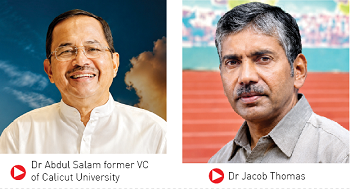
Today, the Sangh is no longer confined to its traditional support base. Increasingly, academics, professionals, entrepreneurs and young people engage with RSS-affiliated institutions with a clear understanding of the organisation's ideology. Reflecting this changing perception, Dr Abdul Salam, former Vice-Chancellor of the University of Calicut, observed: "There has been a change from earlier times. The strong dislike for the BJP and the RSS that existed before has considerably reduced." According to former DGP, Dr. Jacob Thomas, his decision to join the RSS stemmed from his lifelong commitment to public service. As a civil servant, he said, his primary objective had always been to serve the nation and its people. During his years in service, he came across the RSS, a voluntary organisation that, in his view, was working towards the same goal of making the country stronger, better and greater. “Naturally, the RSS attracted me,” he remarked while explaining the reasons behind his association with the organisation.
This shift is evident in the growing number of Muslim and Christian intellectuals, politicians, academics, businesspersons and ordinary citizens who, after observing the organisation's activities and understanding its nationalist outlook, have come to view the RSS and the BJP more favourably. Many among them have emerged as vocal supporters of the organisations and their initiatives.
It is in this context that Dr Mohan Bhagwat's Kerala visit assumes particular significance. The centenary celebrations are not merely commemorative events marking one hundred years of the RSS. They are also intended to articulate the Sangh's perspectives on key national issues, including the concept of Hindu Rashtra, national integration, social harmony, the role of minorities in nation-building, relations with political parties, cultural nationalism, education, social transformation, and India's civilisational future. Above all, the centenary outreach seeks to present the true face of RSS - a national social movement and its engagement with wider sections of society, transcending traditional ideological and political boundaries.
The RSS is no fringe organisation. Over the past century, it has emerged as one of India's largest socio-cultural movements, with a presence that extends across public life. Its ideological influence is reflected in the participation of individuals occupying some of the highest offices in the country, including the President, Vice President, Prime Minister, Union Ministers, Governors, senior civil servants, retired military officers, academics, and university administrators. It is also the organisation from which the Bharatiya Janata Party, currently the world's largest political party and India's ruling party, traces its origins.
As part of its centenary outreach programme, the RSS has been organising public interactions in major cities across the country, including Delhi, Mumbai, Bengaluru, and several state capitals. These events have attracted diverse audiences comprising supporters, critics, academics, diplomats, industrialists, and public figures. At many such gatherings, Bhagwat has responded directly to questions and criticisms concerning the RSS, presenting the organisation's perspective on contemporary national issues.
Bhagwat's Vision for India's Next Century
Throughout his Kerala addresses, Bhagwat repeatedly returned to a central theme: India's future cannot be built solely through political power. According to him, nations are ultimately shaped by organised societies rather than governments alone. Political institutions can provide direction and administration, but social transformation requires active participation by citizens. He argued that one of the major lessons of Indian history is that social weakness eventually leads to political weakness.
Bhagwat emphasised that the RSS was founded to address precisely this challenge. The organisation's mission, he said, has always been to create disciplined, socially conscious and nationally committed individuals capable of contributing to society in every sphere of life. He stressed that the next century of India's development would require not only economic growth but also cultural confidence, social harmony and ethical leadership. Material prosperity alone, he argued, cannot sustain a civilisation. Nations require a moral and cultural foundation that gives meaning to development.
The RSS chief also highlighted the importance of social responsibility. Every citizen, he suggested, must contribute time and effort to the welfare of society. The spirit of service, self-discipline and collective responsibility remains central to the Sangh's understanding of nation-building.
In Thiruvananthapuram, addressing a distinguished invited audience that included academics, professionals and community leaders, Bhagwat's most significant observations were that the RSS was neither created as a reaction against any community nor intended to function as a political organisation. He argued that the Sangh emerged from a recognition that a fragmented society cannot achieve national greatness.
According to him, India's historical experiences demonstrate the dangers of internal divisions. Social fragmentation weakens collective strength and creates opportunities for external forces to exploit national vulnerabilities. The RSS therefore seeks to cultivate unity while respecting diversity. Another major theme was civilisational continuity. Bhagwat argued that India is not merely a political entity created in modern times but a civilisation with a long and continuous cultural tradition. Understanding this heritage, he said, is essential for developing national self-confidence.
He also challenged what he described as widespread misconceptions regarding the RSS. Referring to the Sangh as one of the most misunderstood organisations in the country, Bhagwat urged critics to judge the organisation through direct observation and participation rather than inherited stereotypes.
The RSS chief further stressed that dialogue remains essential in a democratic society. Differences of opinion are natural, he said, but dialogue should not be abandoned. Societies that lose the ability to communicate across ideological divides risk deepening social polarisation.
Society Before Politics
At Thrissur, the Sarsangachalak elaborated further on the relationship between society and politics. He argued that politics reflects the character of society rather than creating it. A healthy democracy depends upon citizens who possess a strong sense of duty, social awareness and ethical commitment.
The RSS vision of national development, he explained, places society before politics. Governments may change, parties may rise and fall, but the strength of a nation ultimately depends upon the quality of its people and institutions. Bhagwat also spoke about social harmony, emphasising that the Sangh does not seek conflict with any community. The objective, he maintained, is to build trust across social, regional and cultural divides.
Particular emphasis was placed on youth participation. India possesses one of the world's youngest populations, and Bhagwat argued that the country's future depends on channelising this demographic energy towards constructive national goals. Character formation, service activities and community engagement were presented as essential elements of this process.
An Unnecessary Controversy
Despite the significance of Bhagwat's speeches, with an aim to appease minorities and to divert public attention, the Congress and the CPM quickly shifted the focus to the attendance of three vice-chancellors from Kerala's state universities. The Chief Minister, V.D. Satheesan, himself has previously attended RSS-linked functions and shared public platforms associated with the organisation, years back, criticised their presence and demanded public explanations. Similar concerns were voiced by sections of the Left, which argued that university heads should avoid participation in programmes organised by ideological organisations.
However, independent observers supported the vice-chancellors, pointing out that no rule prevents a VC from attending a lecture organised by a cultural organisation. Universities exist to promote intellectual engagement, and vice-chancellors routinely participate in programmes organised by a wide range of religious, cultural, social, and political institutions.
They argued that, if so, why should an engagement with the RSS be treated differently from engagement with any other ideological current? Moreover, in the highly politicised academic scenario in Kerala, several VCs have openly participated even in meetings organised by political parties. Moreover, the Thiruvananthapuram event was neither private nor secretive. It was conducted openly, extensively covered by the media, and its photographs and videos were circulated by the RSS's own publicity machinery.
Satheesan's Critique and Its Limitations
The controversy exposed certain weaknesses in the arguments advanced by critics of the vice-chancellors. The first issue concerns consistency. Kerala's academic leaders frequently attend events organised by church institutions, Muslim organisations, Marxist cultural bodies, trade unions, and civil society groups. Such participation is generally viewed as part of their public role rather than evidence of ideological alignment. Why, then, Satheesan is applying a different standard exclusively to the RSS raises questions about intellectual fairness.
The speed with which the issue moved from a public event to a statewide political controversy also attracted attention. Sections of the media highlighted the vice-chancellors' presence prominently, national outlets amplified the story, and political leaders responded almost immediately.
A second issue concerns academic freedom. Universities are expected to encourage engagement with diverse viewpoints. If academic leaders begin avoiding events solely because the organisers belong to a particular ideological tradition, the principle of intellectual openness may be undermined.
A third limitation lies in the intolerance of secular parties towards the RSS. In democratic societies, public dialogue frequently occurs between individuals and institutions holding sharply different perspectives. Participation in such dialogue is generally regarded as a sign of openness rather than conformity.
For many observers, the controversy therefore reflected the intolerance of the Congress and the Communists towards the growing popularity of pro-nationalist forces in the state. They are really less concerned about academic neutrality and more concerned about an enduring discomfort with the increasing legitimacy of the RSS within sections of Kerala's public sphere.
Supporters of the RSS contend that such reactions are rooted in electoral calculations. They argue that certain political actors continue to view opposition to the RSS as an effective strategy for political mobilisation. In their assessment, the controversy reflects an effort to reinforce existing political polarisations rather than engage with the substance of Bhagwat's remarks.
Academic Freedom versus Ideological Policing
Through social media posts and public commentary, Sreejith Panicker, a highly influential social observer, questioned why attendance at an RSS programme should be considered problematic when university leaders regularly share platforms with representatives of other ideological traditions. His argument resonated with many commentators who viewed the controversy as evidence of ideological double standards.
Several public intellectuals and social media influencers observed that academic institutions must remain open to engagement with all streams of thought, including those that may be controversial or politically contested. The purpose of universities, they argued, is not ideological segregation but intellectual exchange.
Kerala BJP chief Rajeev Chandrasekhar wrote on X: “Someone who has normalised radical Islam and anti-Constitution, anti-secular organisations like Jamaat-e-Islami, and who is in power only—repeat, only—because of the support of the Muslim League and Jamaat-e-Islami, must never talk about supporting secularism or representing the Constitution.”
Others pointed out that the RSS is no longer a marginal organisation operating outside mainstream public life. As a century-old social movement with a substantial national presence, and with its members holding top positions in the Indian government, it represents a significant strand of contemporary Indian thought that academics cannot simply ignore.
The debate generated extensive discussion on social media, with many users defending the vice-chancellors' right to attend public lectures without being subjected to political scrutiny.
At its core, the controversy raises a larger question about the nature of academic freedom. Should universities engage with all significant currents of social and political thought, or should certain viewpoints be excluded from engagement? If academics, administrators and public intellectuals are discouraged from attending lectures delivered by figures representing major ideological currents in Indian public life, the scope for informed dialogue may become increasingly restricted.
Democratic traditions generally favour the former approach. Intellectual progress depends upon debate, disagreement, and critical engagement rather than isolation. Many observers argued that demanding apologies merely for attending a lecture risk creating an atmosphere of ideological policing. Such an approach may discourage open discussion and reduce opportunities for meaningful dialogue. They contend that genuine academic neutrality means engaging with diverse viewpoints without becoming captive to any one of them.
From Contestation to Engagement: The RSS in Kerala
Perhaps the most significant aspect of the entire episode is what it reveals about contemporary Kerala. For decades, the RSS occupied a contested position within the state's public discourse. Today, however, engagement with the organisation increasingly extends beyond traditional political boundaries.
The presence of academics, professionals, and community leaders at the centenary lectures suggests that the RSS is gradually becoming part of the mainstream intellectual conversation in Kerala. This does not necessarily imply the growing acceptance of the Sangh in Kerala. Their participation indicates a growing recognition that the RSS is an important social force whose ideas merit engagement. The controversy itself is evidence of a changing landscape. What once appeared politically unthinkable now generates debate rather than outright exclusion.
Dr. Mohan Bhagwat's Kerala visit will be remembered for a long time for the speeches he delivered focusing on social organisation, national development, civilisational confidence, and collective responsibility. They sought to articulate the role the RSS envisions for itself as it enters its second century.
Ultimately, the significance of the episode lies beyond immediate political reactions. It highlights a deeper question confronting Indian democracy: whether engagement across ideological boundaries should be encouraged or discouraged. Ironically, some politicians who frequently accuse the RSS of intolerance appear reluctant even to listen to what the organisation has to say. For many observers, the irony lies in the fact that an event organised in the spirit of public outreach ultimately generated a debate not about what was said from the platform, but about who was permitted to sit on it.
Bhagwat's visit became more than a centenary event. In Kerala, the birthplace of Adi Shankaracharya, whose debates and intellectual engagements helped re-establish Sanatan Dharma across Bharat at a time when it faced profound challenges from hostile forces, the controversy revived a fundamental question about the value of dialogue in public life. It thus emerged as a mirror reflecting the evolving relationship between politics, academia, and civil society in the most literate State in India.
(The content of this article reflects the views of writer and contributor, not necessarily those of the publisher and editor. All disputes are subject to the exclusive jurisdiction of competent courts and forums in Delhi/New Delhi only)




















Comments (5)
C
Excellent write up.
D
Very thought provoking coverage. Author's in-depth knowledge and great involvement in the future of this great country is very well felt in this article. Unfortunately raising objections and controversies for political browney points and media time for few hours have become the in-thing nowadays
D
Very thought provoking coverage. Author's in-depth knowledge and great involvement in the future of this great country is very well felt in this article. Unfortunately raising objections and controversies for political browney points and media time for few hours have become the in-thing nowadays
R
Very well argued. It is heartening to hear that the RSS is growing. The presence of diverse people is wonderful to note.
R
Very well argued. It is heartening to hear that intellectuals and a variety of prominent people attended the meeting.