



DR. PADMALOCHAN DASH
In July 2020, the Modi government released a National Education Policy whose accompanying language was, by the standards of such documents, candid to an unusual degree. India's system had produced graduates capable of clearing examinations but ill-equipped to think independently. It had produced qualified professionals who lacked practical judgment, and institutions that confused credentials with capability. The diagnosis was frank. The ambition it implied was larger still. Five years on, what has followed is a story of real institutional movement, credible early progress, and structural problems that the policy itself could not resolve.
The implementation of Indian Knowledge Systems (IKS) under NEP 2020 has expanded considerably across India's higher education sector. The University Grants Commission has issued guidelines for integrating IKS within higher edu-cation curricula and credit frameworks, while the All India Council for Technical Education has promoted IKS-oriented courses in technical and engineering education. Structured IKS Minor programmes carrying approximately 18-20 cred-its have also been introduced. Faculty capacity-building initiatives have trained around 1,000 educators and developed a network of master trainers, while dedicated IKS centres, internships, workshops, and large-scale digitisation efforts have supported the broader institutionalisation of indigenous knowledge traditions within higher education.
These are not token gestures. Introducing a new intellectual framework into an education system serving hundreds of millions of students, across institutions ranging from elite research universities to chronically under-resourced dis-trict colleges, within five years of policy announcement, is genuinely difficult work. The administrative reach alone sig-nals serious institutional will.
The more fundamental question is one that statistics alone cannot answer: are we merely changing what students learn, or are we transforming how they learn to think? Building a knowledge culture is fundamentally different from assembling a knowledge catalogue. The distinction between the two is, in essence, the distinction between reform and transformation.
What must be the real intent of IKS:
IKS is frequently misread as the study of ancient texts or civilisational achievements. Those are part of the land-scape, but they are not the whole of it. At its core, IKS concerns the methodology of knowledge: how it is generated, questioned, validated, applied, and transmitted across time. It is as much about habits of inquiry as about repositories of content. An institution can introduce an IKS credit and still produce graduates who have never genuinely ques-tioned an assumption. The credit is not the point. The thinking is.
Historically, India's knowledge traditions were sustained not merely through the preservation of information but through cultures of debate, dialogue, observation, mentorship, experimentation, and application. Knowledge was ex-pected to demonstrate relevance through practice and withstand scrutiny through inquiry. In that sense, IKS is less about teaching students what earlier generations knew and more about helping them understand how knowledge itself was created, tested, refined, and transmitted across generations.
From Primary Education to Research: The Knowledge Continuum:
The most visible face of IKS in school education has been the NCERT revision programme. New books for Classes 3 and 6 were released in 2024, with additional grades following in phases. The Class 7 mathematics textbook now situ-ates algebra within Brahmagupta's Bijaganita, credits Acharya Kanad with early atomic theory, and connects Ary-abhata's astronomical work to the lineage behind modern Indian space science. The purpose is to return to Indian stu-dents a sense that the intellectual traditions they are engaging with belong to them, not to a history that arrived from elsewhere.
That purpose is legitimate. One of colonial education's quieter injuries was severing the connection between Indian students and Indian intellectual history, leaving behind a residual sense that rigorous knowledge originated in Europe and was adopted here. Students who understand that their civilisation made foundational contributions to mathemat-ics, medicine, linguistics, and ecological science are better placed to engage those fields with confidence rather than with borrowed deference.
The challenge extends further, though. IKS is not only the Sanskrit-textual inheritance. It encompasses knowledge carried in communities, crafts, agricultural systems, oral traditions, and ecological practices accumulated over genera-tions without ever passing through a formal text. If curriculum reform addresses only the literate, institutionalised strand of that inheritance, it is representing a narrower version of IKS than the concept actually demands.
The implications extend well beyond school education. Textbooks can introduce intellectual traditions, but enduring knowledge systems survive only when they continue to generate new knowledge. If IKS is to become more than a curriculum initiative, it must find expression in universities, laboratories, field research, innovation ecosystems, and scholarly inquiry. The real measure of success will not be how many historical contributions students can recall, but whether future researchers can critically engage inherited knowledge, test its contemporary relevance, build upon it, and contribute original scholarship that addresses contemporary challenges.
The implementation of IKS in the research domain will become truly successful when it cultivates researchers capa-ble of pursuing insight, innovation, discovery, and solutions simultaneously through a holistic intellectual outlook while attaining deep specialisation in their chosen disciplines. Many of India's classical knowledge traditions produced schol-ars whose work traversed scientific, philosophical, social, ecological, and ethical domains without sacrificing rigour within any one field. A knowledge tradition remains intellectually alive not because it is taught, but because it contin-ues to generate new understanding, new capabilities, and new solutions. The ultimate test of IKS, therefore, is not only whether it can preserve knowledge from the past, but, also, whether it can help create knowledge to the future.
The IKS and the NEP 2020:
NEP 2020 does not call for celebrating ancient India only; rather, it calls for the scientific incorporation of IKS wher-ever relevant, with that word scientific carrying the full argumentative weight. Classroom examples, problems, and stories are to be drawn from India's own heritage. IKS courses covering Vedic mathematics, Ayurveda, Yoga, Sanskrit, philosophy, and governance traditions are envisioned as secondary school electives. The broader aim is students who think critically, learn independently, and apply knowledge to actual problems.
The Ministry's monitoring framework lists five themes for NEP progress: learner-centric education, digital learning, industry-institute collaboration, academic research and internationalisation, and Indian Knowledge Systems. IKS is ex-plicitly positioned as one dimension of a shift from content delivery to capability development, not an add-on cultural project sitting alongside an otherwise unchanged system.
Language deserves attention here, more than it usually receives. Knowledge systems do not exist independently of the linguistic ecosystems that carry them. A great deal of India's intellectual inheritance, philosophical, scientific, agri-cultural, and ecological, resides in languages that hold concepts not easily compressed into standardised academic Eng-lish. NEP's emphasis on mother-tongue instruction and the preservation of classical and regional linguistic traditions reflects an acknowledgement that the future of IKS depends not only on what is taught but on the language through which knowledge is accessed and passed on. In practice, this dimension of the reform remains underdeveloped.
The teacher's problem: Training faculty in IKS content is not the same as preparing them to teach differently:
India has a vast higher education ecosystem comprising more than a thousand universities and tens of thousands of colleges. Even the Ministry's expanded target of ten thousand trained faculty is a fraction of the workforce that will actually need to deliver this. And content exposure is not preparation for the kind of teaching IKS requires.
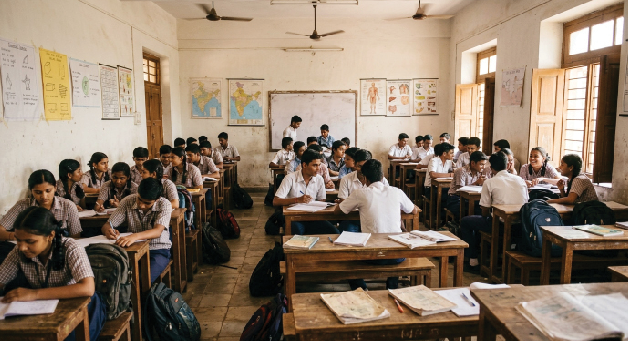
What IKS demands of a teacher is the capacity to facilitate genuine inquiry: to ask rather than assert, to tolerate in-tellectual disagreement, to model evidence-based reasoning and honest uncertainty. These capacities do not emerge from workshops. They develop through sustained practice within institutional cultures that actually reward them. Most Indian educational institutions, at every level, continue to reward the opposite: coverage of syllabus, student acquiescence, examination performance. Assessment systems that privilege recall create structural pressure that no curriculum philosophy easily overcomes.
There is a further point that tends to get lost in discussions about IKS pedagogy. Many of India's knowledge tradi-tions were never transmitted through lectures or texts. Agriculture was learned in fields. Craft was passed through mentorship. Ecological knowledge was acquired through sustained living within landscapes. Integrating IKS into formal education, therefore, requires more than revised syllabi. It requires learning environments that make room for expe-riential engagement, community contact, and the development of practical capability alongside intellectual under-standing.
NIPUN Bharat (National Initiative for Proficiency in Reading with Understanding and Numeracy) is worth acknowl-edging as a genuine systemic advance. Focused on foundational literacy and numeracy, it is among the earliest large-scale implementations under NEP 2020. Findings from the Annual Status of Education Report (ASER) 2024 indicate im-provements in foundational reading and arithmetic among primary school children following the pandemic's learning disruptions, suggesting that sustained attention to foundational learning can yield measurable gains. Dr Wilima Wadhwa of the ASER Centre has argued that what distinguishes such efforts is their systemic character rather than isolated interventions.
That distinction applies directly to IKS. Whether it becomes genuine reform or elaborate compliance depends not on the number of courses introduced, credits assigned, or centres established, but on whether it generates enduring changes in institutional culture, classroom practice, and the ways students learn to think, inquire, and apply knowledge.
The uneven problem: No single policy can function across
India is not a single education system. Several dozen operate simultaneously, linked by common frameworks and separated by stark differences in infrastructure, faculty quality, institutional capacity, and resources. A well-funded private university in an urban centre and a government college in a remote district are, in most practical respects, dif-ferent institutions confronting different realities. A policy that functions as intended in one setting can produce quite different outcomes in the other.
The expansion of digital learning platforms and credit-transfer mechanisms under NEP 2020 represents a significant step towards flexible and multidisciplinary higher education. SWAYAM has witnessed substantial growth in learner participation, while the Academic Bank of Credits has created the institutional framework for storing, transferring, and accumulating academic credits across recognised institutions. Together, these initiatives have strengthened the archi-tecture for student mobility and lifelong learning. Yet important challenges remain. Uneven digital infrastructure, un-reliable internet connectivity in many rural and remote regions, and variations in institutional capacity continue to con-strain implementation. The institutions that stand to benefit most from transformative reforms are often those with the fewest technological, financial, and human resources to implement them effectively. As a result, the promise of educational transformation remains unevenly distributed, highlighting the continuing gap between policy ambition and implementation reality.
The IKS framework, taken at full scope, argues that the intellectual methodologies embedded across India's knowledge traditions, rigorous inquiry, multimodal validation, the integration of knowledge with ethical responsibility, transmission through mentorship rather than instruction, offer something that contemporary education has largely discarded. Recovering those methodologies and embedding them in institutional practice is what would actually change what graduates are capable of. A dashboard can count IKS credits adopted. It cannot tell whether a student from that institution asks better questions than one who went before it.
There is also a practical dimension that cultural discussions tend to overlook. Educational systems derive lasting legit-imacy from their ability to generate capability, not only to preserve knowledge. IKS will ultimately be judged by its con-tributions to innovation, problem-solving, entrepreneurship, and scientific inquiry, not by only whether it produces students with a richer sense of national heritage. A knowledge tradition remains alive because it continues to produce value, not because it is remembered.
When it comes to Research
Research is equally underdeveloped. Textbooks introduce ideas; enduring intellectual traditions are sustained through investigation, validation, and publication. Without research ecosystems capable of critically examining tradi-tional knowledge, testing its contemporary relevance, and generating new understanding from old foundations, IKS risks settling into well-intentioned cultural preservation rather than intellectual vitality. "The ancient traditions IKS draws upon did not produce capable people by talking about capability. They produced them by building environ-ments where inquiry, practice, and responsibility reinforced each other across years."
Five years of NEP implementation, against this standard, look like a beginning. Which is, in fairness, what five years should look like. Educational transformation that produces visible results within a single government term is not trans-formation; it is examination reform or infrastructure investment. Real change operates on generational timescales. The gurukula did not produce its intellectual culture through policy circulars. It emerged through mentorship, appren-ticeship, community continuity, and long-duration learning relationships built across centuries.
The honest reckoning: Where the government deserves credit, and where the harder work begins:
The Modi government deserves credit for naming something previous governments largely avoided: India's educa-tional estrangement from its own intellectual traditions, and the need for a structural response. The UGC credit mandate, the AICTE engineering curriculum requirement, dedicated research centers, and the digitization programme, taken together, represent a more systematic attempt at the IKS agenda than India has
previously made.
The government also deserves scrutiny, not partisan but the kind any serious reform requires, for how implementation has repeated-ly chosen its easier version. A credit requirement is administratively simpler than changing how faculty teach. Textbook revisions are politically more visible than changing what happens inside a classroom. Digitising heritage texts is more measurable than cultivating the habits of mind that would let students engage productively with them. Establishing centres is easier than ensuring those centres pro-duce new knowledge rather than institutional decoration.
The work the next decade must take seriously is the reconstruction of what IKS calls knowledge ecosystems: learning understood as a social activity distributed across families, communities, occupational networks, and institutions rather than a transaction inside schools alone; teachers understood as mentors rather than delivery mechanisms, which requires sustained investment in their own continuing development; assessment understood as a measure of capability rather than recall; and knowledge understood as having to demon-strate relevance through application and contribution to society, not through compliance with a mandate.
None of this is beyond reach. None of it follows automatically from policy mandates, however carefully designed. It requires the slower, less visible work of cultural change in how teachers are prepared, how institutions understand their own purposes, how re-search ecosystems are nurtured, and how communities relate to knowledge being generated around them. In 2025, that work is genu-inely at its beginning. The policy exists. The administrative architecture is being built. Whether the next decade justifies NEP's ambition depends on whether India finds the patience that genuine educational transformation has always required and rarely received.
The civilization that inspired this reform deeply understood its foundations. The traditions it seeks to revive were not built overnight; they were quietly accumulated, tested, and refined through generations. This reflects the level of commitment IKS is encouraging India to pursue. The key question is whether, after establishing the policy and framework, the country is ready to commit to efforts that are visible not just on dashboards but also through essential social engagement.
(The content of this article reflects the views of writer and contributor, not necessarily those of the publisher and editor. All disputes are subject to the exclusive jurisdiction of competent courts and forums in Delhi/New Delhi only)




















Leave Your Comment