


Dr Vikas Bhardwaj
On 15 August 2026 Vande Mataram was sung at the Red Fort, all six stanzas, for the first time since Independence (Business Standard 2026a). The Constituent Assembly had placed it beside the anthem seventy-six years earlier. Why the gap opened, and what closed it, is the subject.
A plural democracy must decide how to honour a hymn that powered anti-colonial mobilisation but whose later stanzas invoke Hindu goddesses. Three decisions frame the answer (Figure 1): the Congress Working Committee’s recommendation of 1937, the Constituent Assembly’s statement of 1950, and the Modi government’s measures of 2025–26. I argue that 1950 settled the song’s standing, while 1937 and 2026 settled only how it is performed and protected. Congress chose subtraction; the present government has chosen ownership.
From a Bengali journal to a national slogan
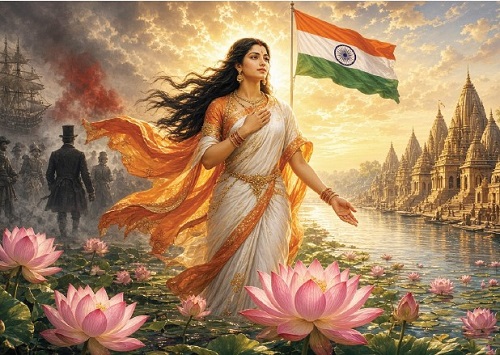
Bankim Chandra Chattopadhyay composed the opening stanzas in 1875, the date the government marks (Press Information Bureau 2025). In Anandamath, published as a book in 1882, the song carries later stanzas invoking Durga, Lakshmi and Saraswati. Tagore sang it at the 1896 Calcutta Congress, and from 7 August 1905 it served as a slogan of swadeshi protest against the partition of Bengal (Press Information Bureau 2026).
Its early public career was not sectarian. The Working Committee recalled the Barisal conference of April 1906, where police beat delegates for crying the words (Indian National Congress 1937); its president was a Muslim barrister, Abdur Rasul (Bhuiyan n.d.). Yet the novel’s setting gave critics something to hold, and Bhattacharya (2003) shows how the song’s meanings multiplied, and divided, as it travelled.
Calcutta, October 1937: tact or retreat?
In late October 1937 the Working Committee, meeting in Calcutta, recommended that at national gatherings only the first two stanzas be sung, leaving organisers free to add or substitute another song (Indian National Congress 1937). It limited use at gatherings and deleted nothing, and the statement called the later stanzas hardly ever sung.
Three readings compete. Pluralism: Bose and Nehru consulted Tagore, whose advice, Bhattacharya (2003) argues, shaped the statement; he told Bose the song’s core was a hymn to Durga, unsuited to a forum of all faiths (Dutta and Robinson 1997, 487), and Congress leaders still make this case (Press Trust of India 2025b). Pragmatism: a party holding a wide coalition together. Concession: Nehru told Bose the outcry was largely “manufactured” by communalists and doubted that a formal statement was needed (Nehru 1937, 184–87); one followed within days.
I read all three as operating together: a good-faith answer to a real objection, given under organised pressure, by a leader who suspected the pressure was partly artificial. Such concessions rarely end the pressure. Jinnah sent Nehru an article rejecting even a pruned version of the song, and Nehru’s list of matters Jinnah wished to discuss ran to fourteen, among them giving it up (Jinnah 1938; Nehru 1938). Nehru refused, so “capitulation” is too strong; but the Prime Minister’s claim that the song’s division “sowed the seeds” of Partition (Press Trust of India 2025a) asks one resolution to carry too much.
1950: equality in words
On 24 January 1950 Rajendra Prasad, presiding over the Assembly, chose a statement over a resolution. Vande Mataram, having played a historic part in the freedom struggle, “shall be honoured equally with Jana Gana Mana and shall have equal status with it” (Constituent Assembly of India 1950, 1). The text says nothing of stanzas, and the government’s own 2025 release acknowledges the declaration (Press Information Bureau 2025). The Modi government did not create the song’s standing.
Yet equality in words never became equality in law. In 1948 Nehru preferred Jana Gana Mana because Vande Mataram’s tune suited bands badly (Nehru 1948a, 284), though he called it the national song par excellence (Nehru 1948b, 422–24); Bose had adopted Jana Gana Mana in the early 1940s (Mukherjee 2025), so the preference was not Nehru’s alone. But section 3 of the 1971 Act, passed under Indira Gandhi, protected only the anthem (Press Information Bureau 2026), and Article 51A still names the flag and anthem but not the song (Jain 2026). No government closed the gap before 2026.
2025–26: reclamation by ceremony and statute
On 7 November 2025 a year-long commemoration began, with mass singing of the full version in offices across States and Union ministries (Press Information Bureau 2025). On 28 January 2026 the Home Ministry prescribed a six-stanza official version of about three minutes ten seconds, to be sung standing at official functions and to precede the anthem when both are played; an order of 9 July restated the protocol (SCC Times 2026; Jain 2026). Parliament passed the amendment on 29 and 30 July (Press Trust of India 2026b; Onmanorama 2026), and Act 11 of 2026 received assent on 6 August (Government of India 2026).
Legal weight differs at each step (Table 1). The Act substitutes section 3 of the 1971 Act: whoever intentionally prevents the singing of the anthem or the song, or disturbs an assembly engaged in it, faces up to three years, a fine, or both (Government of India 2026). It has no commencement clause, so I read it as operative from assent; I found no separate notification. It does not punish silence. On 22 September the Supreme Court said it expected Bijoe Emmanuel (1986) to govern the Act, and on 27 October it issued notice on further petitions, all listed for 30 November (Jain 2026; Bar and Bench 2026).
Two ways of being inclusive
Four contrasts emerge. On unity, the Working Committee bought concord by subtraction; the present government argues for inheritance by addition (Figure 3), backed by a safeguard so far promised only by the Court. On continuity, 1937 saved the uncontested opening and set the novel aside; the 2026 orders treat the whole composition as heritage, which Mohan Bhagwat, the RSS chief, endorsed without hedging on 20 October (Press Trust of India 2026c). Institutionally, in 1937 a party advised its own gatherings, in 1950 a presiding officer made a declaration, and in 2026 the executive, Parliament and the criminal law stand behind the text for the first time.
On 19 August the Congress Working Committee resolved to keep to its 1937 line at party events, and Home Minister Amit Shah called that defiance of the law (Press Trust of India 2026a). I doubt the Act reaches a party’s own functions; the charge is political, not penal. Karnataka’s Congress government then confined state events to two stanzas, except where the President, Vice-President, Prime Minister or Governor attends (Business Standard 2026b). If six stanzas wound pluralism, that exception is hard to explain; if they do not, so is the rule.
The best defence of 1937 is that inclusion sometimes needs restraint; the best defence of 2026 is that heritage deserves continuity. These are compatible if conscience is protected, incompatible if the protocol hardens into compulsion. Nothing I have found suggests Tagore wanted a temporary expedient to become permanent practice. My judgement: 1937 was defensible in its moment and wrong to outlive it; 2026 is defensible for as long as the dissenter’s silence stays safe.
Who carries the inheritance?
Who decides how a national symbol is remembered and performed? In 1937 a party decided, in 1950 an Assembly’s presiding officer, and in 2026 a government, a Parliament and, increasingly, a court. The song’s standing was never in doubt after 1950. What changed was the apparatus around it, and scrutiny followed.
For the government and the Sangh, the change repairs a neglect: equal status in 1950 became equal protection only in 2026. For critics, it risks turning a hymn into a test of loyalty. The record supports both readings, and I doubt it can settle between them. A republic cannot vote on its inheritance. It can only decide on what terms it asks its citizens to carry it.
(The content of this article reflects the views of writer and contributor, not necessarily those of the publisher and editor. All disputes are subject to the exclusive jurisdiction of competent courts and forums in Delhi/New Delhi only)
















Leave Your Comment