



Nilabh Krishna
Democracy is not merely the freedom to protest, raise slogans or accuse those occupying positions of constitutional authority. It is also the willingness to accept institutional processes, submit allegations to scrutiny and recognise that political disagreement cannot be settled by the loudest voice in the street. The right to protest is an essential democratic right, but it does not place any political leader above the law, nor does it convert an allegation into an established fact. These elementary principles have once again come under scrutiny amid the Congress-led INDIA bloc’s recent protests against the Election Commission of India (ECI) and Chief Election Commissioner Gyanesh Kumar.
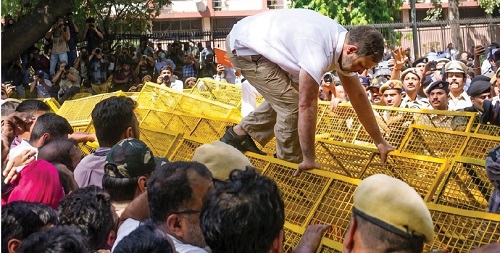
Over the past several days, Rahul Gandhi, Priyanka Gandhi Vadra and other opposition leaders have participated in demonstrations demanding action over alleged irregularities in the revision of electoral rolls. The protests have included marches towards the Election Commission, sit-ins, confrontations with barricades and the detention of opposition lawmakers by Delhi Police. The opposition describes its agitation as a struggle to protect voting rights and defend democracy; the authorities and the BJP reject its allegations of political manipulation. The confrontation has intensified, with the opposition insisting that it will continue its campaign.
The political question, therefore, is not whether opposition parties have the right to protest. They unquestionably do. The question is whether a movement that claims to defend democracy can afford to treat every disagreement with a constitutional institution as proof that the institution itself has lost legitimacy. And when allegations concerning electoral procedures are already receiving judicial scrutiny, what should take precedence: the presentation of verifiable evidence or the attempt to create a political storm around the proceedings?
These questions deserve answers, particularly from a party that governed India for decades and continues to present itself as the principal national alternative to the BJP.
The danger emerges when political confrontation becomes an end in itself. Barricades become props, detention becomes a headline, and a legal dispute becomes a spectacle designed for television and social media. The original question—whether electoral procedures were followed correctly—risks disappearing beneath competing accusations of authoritarianism and anarchy.
If the Congress leadership wants the public to focus on alleged electoral irregularities, it must ensure that the evidence does not become secondary to the theatre surrounding it. Otherwise, the movement risks generating more heat than clarity.
The Politics of Distrust
The Congress has increasingly framed electoral controversies as evidence of a wider crisis of democratic legitimacy. Its supporters argue that questions about electoral rolls, transparency and institutional independence must be taken seriously. Such concerns cannot simply be dismissed because they are raised by an opposition party. Electoral credibility is too important to be reduced to a partisan contest.
But there is an equally important principle: allegations against democratic institutions must be tested, not presumed true. A political party cannot establish the existence of electoral fraud simply by repeatedly using the phrase vote chori. Nor can the Election Commission settle every public concern merely by insisting that its procedures are correct. Trust requires transparent explanations, accessible grievance mechanisms and credible scrutiny.
The Special Intensive Revision controversy illustrates this tension. The opposition has raised concerns about deletions and the possibility that eligible voters could be excluded. The Election Commission’s position is that electoral rolls require verification to remove ineligible or duplicate entries. The dispute therefore demands careful examination of the procedures followed, the reasons for individual deletions, the safeguards available to affected voters and the evidence supporting claims of political bias.
There is no democratic virtue in denying legitimate grievances. Equally, there is no democratic virtue in presenting every administrative revision as a conspiracy before the relevant evidence has been assessed. If genuine errors have occurred, they must be corrected. If allegations are unsupported, that too must be established clearly. The credibility of the electoral process depends on the outcome of that scrutiny, not on which party benefits politically from it.
Rahul Gandhi's challenge is to demonstrate that his campaign is built around a verifiable case. A protest may be the beginning of political accountability, but it cannot be its final destination.
The EVM Argument and the Burden of Proof
The controversy surrounding electronic voting machines offers another illustration of the difficulty of sustaining public confidence amid repeated allegations. Opposition parties have questioned aspects of the EVM system, while the Election Commission has defended its safeguards. The Supreme Court has also examined challenges concerning EVMs and voter-verifiable paper audit trails.
In April 2024, the Supreme Court declined to order a return to paper ballots or universal cross-verification of EVM results with VVPAT records, while issuing directions intended to strengthen safeguards and verification. A subsequent review petition was dismissed in July 2024.
The significance of these proceedings should neither be exaggerated nor misrepresented. The Court's decisions did not establish that every possible electoral irregularity is impossible. They did, however, reject the particular reliefs sought in the cases before it. That distinction matters. A judicial ruling must be understood in the context of the questions actually presented and the findings actually made.
The political temptation is to treat electoral technology as trustworthy when results are favourable and inherently suspect when they are not. Such inconsistency, wherever it occurs, weakens public confidence. But the opposite error is equally dangerous: treating every question about technology as illegitimate simply because it comes from a losing party.
The proper standard is consistent evidence. If a party identifies a specific defect, it should present the details and seek a remedy through the appropriate channels. If it alleges systematic manipulation, it should substantiate the allegation. The public deserves more than a cycle in which each election result is followed by accusations, counter-accusations and an eventual return to the same unresolved political rhetoric.
Democracy requires losers to retain the right to challenge results. It also requires them to distinguish a demonstrable irregularity from dissatisfaction with the outcome. Without that distinction, electoral accountability can become an endless contest over whether the result should be accepted at all.
Congress’s Electoral Geography: A Record That Demands Introspection
There is another question that the Congress leadership cannot escape: if the party believes that electoral institutions have been systematically undermining its prospects, how does it explain its long-term decline across states where it once exercised considerable political influence?
West Bengal has not had a Congress chief minister since 1977. Bihar has not had one since 1990. Uttar Pradesh has not had one since 1989. Odisha has not had one since 2000, and the last Congress chief minister of Andhra Pradesh left office in 2014, before the state was reorganised. These dates are matters of public record.
The significance of this history is not that it proves the Congress lost every election fairly in every circumstance. It does not. Nor does the passage of time absolve electoral authorities of their responsibility to investigate credible allegations. The point is that a party's electoral decline across different states, political periods and competing party systems cannot responsibly be explained by a single accusation without substantial evidence.
Each state has its own political history. In West Bengal, the Congress was overtaken by the Left Front and subsequently marginalised by the Trinamool Congress. In Bihar, caste-based political mobilisation and the emergence of powerful regional parties transformed the electoral landscape. Uttar Pradesh witnessed the rise of the Samajwadi Party and the Bahujan Samaj Party, followed by the expansion of the BJP. Odisha developed its own regional political order, while Andhra Pradesh's political landscape was reshaped by regional forces and the state's bifurcation.
These developments have involved social change, leadership failures, competing political programmes, organisational weaknesses and shifting voter preferences. They cannot be reduced to a single explanation.
That is precisely why the Congress needs political introspection. If voters have repeatedly chosen other parties, the leadership must ask whether its organisation, messaging, candidate selection and connection with ordinary citizens are adequate to contemporary India. Blaming institutions may energise a party's existing supporters, but it cannot replace the hard work of rebuilding public confidence.
The electoral record raises a legitimate question for Rahul Gandhi: is the party investing as much energy in understanding why voters have moved away from it as it is in alleging that the system has worked against it?
The answer matters because elections are not merely contests between political parties. They are periodic judgments by citizens on leadership, governance, promises and performance. No party possesses a permanent entitlement to power, and no electorate owes any political organisation an explanation for choosing its rivals. The responsibility to earn that mandate rests with the party itself.
The Ballot Paper Is Not a Cure for Political Failure
The demand to return to ballot papers has also figured in the wider debate over electoral credibility. Yet the question of voting technology must be separated from the political assumptions surrounding it.
A paper ballot is not automatically immune to malpractice, just as an electronic voting machine should not be declared infallible merely because it is electronic. Every electoral system requires safeguards, transparent procedures, reliable verification and mechanisms for resolving complaints. The objective should be to identify the system that best protects the voter's choice while maintaining the integrity and efficiency of elections.
The experience of elections conducted using paper ballots is relevant to this discussion, but it cannot settle the matter through a simplistic comparison. An election held using paper ballots may demonstrate that the method remains administratively possible; it does not, by itself, establish that switching the entire national system would resolve the particular allegations currently being made.
The Congress must therefore explain what specific problems a return to paper ballots would solve, what safeguards would accompany such a change, and how the proposed system would prevent the very irregularities it alleges. The same standard of scrutiny must apply to the EVM system and any alternative.
The public discussion should also distinguish the question of technology from the question of electoral-roll accuracy. A voting machine records the vote cast through the prescribed process; a voter list determines who is eligible to cast that vote. Problems in one area cannot automatically establish wrongdoing in the other.
The most important test is whether every eligible voter can exercise the right to vote and whether every valid vote is accurately counted. That objective should unite political parties, not become another instrument for deepening partisan suspicion.
The International Audience and India’s Democratic Reputation
India's democratic institutions are watched far beyond its borders. As the world's largest electoral democracy, the country has a legitimate interest in demonstrating that political disagreements can be resolved through constitutional means.
When opposition leaders take their grievances to the streets, international media will report them. That is neither surprising nor inherently damaging. Peaceful protest is itself a feature of democratic life, and the visibility of political dissent can demonstrate that competing voices remain active.
The problem arises when allegations are presented as conclusive findings before they have been established. There is a difference between telling the world that a party suspects electoral irregularities and declaring that democracy has been stolen as though a judicial determination has already been made. The former expresses a political position; the latter makes a claim that requires evidence.
Rahul Gandhi and the Congress leadership have every right to communicate their concerns internationally. They also carry a responsibility to distinguish allegations from proven facts. Equally, the government and the Election Commission must answer credible questions with verifiable information rather than assume that criticism of their conduct is automatically hostile to India.
India's democratic reputation will not be strengthened by suppressing criticism, nor will it be strengthened by turning every institutional dispute into a declaration that the entire system is illegitimate. It will be strengthened when allegations are investigated, mistakes are corrected, unlawful conduct is addressed and the findings are made public.
The same standard should govern the treatment of foreign commentary. International criticism should not be accepted as definitive merely because it is unfavourable to the government, and international praise should not be treated as proof that every domestic concern has been resolved. India's democratic credibility must rest on evidence and institutions, not on the approval or disapproval of external observers.
The Real Crisis Is Political Trust
At the heart of the confrontation lies a problem that cannot be solved by another march, another slogan or another televised exchange between party spokespersons. It is the growing difficulty of maintaining public trust when political rivals increasingly question the legitimacy of one another's institutions, motives and mandates.
The Congress says it is defending democracy. The BJP argues that the opposition is undermining confidence in institutions by repeatedly alleging electoral manipulation. Neither assertion, standing alone, settles the issue. The relevant test is whether the allegations can be substantiated, whether the Commission's procedures withstand scrutiny, and whether the judicial process can deliver a reasoned assessment.
For Rahul Gandhi, the political stakes extend beyond the immediate dispute. The Leader of the Opposition occupies an important constitutional and parliamentary role. His responsibility is not simply to challenge the government but to scrutinise its actions, identify failures and offer credible alternatives. That role can be exercised forcefully without treating every disagreement as proof of institutional collapse.
The same expectation applies to the government. It must not confuse electoral success with a licence to dismiss criticism. It must respect the right to peaceful protest, ensure that the police act within the law and support transparent answers to questions concerning electoral administration.
Democracy is not strengthened when one side demands unquestioning faith in institutions, nor when the other encourages unquestioning distrust. It is strengthened when institutions earn confidence through their conduct and political leaders accept the discipline of evidence.
The Supreme Court's role is particularly important in this context. It must be allowed to examine the dispute independently, without pressure to deliver a politically convenient result for either side. If the opposition's case is strong, the evidence should establish that strength. If it is weak, political mobilisation cannot make it stronger. And if genuine procedural shortcomings are found, they should be corrected regardless of which party gains or loses from the outcome.
From Barricades Back to the People
Ultimately, the Congress faces a choice about the direction of its politics. It can use the current controversy to demonstrate the seriousness of its allegations through documentation, legal arguments, public disclosures and a clear programme of electoral reform. Or it can allow the confrontation to become another recurring spectacle in which the political drama surrounding an allegation overshadows the work required to prove it.
The first approach would give voters something concrete to evaluate. The second risks leaving them with another cycle of accusations and counter-accusations.
The same choice confronts every political party in a democracy. Electoral defeats must prompt introspection; electoral victories must not produce complacency. Institutional authority must be accountable, but accountability must operate through lawful and credible procedures. The right to protest must be protected, but protest cannot become a substitute for proof.
Rahul Gandhi does not need to agree with the Election Commission. He does not need to abandon his criticism of the government. He does not even need to suspend his political campaign while the courts consider the controversy. But he must recognise the difference between challenging an institution and declaring its legitimacy forfeited before the evidence has been examined.
The question that now confronts the Congress is therefore larger than the immediate dispute over voter lists. Can the party make a convincing case that it has a credible electoral alternative, or will its politics remain centred on questioning the system whenever it believes that system has failed it?
The answer will not be found in the number of people gathered behind barricades in Delhi. It will emerge from the evidence presented before the courts, the transparency of the electoral process and the judgment of citizens at the ballot box.
Democracy cannot function without dissent. But neither can it function if dissent is used to replace evidence with accusation and institutional scrutiny with political spectacle. The Constitution protects the right to challenge authority; it also establishes the processes through which those challenges must be tested.
In a democracy, the street can raise the question, the evidence must substantiate the charge, and the court must be free to deliver its judgment. No political leader, however prominent, can claim the right to reverse that order.
(The content of this article reflects the views of writer and contributor, not necessarily those of the publisher and editor. All disputes are subject to the exclusive jurisdiction of competent courts and forums in Delhi/New Delhi only)





















Leave Your Comment