


India’s maritime defence ambitions have entered another significant phase with Cochin Shipyard Limited (CSL) commencing construction of the first Next Generation Missile Vessel (NGMV) for the Indian Navy. The keel-laying of the vessel, temporarily designated BY 531, marks an important step towards building a new class of fast, weapon-intensive platforms designed to deliver offensive punch at sea while strengthening coastal and offshore defence capabilities.
The waters around India are witnessing a gradual transformation as the country expands its indigenous naval capabilities. Cochin Shipyard Limited, the government-owned shipbuilder that constructed and delivered India’s first indigenous aircraft carrier, has now begun work on a new generation of missile vessels intended to add greater flexibility and firepower to the Indian Navy.
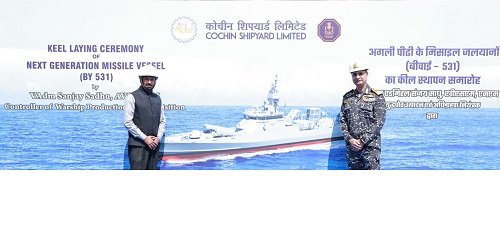
The keel-laying ceremony for the first NGMV, designated BY 531, was conducted in the presence of Vice Admiral Sanjay Sadhu, Controller of Warship Production and Acquisition at Integrated Headquarters of the Indian Navy, along with Jose V J, Chairman and Managing Director of CSL, Rear Admiral Kapil Mehta, ACWP & A, senior naval officers and government officials.
The laying of a keel is far more than a ceremonial milestone. The keel constitutes the bottom-most structural backbone of a ship, extending from its forward to its rear section. It provides the fundamental base upon which the vessel’s hull and superstructure are subsequently constructed. With this stage completed, BY 531 has formally moved from design and preparation towards physical construction.
The NGMV programme is strategically significant because these vessels are being conceived primarily as offensive platforms. Their principal task will be to provide the Navy with the ability to engage hostile warships as well as selected targets on land. Equipped for Maritime Strike Operations and Anti-Surface Warfare Operations, the vessels are expected to serve as potent instruments of sea denial, particularly around strategically important choke points.
Sea denial is an important component of modern naval warfare. Rather than simply seeking permanent control of large stretches of ocean, a sea-denial strategy aims to make specific maritime areas difficult and costly for an adversary to operate in. Missile-equipped vessels can play a crucial role in such operations by threatening hostile surface ships and restricting their freedom of movement.
At the same time, the NGMVs will not be confined to offensive missions. Their defensive responsibilities will include local naval defence operations and the seaward protection of offshore development areas. This gives the platform a broader operational role, linking conventional maritime strike capabilities with the protection of India’s maritime interests and offshore assets.
Under the 2023 contract with the Indian Navy, CSL has received an order to construct and deliver six NGMVs. The programme therefore represents not merely the construction of an individual warship but the establishment of an entire class of advanced naval platforms.
For CSL, the project also represents an expansion of its capabilities. The shipbuilder has described the programme as its entry into the construction of advanced, weapon-intensive platforms for the Indian Navy. This is significant for a shipyard whose portfolio has already included major naval projects, most notably the indigenous aircraft carrier.
The NGMV programme consequently fits into the broader objective of Aatmanirbhar Bharat, with greater emphasis on designing, developing and manufacturing sophisticated defence platforms within India. Indigenous warship construction can reduce dependence on foreign suppliers while simultaneously strengthening domestic industrial expertise, supply chains and technological capabilities.
The keel of BY 531 may therefore be only the first visible piece of a much larger strategic endeavour. As the six-vessel programme progresses, the NGMVs are expected to add another layer to India’s maritime deterrence and defensive architecture, combining indigenous shipbuilding expertise with modern offensive and defensive naval requirements.





















Leave Your Comment