


Nilabh Krishna
How Bankim Chandra Chattopadhyay’s immortal composition became the voice of India’s freedom struggle, a symbol of cultural identity and an enduring expression of national unity.
On November 7, 1875, a song appeared in the Bengali literary journal Bangadarshan that would eventually become one of the most powerful expressions of Indian nationalism. Written by Bankim Chandra Chattopadhyay, Vande Mataram was not born in a political rally, nor was it originally conceived as a national anthem for a country that had yet to win its independence. It began as a literary composition, an invocation to the motherland that captured a deep emotional connection between a people and the land they called home. Yet, over the decades that followed, those words would travel far beyond the pages of a journal, finding their way into public meetings, protest marches, revolutionary movements, prison cells and the collective memory of a nation.
By 2026, the song has crossed 150 years of history, surviving colonial repression, political upheaval and the changing demands of a modern democracy. Its journey is remarkable not merely because it became India’s National Song, but because it helped give an emerging national consciousness a voice of its own. In an era when India was still struggling to imagine itself as a united political nation, Vande Mataram offered something profoundly powerful: the idea that the motherland was more than a territory ruled by an empire. She was a shared inheritance, a source of nourishment, a cultural memory and a cause worthy of sacrifice.
The story of Vande Mataram is, therefore, inseparable from the story of India itself. It is a story of how literature can become a movement, how emotion can inspire political courage, and how a song can outlive the circumstances that first gave it meaning.
The Birth of a National Imagination
The late nineteenth century was a period of profound change in India. British colonial rule had consolidated its power, while Indian society was undergoing intellectual, cultural and political transformations. Western education had introduced new ideas about rights, representative government and national identity, but colonial rule also exposed the contradiction between the language of liberty and the reality of imperial domination. Across the country, educated Indians, writers, reformers and emerging political leaders were searching for ways to articulate a collective identity that could transcend local loyalties and challenge foreign rule.
It was in this environment that Bankim Chandra Chattopadhyay, one of Bengal’s most influential literary figures, composed Vande Mataram. The phrase, commonly translated as “I bow to thee, Mother”, expressed reverence for the motherland through the familiar and deeply rooted cultural image of the mother. Rather than describing India simply as a geographical space, Bankim imagined her as a living presence, endowed with beauty, abundance, strength and dignity.
The opening lines evoke a land blessed with flowing waters, fertile fields, cooling breezes and abundant harvests. These images were not incidental decorations. They connected patriotism with the everyday experience of belonging to a place: its rivers, soil, seasons, food and natural beauty. The motherland was worthy of devotion because she sustained life, nurtured communities and carried the accumulated memories of generations.
The song was subsequently incorporated into Bankim’s celebrated novel Anandamath, published in 1882. Set against the backdrop of the late eighteenth-century Sannyasi Rebellion and the suffering associated with famine and political disorder in Bengal, the novel explored the relationship between sacrifice, resistance and devotion to the motherland. Within this literary setting, Vande Mataram acquired a wider emotional and political significance. It became a declaration that love for the country could demand something greater than private sentiment: it could require courage, discipline and a willingness to place the collective good above individual comfort.
The composition drew upon India's cultural and literary traditions, including the personification of the motherland through sacred imagery. Its language and symbolism gave emerging nationalism an emotional vocabulary that was distinctly Indian. At a time when the idea of an Indian nation was still developing, Bankim's song helped people imagine their attachment to the country as a bond deeper than the boundaries of a province or the interests of a particular community.
The song's publication in 1875 marks the beginning of its documented journey, but its historical importance lies in what happened afterwards. A literary creation would gradually become a public expression of political resistance, giving a growing movement a phrase that was simple enough to remember and powerful enough to unite people around a common cause.

From Literary Composition to the Voice of Freedom
The transformation of Vande Mataram from literature into a national rallying cry gathered momentum in the final years of the nineteenth century. In 1896, Rabindranath Tagore sang the song at the Calcutta session of the Indian National Congress, bringing it before a major political gathering. Tagore's rendition helped establish its place in the emerging national movement, connecting Bankim's literary vision with a political audience increasingly conscious of India's subjugation.
This was a critical moment in the evolution of Indian nationalism. The freedom struggle had not yet developed the mass character it would acquire in the twentieth century. Political activity remained uneven, and the challenge was to transform dissatisfaction with colonial rule into a shared national purpose. A song that could be sung collectively, remembered easily and understood emotionally offered something that speeches and political resolutions alone could not provide.
The turning point came in 1905, when the British government partitioned Bengal. The colonial administration presented the decision as an exercise in administrative convenience, but the partition was widely opposed and came to be seen by nationalists as an attempt to weaken political solidarity by dividing the province along communal lines. The announcement ignited protests and helped launch the Swadeshi movement, which urged Indians to boycott foreign goods, promote indigenous products and build economic self-reliance.
On August 7, 1905, demonstrators in Calcutta raised cries of Vande Mataram during a major public gathering associated with the boycott of foreign goods. The slogan soon spread beyond Bengal. It appeared in processions, political meetings and public demonstrations, becoming a recognisable expression of resistance to British authority. The cry was no longer confined to the literary world. It belonged to the streets, where ordinary people were discovering the power of collective political action.
Students, workers, intellectuals and political activists embraced the song. It travelled through networks of public meetings, newspapers and nationalist organisations, acquiring new significance as the movement expanded. The words offered protesters a shared identity at a time when the colonial government was attempting to contain a growing challenge to its authority.
The British administration increasingly regarded nationalist slogans and gatherings as threats to public order. Attempts to restrict expressions of resistance only reinforced the song's association with defiance. To raise the cry of Vande Mataram was to affirm that India could not be reduced to a possession of the British Empire and that its people had the right to imagine a different political future.
The song also helped link cultural pride with economic nationalism. The Swadeshi movement was not merely a protest against partition; it was a call to reconsider the relationship between political independence and economic dependence. Supporting Indian-made goods, reviving indigenous enterprise and resisting colonial economic domination became practical expressions of patriotism. Vande Mataram provided an emotional thread connecting these different activities.
Its spread beyond Bengal demonstrated that an expression rooted in a particular linguistic and cultural setting could acquire national significance. The song's journey was part of a larger transformation: the gradual emergence of an Indian nationalism that sought to connect people across regional boundaries and turn resistance to colonial rule into a common cause.
A Song That Entered the Freedom Fighter's Vocabulary
As the freedom struggle gathered strength in the early twentieth century, Vande Mataram became closely associated with the courage and sacrifices of those who challenged colonial rule. It was heard at political gatherings and processions, while its words became part of the vocabulary of revolutionary nationalism. For many activists, it represented an India that existed in the imagination before it could be realised in law or political institutions.
The song's significance lay partly in its ability to transform fear into a sense of purpose. Colonial rule was backed by an extensive administrative and coercive apparatus. Protesters faced arrest, restrictions, imprisonment and, in some cases, brutal repression. Against this backdrop, a collective cry could become an assertion of dignity. It reminded participants that they were not isolated individuals confronting an empire alone; they were part of a wider struggle.
In 1907, revolutionary nationalist Bhikaji Cama raised an Indian flag at an international socialist gathering in Stuttgart, Germany, carrying the words Vande Mataram on it. The episode illustrated how the song had travelled beyond India's borders, becoming part of the effort to draw international attention to the Indian freedom movement. The motherland it invoked was under colonial rule, but the aspirations associated with her had acquired an international audience.
As the movement evolved, Vande Mataram remained one of its most recognisable expressions, even as different leaders and organisations pursued different strategies. Constitutional reform, mass mobilisation, revolutionary action, non-cooperation and civil disobedience were not identical approaches. Nor did all nationalists agree on political methods or the future shape of independent India. Yet the song retained a prominent place in the broader history of resistance.
Independence and the Making of a National Song
India's independence in 1947 transformed the political meaning of Vande Mataram. The country that the song had invoked as an aspiration was now a sovereign nation, responsible for building its own democratic institutions and defining the relationship between its diverse citizens. The challenge was no longer simply to resist colonial rule. It was to turn the promise of freedom into a durable national community.
On January 24, 1950, as the Constituent Assembly completed its historic work, its president, Dr Rajendra Prasad, declared that Vande Mataram, which had played a historic role in the struggle for Indian freedom, would be honoured equally with Jana Gana Mana. The latter was to serve as the National Anthem, while Vande Mataram was recognised as the National Song. This distinction gave the composition a permanent place in independent India's national life.
The decision reflected the importance of the song's contribution to the freedom movement while recognising the need to establish national symbols that could command respect across the country's diverse population. The Constitution's larger vision was one of democratic citizenship, equality and fraternity, bringing together people of different languages, religions, regions and cultural traditions.
The history of Vande Mataram also calls for an honest understanding of its complexities. Its later stanzas employ religious imagery that has generated debate, particularly over how the personification of the motherland relates to the beliefs of citizens from different religious traditions. The political discussion surrounding the song predates independence and formed part of the broader effort to establish a national vocabulary that could accommodate India's diversity.
From the Memory of Freedom to the India of 2026
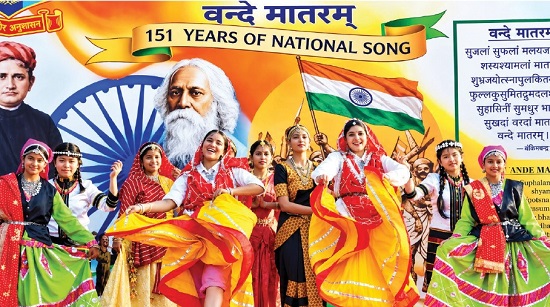
In 2025, India began a year-long national commemoration marking 150 years of Vande Mataram. Inaugurated on November 7, 2025, the anniversary programme brought renewed attention to the song's journey from its nineteenth-century origins to its place in the modern Republic. The celebrations included cultural presentations, exhibitions, public participation and commemorative releases. The song also featured prominently in the Republic Day parade of January 26, 2026, through a tableau celebrating its historical and cultural significance.
The commemoration, extending into November 2026, offers an opportunity to look beyond ceremonial observances and consider what the song means to a new generation. For young Indians who have grown up in a sovereign, technologically advancing and globally connected country, the colonial world that produced Vande Mataram may appear distant. Yet the underlying question remains relevant: what does it mean to belong to a nation, and what responsibilities accompany that belonging?
The answer cannot be confined to singing a patriotic song on national occasions. The spirit of Vande Mataram can also be understood through the everyday responsibilities of citizenship: protecting public property, respecting fellow citizens, preserving the natural environment, supporting honest public institutions and contributing to the country's progress. Its imagery of fertile fields, flowing waters and a nurturing motherland has particular relevance at a time when environmental protection, water security and sustainable development are increasingly important national concerns.
The song's enduring appeal also lies in its connection between patriotism and self-reliance. During the Swadeshi movement, the boycott of foreign goods was a practical expression of resistance to colonial economic domination. In contemporary India, the economic circumstances are different, but the question of national capacity remains central. Developing domestic manufacturing, strengthening scientific research, encouraging innovation and expanding opportunities for Indian businesses can all be understood as modern expressions of the desire for a country capable of shaping its own future.
Similarly, the song's historical role in bringing people together offers a useful lesson for a society in which political disagreements and competing identities can sometimes deepen divisions. National unity does not require citizens to think alike or abandon their regional languages, religious traditions and cultural differences. It requires them to recognise that these differences exist within a larger shared national framework. The freedom movement drew strength from the participation of people with different backgrounds and convictions; independent India must preserve that capacity for collective purpose.
The motherland celebrated in Vande Mataram is not merely an idea preserved in history books. She is the country experienced in the present: in the villages and cities, the farms and factories, the universities and laboratories, the armed forces and the public institutions that sustain the Republic. Love for such a country is expressed not only through words but also through work, responsibility and a willingness to contribute to the common good.
For the younger generation, therefore, the song's legacy should be an invitation to understand the sacrifices that made freedom possible and the responsibilities that freedom imposes. Remembering the past matters, but remembrance acquires greater value when it shapes the choices of the present. A nation that honours its freedom fighters must also strive to build a society in which opportunity, dignity and justice are available to its citizens.
The Enduring Spirit of Vande Mataram
One hundred and fifty years after its publication, Vande Mataram continues to occupy a distinctive place in India's national consciousness. Few literary compositions have travelled such a distance—from a Bengali literary journal in 1875 to the streets of the Swadeshi movement, from the history of colonial resistance to the institutions of independent India, and from the memories of freedom fighters to the public celebrations of 2026.
Its journey demonstrates the power of cultural expression to shape political history. Bankim Chandra Chattopadhyay could not have known the full course his composition would take, but the emotional force of his words gave subsequent generations a means of expressing their attachment to the motherland. Tagore's rendition at the 1896 Congress session, the song's emergence as a rallying cry during the anti-partition movement and its recognition in 1950 each marked a different stage in that journey.
The challenge now is to preserve its historical meaning without reducing it to a ceremonial ritual or a political slogan. Its legacy deserves serious engagement in schools, universities, cultural institutions and public discussions. Young Indians should encounter not only the familiar words but also the history of the people who sang them, the circumstances in which they became a symbol of resistance and the debates that accompanied their adoption into national life.
Ultimately, the story of Vande Mataram is a reminder that a nation is sustained by more than its borders, institutions and economic achievements. It also draws strength from shared memories, cultural expressions and the collective determination of its people. The song became powerful because it gave voice to a longing for freedom at a time when freedom remained beyond reach. Its significance today depends on how that spirit is carried forward in a country that is already independent but continues to face the demanding task of building a more prosperous, cohesive and confident future.
As India moves towards the centenary of independence in 2047, the message of Vande Mataram can serve as a bridge between the sacrifices of the past and the aspirations of the future. Its history calls on citizens to value the freedom they inherited, respect the diversity of the society they share and contribute to the progress of the country they call home.
The words first published in 1875 have outlived the empire against which their patriotic spirit eventually rose. Their journey from literature to the freedom struggle and from independence to contemporary India reveals the extraordinary ability of a song to become part of a nation's identity. In 2026, Vande Mataram remains more than a historical echo. It is a living reminder of the struggle that shaped modern India and of the responsibility every generation bears for the nation's future.
Vande Mataram is, above all, a tribute to the motherland—and a call to ensure that the freedom, unity and dignity for which generations struggled continue to guide India's journey.
(The content of this article reflects the views of writer and contributor, not necessarily those of the publisher and editor. All disputes are subject to the exclusive jurisdiction of competent courts and forums in Delhi/New Delhi only)




















Leave Your Comment