


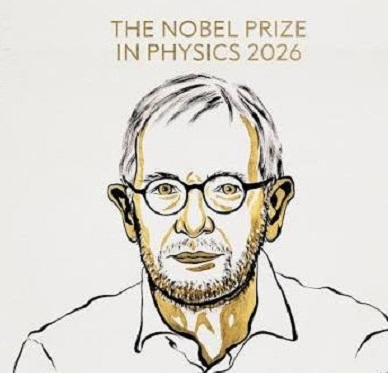
The 2026 Nobel Prize in Physics has been awarded to physicist Francis Halzen for his decisive contribution to the IceCube Neutrino Observatory and the discovery of high-energy neutrinos of astrophysical origin. The Royal Swedish Academy of Sciences recognised his work that has opened a new window into some of the most violent and energetic processes in the universe.
The 2026 Nobel Prize in Physics has gone to Francis Halzen for his decisive contribution to the IceCube Neutrino Observatory and the discovery of high-energy neutrinos of astrophysical origin. The award recognises decades of scientific vision that transformed an unusual idea about Antarctic ice into a powerful instrument for exploring the universe.
Neutrinos are among the most elusive particles known to science. They have no electric charge and interact extremely weakly with matter, allowing enormous numbers of them to travel across the universe without being absorbed or deflected. This makes them extraordinarily difficult to detect, but also exceptionally valuable to scientists seeking information about distant cosmic events.
Halzen recognised that the enormous volume of clear ice beneath the South Pole could serve as a natural particle detector. The IceCube observatory uses thousands of light-sensitive sensors embedded deep within Antarctic ice. When a neutrino interacts with an atomic nucleus, it can produce a secondary charged particle that generates a faint flash of light. By detecting and analysing these flashes, scientists can determine the direction and energy of incoming neutrinos.
The significance of this achievement goes beyond the discovery of another particle phenomenon. Traditional astronomy relies heavily on electromagnetic radiation such as visible light, radio waves and X-rays. Neutrinos provide a different kind of messenger. Because they can travel through dense matter and across vast cosmic distances largely unaffected, they can carry information from regions that conventional telescopes cannot easily observe.
The IceCube observatory has therefore helped establish what scientists describe as a new form of astronomy. High-energy neutrinos can point researchers towards extreme cosmic environments where particles are accelerated to enormous energies. Such environments may include powerful astrophysical objects and violent processes capable of producing conditions far beyond anything achievable on Earth.
Halzen's Nobel recognition is consequently as much about scientific persistence as it is about a particular discovery. Developing IceCube required an international collaboration involving scientists, engineers and technicians and the construction of a detector on an extraordinary scale in one of the planet's most remote environments. The Nobel Committee highlighted Halzen's scientific vision and leadership in creating this instrument.
The award also underlines how discoveries in fundamental physics can reshape humanity's understanding of the cosmos. Neutrinos were once regarded primarily as elusive particles of particle physics. Today, they have become astronomical messengers capable of helping scientists investigate the origins of some of the universe's most energetic phenomena.
For Halzen, the Nobel Prize represents the culmination of a long scientific journey. For physics, it marks the growing importance of neutrino astronomy and the possibility that observations of these ghost-like particles could reveal cosmic phenomena that remain invisible through other methods.
The 2026 Physics Nobel thus celebrates more than the detection of high-energy particles. It honours a new way of observing the universe—one in which the darkness of Antarctic ice becomes a window into the most energetic and mysterious corners of space.






















Leave Your Comment