


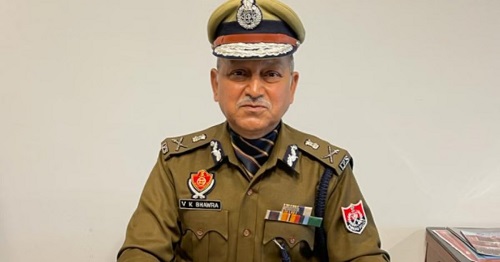
In a significant legal development, former Punjab Director General of Police (DGP) V.K. Bhawra has challenged a ruling by the Central Administrative Tribunal (CAT) in the Punjab-Haryana High Court. The CAT had upheld the appointment of the current Punjab DGP, Gaurav Yadav, and dismissed Bhawra's petition. Bhawra's appeal to the high court alleges that the Bhagwant Mann-led government pressured him to engage in illegal activities and forced him to resign shortly after taking office.
Bhawra's petition outlines a series of grievances against the state government, claiming that upon assuming office, the administration exerted undue pressure on him to resign from his position. He contends that his removal violated Supreme Court guidelines on the transfer and posting of senior police officials. According to Bhawra, the government coerced him into providing security to individuals from outside the state and exerted pressure to file cases against prominent individuals.
The high court has issued notices to DGP Gaurav Yadav and the central government, seeking their responses to Bhawra's allegations. The next hearing in this case is scheduled for July 4th.
V.K. Bhawra is a 1987 batch Indian Police Service (IPS) officer with a distinguished career spanning 35 years. The Union Public Service Commission (UPSC) recommended his appointment as Punjab Police Chief in 2020 and again in 2022. Throughout his career, Bhawra has held various high-ranking positions, including roles in intelligence, provisioning and modernization, information technology and telecommunications, and human rights.
His exemplary service has earned him prestigious awards such as the Police Medal for Meritorious Service and the President’s Police Medal for Distinguished Service.
In his petition, Bhawra claims that as soon as the Aam Aadmi Party (AAP) government, led by Bhagwant Mann, took charge, there was immediate pressure on him to vacate his position. He alleges that his removal was orchestrated to ensure the appointment of a DGP aligned with the new government’s interests. Bhawra asserts that his original appointment adhered to all regulatory norms, and his subsequent removal was unjust and politically motivated.
Bhawra's allegations highlight a significant issue regarding the independence and integrity of police appointments and the influence of political considerations in these decisions. The outcome of this case may have far-reaching implications for the governance and administrative practices in Punjab, particularly concerning the autonomy of police operations and the adherence to legal frameworks governing such appointments.



















Leave Your Comment