



RAKESH KUMAR
Archbishop Desmond Tutu once captured the bitter irony of colonialism in Africa with his famous words:
"When the missionaries came to Africa, they had the Bible and we had the land. They said, 'Let us pray.' We closed our eyes. When we opened them, we had the Bible and they had the land."
This piercing observation lays bare how faith was wielded as a tool of distraction, while land, resources, and sovereignty were stripped away. It is a story of dispossession cloaked in piety, a reminder of how imperialism often marched hand in hand with religion.
In India, colonizers first arrived under the guise of trade, spending decades negotiating permissions and building trust. Once entrenched, they constructed grand kothis—and began the systematic looting of wealth. Missionaries followed later, but by then the machinery of exploitation was already in motion.
India’s struggle was long and grueling, culminating in freedom fractured into three nations. In the meantime, religion, education, and commerce bore the brunt of colonial interference. Schools and hospitals, institutions meant to nurture, were often repurposed as subtle instruments of conversion. The damage was not only material but cultural, leaving scars that nations like India continue to wrestle with today.
What FCRA has to do with this.
The ground rules have changed. No longer is it trade or armies that dominate the field; instead, foreign funding has become the new instrument of influence. What once arrived in ships and battalions now flows quietly through grants and aid, reshaping societies in subtler but equally powerful ways.
The Niyogi commission gave its recommendations as early as 1956 yet the pseudo secular government kept it under the carpet. Madhya Pradesh and Orissa passed the bills to implement the recommendation. The Supreme Court upheld the constitutionality of the Madhya Pradesh law, which was drafted on the recommendations of the Niyogi Committee Report. In the landmark 1977 case Rev. Stainislaus v. State of Madhya Pradesh, the apex court validated both the M.P. Dharma Swatantraya Adhiniyam and a similar Orissa Act.
Failed efforts in the past !
It took the Indian government nearly half a century to respond decisively. Amendments that could have been enacted as early as 1979 were delayed when the Janata Party government fell, just after tabling the Dharm Swatantrata Bill proposed by O.P. Tyagi. That moment of collapse postponed crucial safeguards, leaving the nation vulnerable to decades of unchecked external interference.
The lesson is stark: colonialism evolves, but its essence remains—control, extraction, and influence. Where once land and resources were seized, now minds and institutions are targeted. The vigilance required today is no less demanding than it was in the past.
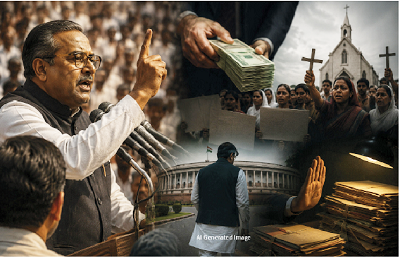
India’s proposed FCRA amendments, paired with stronger PMLA enforcement, have triggered a sharp political backlash, particularly from church bodies, opposition parties, and NGOs. While critics frame the measures as draconian and anti-democratic, the government argues they are necessary to curb financial misuse, money laundering, and illicit foreign funding. At the center of the debate lies a deeper concern: the intersection of foreign-funded religious conversion networks with extremist ecosystems, including Maoist and Islamist channels. Evidence from investigations, license cancellations, and intelligence inputs suggests that vulnerabilities in the NGO sector have been repeatedly exploited. The resistance, therefore, reflects not only civil society concerns but also competing interests over transparency, influence, and control in India’s evolving national security landscape. A look at the past becomes necessary.
Tryst with trust of a different kind?
In a widely quoted speech delivered in 2009, L. K.Advani recalled that Janata Party leaders demanded that former Jana Sangh members sever ties with the RSS. Refusal led to the formation of the BJP in 1980.
The dual membership issue was the direct consequence of the Dharm swatantrata bill tabled as a private bill by O.P Tyagi.
Some politicians—have claimed in speeches and memoirs that foreign-funded missionary groups mobilized against the Freedom of Religion Bill and influenced politics. The charges were never investigated as the Janta party lost power and the beneficiary had no intention to investigate.
Why do some people believe foreign money was involved?
Is there anything wrong with the proposed amendments?
Controlling foreign funds to restrain induced conversions involves strict regulatory measures overseen by the Ministry of Home Affairs via the Foreign Contribution Regulation Act ( FCRA). Prohibiting against utilizing of overseas donations for proselytization, mandating transparent reporting and rigorous operational compliance.
Regulatory Mechanisms.
The legal framework to prevent foreign capital from being used to induce religious conversions relies on transparency and oversight:
The Indian Rebellion of 1857 Changed British Religious Policy in India but missionaries failed to learn!
The reader will be surprised to know that India is the only country where the invaders have failed to destroy the native religion. The Indian Rebellion of 1857 led the British government to become much more cautious.
Before 1857:
After 1857:
Ongoing Debate on proposed amendments.
Navigating the FCRA compliance rules requires sticking to guidelines, the Government of India updated the rules to establish monitoring structures, ensuring zero leakage of overseas capital into unauthorized fields.
Eligibility & Compliance Requirements
To legally receive foreign funding, non-governmental entities must secure explicit registration.
Penalties for Misuse and Violations.
The updated legal framework establishes severe compounding fines, registration blacklisting, and asset clawbacks to deter misutilization:
Mission Funding Faith, Not Progress” is raising a cry of foul play.
The internet is flooded with articles which raise concerns over the impact of these impacts. The major issues raised are:
One can see the weakness in the above arguments as 50 percent for administrative cost is too excessive and no efficient organisation spent this much. Clearly it leaves a big window for malpractices.
Safeguarding Sovereignty Through FCRA.
The government has been clear about the real objective behind the FCRA changes. Countering the opposition’s charges Nityanand Rai, Union Minister of State for Home Affairs asserted in the Lok Sabha,” FCRA amendments are “indeed dangerous” only for those misusing foreign contributions for forced religious conversions”.
Conclusion.
The amendments to FCRA might be a beginning only. The anti India forces keep inventing new loopholes. The recent credit card funding scam is an eye opener.
“The Enforcement Directorate (ED) has uncovered a sprawling foreign funding network allegedly operating through clandestine cash withdrawals across India. The probe, linked to "The Timothy Initiative (TTI)", has raised serious questions about the possible use of foreign money in Maoist-affected regions and, even more explosively, for alleged religious conversions.” NDTV. India news Apr 25 2026.
To mitigate such risk the government has to invest heavily in cyber as well as financial intelligence to identify and neutralise the eco system, hurting our mission of India becoming a leading economy by 2047.
(The content of this article reflects the views of writer and contributor, not necessarily those of the publisher and editor. All disputes are subject to the exclusive jurisdiction of competent courts and forums in Delhi/New Delhi only)






















Leave Your Comment