


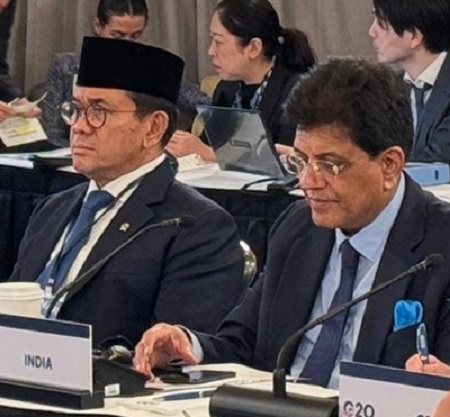
India’s intervention at the G20 Trade Ministers’ Meeting in Milwaukee brings a larger economic principle into focus: protecting domestic food security should not automatically be interpreted as using food as a geopolitical weapon. Commerce and Industry Minister Piyush Goyal’s remarks underline India’s effort to balance open and predictable trade with the sovereign responsibility of governments to protect their populations from supply disruptions and price shocks. At the same time, India’s engagement with the European Union over the proposed free trade agreement shows that New Delhi is pursuing deeper global economic integration while retaining policy space for domestic priorities.
India’s position reflects a longstanding tension in the international trading system. On one side is the argument that unrestricted and predictable trade strengthens global food supplies by allowing countries to source commodities from the most efficient producers. On the other is the reality that food is not merely another tradable commodity. For governments, ensuring adequate and affordable food supplies is directly linked to social stability, inflation management and national security.
Goyal’s intervention therefore seeks to establish a distinction between protectionist or coercive trade practices and legitimate national measures designed to safeguard food availability. His message at the G20 was that the ultimate purpose of international trade should be cooperation and stability rather than creating vulnerabilities that can be exploited during crises.
The distinction has particular significance for developing economies. Global disruptions in recent years—from geopolitical conflicts and shipping disruptions to extreme weather events—have demonstrated how quickly food and commodity markets can be affected. Countries with large populations cannot be expected to ignore domestic requirements simply to maintain uninterrupted export flows.
At the same time, India’s approach is not a rejection of international trade. Its simultaneous push for the India-EU Free Trade Agreement demonstrates precisely the opposite. India is seeking wider market access, investment and technology partnerships while attempting to preserve adequate policy flexibility in sensitive sectors.
The India-EU FTA is particularly important in this context. Negotiations, which began in 2007 and were relaunched in 2022, concluded on January 27 this year. The European Commission has subsequently submitted the agreement to the EU Council for authorisation for signature and conclusion. The next phase will determine how the negotiated commitments translate into an operational trading framework.
For India, the agreement represents an opportunity to deepen its economic relationship with one of the world's largest trading blocs. Greater access to European markets could create opportunities for Indian manufacturers, exporters and service providers. Conversely, European companies could gain greater access to India's expanding consumer and industrial markets.
But the significance of the agreement goes beyond tariffs. Discussions between Goyal and European Commissioner for Trade and Economic Security Maroš Šefčovič also covered the India-EU Trade and Technology Council, World Trade Organisation reform and shared G20 priorities. This indicates that the economic relationship is increasingly being shaped by technology, supply-chain resilience, investment and strategic economic security.
Technology is especially important to India's industrial ambitions. Minister of State for Commerce and Industry Jitin Prasada has emphasised that the pact could expand opportunities for trade and investment, while technology transfers, local manufacturing and artificial intelligence could contribute to India's next phase of industrial development.
This combination of trade liberalisation and technological cooperation is central to India's evolving economic strategy. Market access alone cannot guarantee industrial competitiveness. India also needs investment, advanced technology, stronger domestic production capabilities and integration into global value chains.
The G20 platform gives India an opportunity to place these issues within a wider discussion. Food security, trade liberalisation, technology and supply-chain resilience are increasingly interconnected. A disruption in one area can quickly affect the others.
India's message in Milwaukee consequently goes beyond the immediate debate over food exports or trade restrictions. It reflects an attempt to define a model in which international economic integration does not require countries to surrender their ability to protect essential domestic interests.




















Leave Your Comment