



Debendra Nath Rout
The foundational bedrock of any meritocratic society relies heavily on the absolute sanctity and unassailable integrity of its examination systems. For millions of aspiring young minds across India, the National Eligibility cum Entrance Test (NEET) is not merely a standardized evaluation; it represents the culmination of years of relentless sacrifice, unwavering dedication, and the collective dreams of families striving for upward social mobility. However, the recurring and deeply unsettling shadow of question paper leaks, institutional malpractices, and the sophisticated machinations of organized examination syndicates have threatened to erode the very core of this vital ecosystem. When the future of lakhs of hardworking, meritorious students is jeopardized by a handful of unscrupulous elements and systemic vulnerabilities, it ceases to be a localized administrative failure; it morphs into a profound national crisis that demands urgent, holistic, and unyielding intervention. The recent upheavals surrounding the conduct of high-stakes national examinations have brought India to a critical historical juncture, forcing a comprehensive re-evaluation of how our apex testing bodies function and, more importantly, how the state responds to threats that undermine the aspirations of its youth.
To fully understand the gravity of the current scenario, it is essential to contextualize the systemic evolution of anti-leak interventions and contrast past administrative methodologies with contemporary strategic responses. Historically, India’s approach to examination malpractices has been largely reactive, characterized by a pattern of post-facto firefighting. In previous decades, whenever a major examination paper leak was exposed, the standard governmental response followed a predictable and often sluggish trajectory. Typically, an ad-hoc investigative committee or an internal inquiry panel would be constituted to probe the localized breach. These committees would painstakingly deliberate for months, eventually releasing voluminous reports containing recommendations that were frequently overtaken by technological advancements or archived due to a lack of political and administrative will. While sporadic arrests of low-level conduits or local coaching centre operators were made, the deep-rooted, multi-state networks of organized examination mafias remained largely untouched. The systemic vulnerabilities inherent in the physical logistics of examinations; ranging from the manual printing of question papers to their physical transport via insecure transport networks and storage in vulnerable local bank vaults were left unaddressed, allowing the same vulnerabilities to be exploited in subsequent examination cycles.
The structural limitations of these historical interventions stemmed from a fundamental misdiagnosis of the problem. Paper leaks were long treated as isolated instances of criminal opportunism rather than what they truly are: highly organized, technologically sophisticated, and financially lucrative white-collar crimes operating across state borders. Past administrations frequently relied on administrative damage control, attempting to suppress public panic through piecemeal re-examinations confined to specific centres, a strategy that often compounded the mental agony of students while leaving the core integrity of the pan-India rank list severely compromised. Furthermore, the legal frameworks governing public examinations in earlier eras lacked the teeth required to act as a formidable deterrent. Punitive actions were governed by generic sections of the Indian Penal Code, which allowed masterminds to exploit legal loopholes, secure swift bail, and resume their illicit operations under different guises. This legacy of reactive governance and inadequate systemic insulation ultimately created a culture of impunity among examination syndicates, culminating in the complex vulnerabilities that plagued modern centralized testing agencies like the National Testing Agency (NTA).
In sharp contrast to the slow-moving and defensive administrative paradigms of the past, the current Ministry of Education has orchestrated a remarkably swift, transparent, and structurally transformative response to the NEET crisis. Breaking away from the traditional bureaucratic playbook of denial and delay, the current leadership chose the path of radical transparency by openly acknowledging the systemic and human errors within the examination machinery. Adopting an uncompromising policy of "zero tolerance" toward any form of malpractice, the Education Minister initiated a multi-layered offensive designed not just to punish the immediate perpetrators but to comprehensively dismantle the structural foundations of examination fraud in India. Recognizing that a crisis of this magnitude required a premier investigative agency with a transnational reach, the Ministry bypassed routine police inquiries and immediately handed over the entire pan-India investigation to the Central Bureau of Investigation (CBI). This decisive move ensured that the multi-state linkages of the paper leak mafia were targeted simultaneously, leading to high-profile arrests and the disruption of entrenched criminal networks operating across states like Bihar, Gujarat, and Maharashtra.
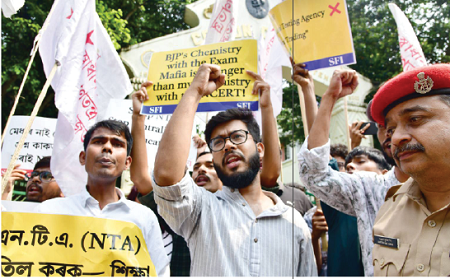
Beyond punitive enforcement, the present leadership's handling of the situation stands out due to its highly sophisticated integration of technology and digital intelligence to neutralize real-time threats. In the contemporary digital landscape, the proliferation of encrypted social media channels, such as Telegram, has emerged as a primary vector for the rapid dissemination of leaked materials, morphed answer keys, and fraudulent "guess papers" designed to extort vulnerable students. Understanding the viral nature of this threat, the Ministry of Education worked in tandem with the Ministry of Electronics and Information Technology to execute a massive digital crackdown. By identifying and blocking over 120 illicit online channels and deep-web forums, the administration effectively severed the communication lifelines of these digital syndicates, preventing the further weaponization of misinformation and safeguarding students from financial extortion. This proactive digital stance marked a paradigm shift from traditional policing, establishing a precedent for real-time cyber monitoring in the administration of national-scale competitive exams.
The true hallmark of dynamic governance, however, lies in the ability to convert a systemic crisis into an opportunity for permanent structural revolution. The most significant and far-reaching intervention championed by the current Education Minister is the definitive declaration to phase out the traditional, logistically vulnerable Pen-and-Paper (OMR-based) testing methodology for NEET and transition entirely to a robust, Computer-Based Test (CBT) model. The traditional OMR format possesses inherent physical vulnerabilities; the question papers must be printed in massive quantities weeks in advance, packed, transported across thousands of kilometres via various transit networks, and stored in local strongrooms before being distributed to thousands of physical centres. Every single link in this long physical chain represents a potential point of compromise. By mandating a transition to the CBT framework, the Ministry is effectively cutting the Gordian knot of examination leaks. In a fully digitized CBT architecture, the physical printing, transportation, and storage of question papers are entirely eliminated, thereby eradicating the primary vulnerabilities that traditional examination mafias have exploited for decades.
Furthermore, the operational architecture of the proposed CBT model incorporates state-of-the-art technological safeguards that render traditional leak mechanisms obsolete. Under this advanced digital framework, question papers are stored in highly secure, centralized cloud servers protected by military-grade, multi-layered encryption protocols. These encrypted data packets are transmitted to designated, high-security digital examination centres via secure, dedicated networks only a few minutes before the commencement of the exam. The decryption keys are generated dynamically through automated algorithms and are released only when the student logs into their individual terminal at the scheduled time. This means that even if an unauthorized entity attempts to intercept the data stream during transit, they would encounter nothing but unreadable, encrypted code. Additionally, the CBT system allows for the seamless implementation of dynamic section-shuffling and individualized question sequencing, ensuring that no two adjacent terminals display the same question in the same order, thereby neutralizing localized cheating and institutional collusion at the centre level.
To complement these technological barriers, the government has established a formidable, institutionalized legal deterrent by operationalizing the Public Examinations (Prevention of Unfair Means) Act. This landmark piece of legislation introduces unprecedentedly harsh punitive measures specifically tailored to combat organized examination fraud. Under the strict provisions of this Act, individuals found guilty of conspiring to leak question papers, tampering with answer scripts, or facilitating institutionalized cheating face severe criminal charges, including non-bailable imprisonment terms extending up to ten years and astronomical financial penalties of up to one crore rupees. Crucially, the law introduces the concept of corporate and institutional accountability; if an examination service provider or a private test centre is found complicit in malpractices, they face immediate blacklisting, asset forfeiture, and the recovery of the entire proportionate cost of conducting the examination. This legislative framework creates a massive financial and legal disincentive, ensuring that the risk of engaging in examination malpractice vastly outweighs any potential illicit financial gain, thereby effectively paralyzing the economic incentives of the paper-leak industry.
While structural and legislative overhauls are critical for long-term stability, the present administration has simultaneously demonstrated deep institutional empathy by prioritizing the immediate mental well-being and logistical convenience of the affected students. Recognizing that a disrupted examination schedule inflicts severe psychological trauma, anxiety, and financial strain on families, the Ministry of Education rolled out a comprehensive student-centric relief package. For all students required to participate in rescheduled or makeup examinations, the government completely waived any additional examination fees, ensuring that no aspiring candidate faced financial barriers to justice. Furthermore, the NTA optimized its logistical algorithms to grant candidates the maximum possible flexibility in selecting their preferred examination cities and centres, drastically reducing travel times and eliminating the need for expensive overnight stays. By combining unyielding administrative firmness against criminals with profound institutional compassion for the student community, the current leadership successfully averted a widespread crisis of confidence, keeping the nation's youth anchored to the principles of merit and fair play.
Looking forward toward a future perspective, these comprehensive, multi-dimensional steps are poised to fundamentally reshape the landscape of Indian higher education, ushering in an era of absolute transparency, predictability, and global benchmarked standards. The permanent shift to a digitally insulated, CBT-driven assessment model for NEET will establish a highly scalable and tamper-proof template that can be seamlessly replicated across all other national and state-level competitive examinations, such as JEE, CUET, and various Union Public Service Commission evaluations. As India transitions into a knowledge economy, the institutional stabilization of its apex testing bodies will ensure that the country’s human resource selection processes remain completely unblemished, guaranteeing that only the most qualified, capable, and dedicated minds ascend to vital sectors like medicine and engineering. This systemic resilience will eliminate the recurring administrative disruptions, costly legal battles, and paralyzing delays that have historically plagued our educational calendar, allowing academic sessions to commence with absolute temporal precision.
Ultimately, the successful execution of these visionary reforms will yield a profound socio-educational dividend, restoring the sacred social contract between the citizen and the state. When a nation’s youth are fully assured that their destiny is governed solely by the intensity of their hard work and the calibre of their intellect rather than the depth of their financial pockets or their access to illicit underground networks, it unleashes an unprecedented wave of creative energy, aspiration, and civic trust. The transition from the vulnerable, reactive systems of yesterday to the highly sophisticated, proactive, and dynamic governance model of today marks a definitive turning point in our educational history. By dismantling the criminal syndicates, embedding cutting-edge encryption technology into the testing architecture, and enforcing an uncompromising legal framework, the current administration has not just resolved a contemporary crisis; it has effectively future-proofed the aspirations of generations to come, ensuring that the flame of meritocracy in India burns brighter, cleaner, and more resilient than ever before.
(The content of this article reflects the views of writer and contributor, not necessarily those of the publisher and editor. All disputes are subject to the exclusive jurisdiction of competent courts and forums in Delhi/New Delhi only)





















Leave Your Comment