


The Delhi Police’s decision to register an FIR over the alleged forcible entry of Rahul Gandhi, Priyanka Gandhi Vadra and other INDIA bloc MPs into Akashvani Bhavan has added a legal dimension to an already charged political confrontation with the Election Commission. The episode highlights a difficult democratic balance: Opposition parties have the right to protest and demand institutional accountability, but that right operates within rules governing access to public premises, marches and public order. At the same time, the FIR is likely to intensify the political debate over whether restrictions on protest are being applied neutrally or becoming part of the larger confrontation between the Opposition and electoral authorities.
The registration of an FIR by Delhi Police over the alleged unauthorised entry of Rahul Gandhi, Priyanka Gandhi Vadra and other INDIA bloc MPs into Akashvani Bhavan has taken the Opposition’s confrontation with the Election Commission from the political arena into the legal domain.
The INDIA bloc’s protest was organised around serious political objections to the Election Commission, particularly over the Special Intensive Revision (SIR) of electoral rolls and the Opposition’s demand for the resignation of Chief Election Commissioner Gyanesh Kumar. The protesters intended to march from Parliament towards Nirvachan Sadan, but Delhi Police said that no permission had been sought or granted for the proposed march.
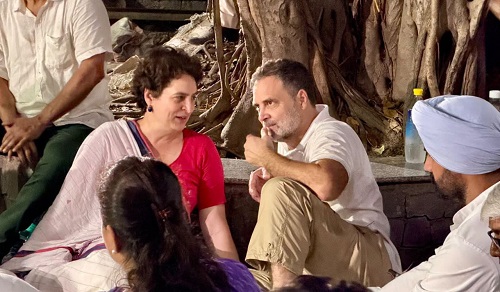
The confrontation escalated when the protesters were stopped near the Election Commission headquarters. Rather than ending the demonstration, several Opposition leaders staged a sit-in. Rahul Gandhi and Priyanka Gandhi Vadra subsequently entered the Akashvani Bhavan premises along with other MPs and leaders.
According to the police, the protesters had entered the premises without permission and refused to leave despite being asked to vacate. The police eventually removed and detained them, saying the intervention was necessary to maintain law and order.
The registration of an FIR changes the character of the episode. What began as a political demonstration is now also a matter for the criminal justice system. The precise sections invoked and the evidence collected will therefore become important in determining whether the case remains primarily procedural or develops into a more consequential legal dispute.
At the heart of the controversy is a fundamental democratic question: where does the right to protest end and unlawful occupation or obstruction begin?
Political parties in a democracy must be able to challenge institutions, question constitutional authorities and mobilise public opinion. Demonstrations are an essential instrument of political expression, particularly when Opposition parties believe that electoral processes require greater transparency or scrutiny.
But the right to protest does not automatically provide unrestricted access to government premises. Public buildings operate under security and administrative rules, and authorities have a legitimate responsibility to regulate entry, movement and demonstrations within them.
This is where the Akashvani Bhavan episode becomes significant. If the police allegation that the leaders entered without permission and subsequently refused to vacate is established, the authorities can argue that intervention was necessary irrespective of the political identity of the protesters.
The Opposition, however, is likely to view the FIR through a different lens. Since the protest itself concerned the functioning of the electoral system and the Election Commission, any police action against elected MPs can become part of the broader political argument about democratic space.
The challenge for the authorities is therefore not merely to enforce the law but to demonstrate that enforcement is proportionate, transparent and politically neutral.
The immediate FIR may eventually be resolved through the legal process, but the political dispute that produced the protest is unlikely to disappear.
The Opposition’s campaign against the SIR process reflects a wider concern over electoral rolls, voter verification and the powers exercised by election authorities. Its demand for Gyanesh Kumar’s resignation has transformed what might otherwise have been an administrative disagreement into a larger confrontation over institutional credibility.
The detention of around 260 protesters, including 10 MPs, further amplified the dispute. For the Opposition, the episode provides another argument that its concerns are not receiving adequate institutional hearing. For the police and government, the absence of permission for the march and the alleged unauthorised entry into Akashvani Bhavan provide grounds for asserting that political protest cannot override established procedures.
The real test now lies in how both sides respond. The Opposition has the opportunity to pursue its allegations through parliamentary, constitutional and legal mechanisms rather than allowing the confrontation to become exclusively street-driven. The authorities, meanwhile, must ensure that the FIR is investigated objectively and that lawful protest is not unnecessarily criminalised.
In a democracy, institutions gain legitimacy not merely by exercising authority but by demonstrating fairness while doing so. The Akashvani Bhavan episode has therefore become larger than a question of an alleged trespass. It is now another test of the relationship between political dissent, public order and institutional trust at a time when the credibility of the electoral process itself is under intense political scrutiny.



















Leave Your Comment