



MANOJ DUBEY
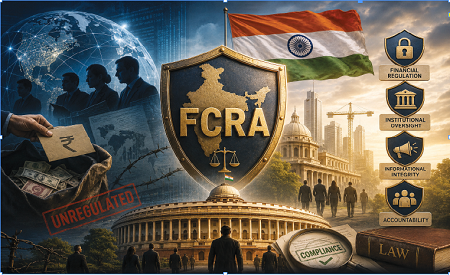
The Foreign Contribution Regulation Act (FCRA) has evolved into India’s legal framework for regulating foreign donations received by individuals, associations, and organisations. The first Foreign Contribution Regulation Act, 1976, was enacted by the gaovernment led by Indira Gandhi. Its purpose was to regulate the acceptance and utilisation of foreign contributions by organisations and individuals, so that foreign money would not influence political, social, or economic processes. This law was replaced by the Foreign Contribution Regulation Act, 2010. The major changes included: registration renewal requirements, stronger monitoring of funds, restrictions on the transfer of foreign contributions, and greater compliance obligations. FCRA was amended in 2020, introducing stricter controls, including a ban on transferring foreign funds to other NGOs, a reduced administrative expenses limit, and the mandatory use of a designated FCRA bank account at the State Bank of India, New Delhi branch, for receiving foreign funds.
Misuse of FCRA
The Foreign Contribution Regulation Act governs how Indian organisations can receive and use foreign donations. Its stated purpose is to ensure that foreign funds do not harm national interest, political processes, or public accountability. A concern is the diversion of funds by some organisations, using foreign donations for purposes different from those declared in their registration, such as spending on activities outside their stated objectives. Financial irregularity cases have involved allegations of poor accounting, lack of documentation, related-party transactions, or improper transfer of funds.
The law restricts foreign-funded organisations from engaging in political activities. Authorities have acted against some NGOs for alleged political involvement. Some groups have alleged that foreign funds were used for religious propagation or conversions. However, under FCRA, receiving foreign funds for legitimate charitable, educational, or religious purposes is not automatically illegal; the issue is whether funds are used in compliance with the law. Some groups have alleged that foreign funds were used for religious propagation or conversions. However, under FCRA, receiving foreign funds for legitimate charitable, educational, or religious purposes is not automatically illegal; the issue is whether funds are used in compliance with the law. The government has strengthened FCRA rules through amendments, including tighter reporting requirements, limits on the transfer of foreign funds between organisations, and increased scrutiny. Some civil society groups argue that excessive restrictions can affect genuine NGOs working in areas such as health, education, disaster relief, and social welfare.
The main challenge is balancing national security and financial transparency with the ability of genuine organisations to operate.
Foreign funding and religious conversion are subjects of debate in India. The law holds that foreign donations are not automatically illegal simply because they are received by a religious organisation. The issue is whether the funds are used for lawful activities and whether any conversion is carried out through unlawful means. Critics sometimes argue that welfare activities can be linked to attempts to influence religious choices, while organisations often state that their services are provided regardless of faith. Some groups allege that money or benefits are used to encourage conversions. Indian law does not permit conversion through force, fraud, or improper inducement; several states have laws regulating such conversions. Foreign funds may support training, publications, religious education, or community development.
Whether this amounts to unlawful conversion depends on the specific conduct and the applicable law. The debate involves balancing freedom of religion and the right to propagate religion under the Constitution, while regulating foreign funding and preventing misuse.
Different organisations and political groups have differing views on how often such misuse occurs and how strict regulation should be.
Gazette Notification, 2026
The Ministry of Home Affairs issued a Gazette Notification on June 22, 2026, updating the Foreign Contribution (Regulation) Rules to enhance compliance, accountability, and transparency for FCRA-registered entities. Key changes include mandatory reporting of operational locations and specific purposes, a broader definition of "key functionary," and stricter guidelines for managing the assets of non-operational or cancelled organisations. Additional information on donors, office-bearers, and organisational details is required. Organisations must submit details of their operational states within one year.
Reports and political discussions have linked the changes to concerns about alleged misuse of foreign funds for religious propagation or conversion. However, the rules govern the use of foreign funds; they do not, on their own, render all religious activities illegal.
Demographic Changes
India remains a religiously diverse country. Changes in the share of different religious communities over time are driven mainly by differences in fertility rates, migration, and historical patterns of conversion.
The Muslim population in India increased substantially in absolute numbers after independence, and its share of the total population also rose gradually. Muslims were about 10.4% of India’s population (around 35 million people) in 1951 and reached about 14.2% in 2011. Growth has been more pronounced in states with large Muslim populations, such as Uttar Pradesh, West Bengal, Bihar, Assam, and Kerala. Migration, especially in border areas, has influenced population patterns in some regions.
The Christian population in India grew in absolute numbers after independence, but its share of the total population remained relatively stable. Christians constitute about 2.3% of India’s population. Their absolute number rose from 8.3 million in 1951 to 27.8 million in 2011. Christian organisations established schools, hospitals, and social-service institutions, especially during the colonial period and after independence. Some people converted to Christianity for religious reasons, educational opportunities, social factors, or community influences. States such as Nagaland, Mizoram, and Meghalaya saw major increases in the Christian population during the 19th and 20th centuries, particularly among several tribal communities.
Conclusion
The June 2026 Gazette notification amending the FCRA Rules is expected to significantly affect organisations receiving foreign funds in India. It changes the FCRA Rules (procedures and compliance). NGOs and associations will need to clearly specify the purpose of receiving foreign funds and the areas (states/UTs) where activities will be carried out. This may reduce flexibility for organisations that previously used funds across multiple activities or locations. The new framework provides clearer categories for religious activities. Faith-related activities may continue, but activities classified as proselytisation are specifically excluded from certain permitted categories under the new rules. Supporters of the changes argue they will help prevent misuse of foreign money for activities such as forced or improper conversions. Critics believe that stricter rules could affect legitimate religious and charitable organisations and reduce space for civil society work.
Overall, the notification shifts FCRA compliance from a broad approval model to a more activity- and location-specific monitoring system. The central issues are ensuring transparency of foreign funds, protecting religious freedom, and preventing coercive or fraudulent practices. Funds must be used to empower people through education and to raise awareness. Proselytisation can never be justified; no religion is superior to humanity.
(The content of this article reflects the views of writer and contributor, not necessarily those of the publisher and editor. All disputes are subject to the exclusive jurisdiction of competent courts and forums in Delhi/New Delhi only)





















Comments (5)
A
Great topic Sir
S
भारत सरकार द्वारा लागू किए गए नए 'विदेशी अंशदान विनियम अधिनियम (FCRA)' के तहत अब विदेशी फंडिंग पर चलने वाले NGOsको 1. FCRA 2.0 पोर्टल व्यवहार में लाना अनिवार्य है 2. अपनी website, Twitter (X) और Facebook पेज का विवरण देना अनिवार्य है 3. Geo-tagging देना अनिवार्य है और धन का उपयोग केवल शैक्षणिक, आर्थिक, धार्मिक, सांस्कृतिक कार्यक्रमों के लिए ही किया जा सकता है,प्रत्यक्ष या अप्रत्यक्ष रूप से धर्मांतरण के लिए नहीं कर सकते। सरकार का यह कदम सराहनीय है।इस article के लेखक धन्यवाद के पात्र हैं।
H
Wonderful article presented with deep knowledge of the subject matter. My good wishes to him.
N
The wonderful article outlines the evolution of India's Foreign Contribution Regulation Act (FCRA), highlighting recent 2026 amendments designed to shift compliance toward strict, location-specific monitoring. It explores the delicate balance between ensuring financial transparency to protect national security and preserving religious freedom while preventing illegal proselytization. Mr. Dubey has been contributing academic articles regularly and providing healthy reading.
S
Mr. Dubey has his way of throwing light on current topics in a very simple enlightening manner. Easy for any layman to fathom. Great going Sir!