


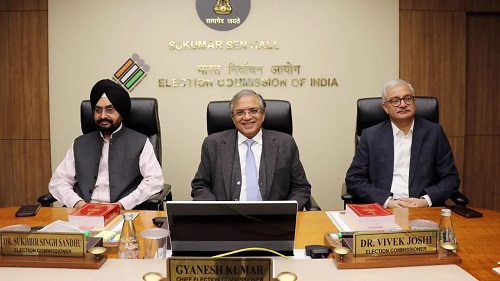
The Election Commission has rejected reports of differences among its three members over key decisions concerning electoral rolls and the Special Intensive Revision (SIR), saying that all decisions of the poll panel were taken unanimously. The clarification came after a report claimed that Election Commissioners Sukhbir Singh Sandhu and Vivek Joshi had recorded objections to several decisions over a 10-month period.
The Election Commission on Wednesday maintained that there was no division among its members over the functioning of the poll panel, including the ongoing Special Intensive Revision of electoral rolls.
According to Election Commission sources cited by Hindustan Times, every decision taken by the Commission, including those related to SIR, had the approval of Chief Election Commissioner Gyanesh Kumar and Election Commissioners Sukhbir Singh Sandhu and Vivek Joshi. The sources described the decisions as unanimous.
The clarification followed an Indian Express investigation which reported that Sandhu and Joshi had raised written objections to several decisions over a period of 10 months. The report, based on internal records it said it had examined, claimed that the two commissioners recorded objections on at least 14 occasions between November 2025 and August 2026.
The reported disagreements related to important aspects of electoral-roll management, including changes proposed to Form 6, the centralisation of access to the electoral-roll database, appeals concerning deleted voters in West Bengal and the inability of authorities in Goa to add some voters whom local election officials had found eligible.
One of the reported areas of disagreement concerned Form 6, which is used by individuals seeking inclusion in the electoral rolls.
The Indian Express reported that Vivek Joshi had objected to changes proposed to the form in connection with SIR. According to the report, Joshi argued that Form 6 is prescribed under the Registration of Electors Rules, 1960, and therefore could not be altered without an amendment to the relevant rules.
The report further said that the proposed change introduced questions linked to the previous SIR exercise, including whether an applicant or the applicant's parents or grandparents had appeared in an earlier electoral roll.
According to the report, objections were also raised over the manner in which the change was implemented despite the concerns recorded by the commissioners.
Another reported issue involved the growing centralisation of the electoral-roll database and the functioning of ECINet, the Election Commission's technology platform.
The Indian Express reported that Sandhu and Joshi questioned whether electoral-roll changes were becoming increasingly dependent on systems controlled from the Commission's headquarters in Delhi. They reportedly suggested measures to ensure that only authorities legally empowered to modify electoral records could make such changes.
The investigation also referred to a case in Goa involving voters whose eligibility had reportedly been accepted by local election officials but whose names could not be added through the software system.
The reported objections also touched upon the handling of appeals involving electoral-roll deletions in West Bengal.
The issue is significant because the SIR process in the state has generated a large number of appeals. The Election Commission recently told the Supreme Court that more than 22 lakh of the 27.16 lakh voters removed during the exercise had filed appeals seeking reinstatement.
The Indian Express report said questions were raised internally about the processing of such appeals and the manner in which electoral-roll decisions were being handled.
Despite the issues highlighted in the report, Election Commission sources have rejected the suggestion that these instances reflected a split within the Commission.
The EC's position is that all decisions, including those concerning SIR, received the approval of all three members. This puts the Commission's official account at odds with the interpretation of internal records presented in the Indian Express investigation.
The developments come at a time when the electoral-roll revision exercise is facing scrutiny in several states. The Supreme Court has also recently sought responses from the Election Commission over concerns surrounding the manner in which notices were issued during the Delhi SIR process.
For now, the central issue remains a matter of competing accounts: the Election Commission says its decisions were unanimous, while the reported internal documents indicate that two commissioners had raised objections to several specific measures.





















Leave Your Comment