


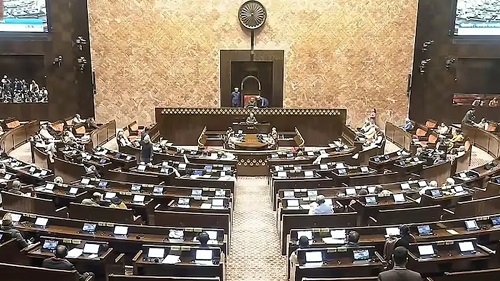
The Election Commission of India on Friday announced elections for 24 Rajya Sabha seats spread across 10 states, with polling scheduled for June 18 and results to be declared the same day at 5 pm. The biennial elections are being held as several sitting members of the Upper House are set to retire between June 21 and July 19.
The elections will take place for four seats each in Andhra Pradesh, Gujarat, and Karnataka; three seats each in Madhya Pradesh and Rajasthan; two in Jharkhand; and one seat each in Manipur, Meghalaya, Arunachal Pradesh, and Mizoram.
The announcement has triggered intense political activity, with major parties beginning internal consultations over candidate selection and alliance arithmetic. The ruling National Democratic Alliance (NDA) appears comfortably placed to retain its numerical advantage in most states, while regional parties are also expected to play a decisive role in a few contests.
Among the prominent leaders completing their Rajya Sabha terms are former Prime Minister and Janata Dal Secular leader H. D. Deve Gowda and Congress president Mallikarjun Kharge, both representing Karnataka.
Other notable retiring members include Union ministers Ravneet Singh Bittu and George Kurian, senior Congress leader Digvijaya Singh, and Congress leader Shaktisinh Gohil.
From Andhra Pradesh, Yuvajana Sramika Rythu Congress Party members Alla Ayodhya Rami Reddy, Pilli Subhash Chandra Bose, and Parimal Nathwani are retiring, along with Telugu Desam Party member Sana Satish.
The BJP will also see several members retiring, including Nabam Rebia from Arunachal Pradesh, Deepak Prakash from Jharkhand, K Narayan and Iranna B Kadadi from Karnataka, Sumer Singh Solanki from Madhya Pradesh, Leishemba Sanajaoba from Manipur, and Rajendra Gehlot from Rajasthan.
Regional parties too will witness key retirements, including National People’s Party member Wanweiroy Kharlukhi from Meghalaya and Mizo National Front’s K Vanlalvena from Mizoram.
The Election Commission released the detailed election calendar for the biennial polls:
The outgoing composition of these 24 seats heavily favours the NDA, which currently holds 16 of them. The BJP alone accounts for 12 seats, while its allies — the National People’s Party, Janata Dal Secular, Mizo National Front, and Telugu Desam Party — hold one seat each.
The INDIA bloc currently has five members among the retiring MPs, including four from the Congress and one from the Jharkhand Mukti Morcha. One Rajya Sabha seat from Jharkhand has remained vacant since the death of former Chief Minister and JMM patriarch Shibu Soren last year.
Political calculations suggest that the NDA is likely to maintain its tally. The BJP is expected to sweep all four seats in Gujarat and secure strong performances in Madhya Pradesh and Rajasthan. In Andhra Pradesh, the NDA alliance led by the Telugu Desam Party is expected to dominate all four seats.
In Karnataka, the contest may witness strategic coordination between the BJP and its ally JD(S), while regional equations in Tamil Nadu are generating fresh interest after indications that Chief Minister C. Joseph Vijay’s Tamilaga Vettri Kazhagam could potentially open its account in Parliament in the near future.
Alongside the Rajya Sabha elections, bypolls for two vacant seats in Maharashtra and Tamil Nadu will also be held on June 18.
The Maharashtra seat fell vacant after the resignation of Nationalist Congress Party president Sunetra Ajit Pawar, who subsequently won the Baramati Assembly by-election following the death of her husband and Maharashtra Deputy Chief Minister Ajit Pawar earlier this year.
In Tamil Nadu, the vacancy arose after AIADMK rebel leader C. Ve. Shanmugam resigned from the Upper House to retain his Mailam Assembly constituency seat.
With the Rajya Sabha playing a crucial role in the legislative process, the upcoming elections are expected to further consolidate the BJP-led NDA’s influence in the Upper House while also offering regional parties an opportunity to strengthen their parliamentary presence.



















Leave Your Comment