


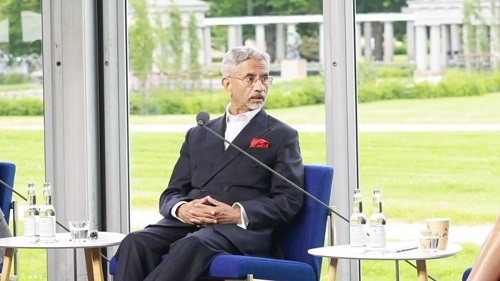
External Affairs Minister Dr. S. Jaishankar on Friday strongly defended India’s decision to purchase Russian oil following the outbreak of the Ukraine war in 2022, while accusing Western nations of applying double standards when judging India’s energy choices. Speaking at the Kultaranta Talks in Finland during a discussion on “Emerging Powers and the New Geopolitical Competition,” Jaishankar asserted that India’s energy decisions are guided solely by national interest, affordability, and availability.
Responding to criticism from European countries over India’s imports of discounted Russian crude, Jaishankar explained that global market conditions at the time left India with limited options. He noted that European nations had largely shifted their focus to oil supplies from the Middle East, traditionally one of India’s major sources of energy imports, which in turn pushed India toward Russian supplies.
“I buy oil based on cost and availability. At that point of time, much of the oil available in the market was Russian because Europeans were essentially buying oil from the Middle East, which was our traditional supplier. So circumstances pushed us in a certain direction,” Jaishankar said.
The External Affairs Minister also took aim at Europe’s stance on security matters, drawing attention to Western military exports to countries that have historically posed security challenges for India. In a sharp remark, he contrasted India’s conduct with that of European nations.
“No European country has been attacked with Indian weapons. I wish I could say that for Europe weapons vis-à-vis India,” he said. “Europe sells weapons, which are used to attack India. Not just now but for many years. We Indians have never done anything to endanger Europe. I think that’s a reasonable point.”
Jaishankar’s comments highlighted New Delhi’s long-standing concerns regarding arms sales by Western nations to Pakistan and other regional actors, even as those same countries criticize India’s economic engagement with Russia.
Addressing broader geopolitical developments, Jaishankar said that ongoing conflicts across the world, including the Russia-Ukraine war and tensions involving Iran, have consequences that extend far beyond their immediate regions. He stressed that diplomacy and dialogue remain the only sustainable solutions to global conflicts and warned that prolonged instability could have serious implications for global trade, energy security, and economic growth.
The minister further emphasized the importance of building resilient supply chains in an increasingly uncertain world. According to him, countries must focus on “de-risking and diversifying” critical supply networks while creating greater resilience and redundancy to withstand geopolitical shocks.
Jaishankar also revealed that during the early phase of the Ukraine conflict, the United States itself encouraged India to continue purchasing Russian oil in order to prevent a major disruption in global energy markets. He argued that this demonstrated the practical realities that often shape international policy decisions.
“At that time, the US directly asked India to buy Russian oil to stabilise the oil market. We buy oil based on cost and availability,” he said.
Referring to changing American policies on Russian energy, Jaishankar suggested that geopolitical decisions are often driven by pragmatism rather than principle. “Right now, if you see, after having first put tariffs on us for buying Russian oil, the US then again lifted its sanctions. Let’s not pretend there’s some great principle involved here. I don’t think making this about sanctimony is really warranted,” he remarked.
The minister’s comments come amid continuing global debates over energy security, sanctions, and the balance between national interests and geopolitical alignments. India has consistently maintained that its energy procurement decisions are made to safeguard the interests of its 1.4 billion people and ensure affordable access to fuel, particularly during periods of global uncertainty.
Jaishankar’s remarks in Finland underscore India’s growing willingness to openly challenge Western narratives on global issues while reinforcing its commitment to strategic autonomy and an “India First” approach in foreign and economic policy.




















Leave Your Comment