


Travel through the Middle East is facing unprecedented disruption, with widespread airspace closures setting off cancellations, diversions and deep uncertainty for passengers across continents. At the centre of the crisis is Dubai International Airport, one of the world’s busiest aviation hubs, which has effectively ground to a halt.
As regional tensions escalate, multiple countries across West Asia have shut their airspace, forcing airlines to reroute flights or suspend operations altogether. The ripple effect has been immediate and severe. Flights from Europe, Asia and India have either been cancelled mid-route or turned back after hours in the air, leaving thousands of passengers stranded and travel plans in disarray.
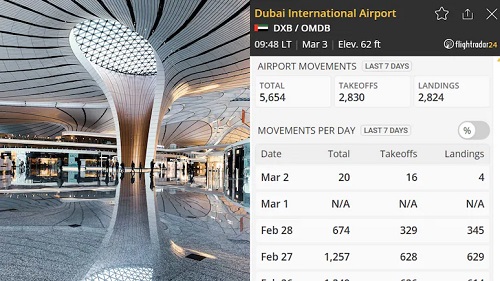
Data from March 2, 2026, paints a stark picture of the scale of disruption. According to flight tracking platform Flightradar24, just 20 total aircraft movements were recorded at Dubai International Airport that day:
16 take-offs
4 landings
To put this into perspective, the airport typically handles well over 1,000 movements daily. In the previous week alone, it recorded 5,654 total movements, including 2,830 take-offs and 2,824 landings.
On February 27, the airport saw 1,257 movements in a single day. February 26 recorded 1,240 movements, while February 25 saw 1,236. Against those figures, March 2’s total of just 20 movements represents a near-total standstill.
Among the four arrivals on March 2 were:
EK501 from Mumbai (BOM), operated by Emirates (Airbus A380 A6-EVP), which landed at 5:11 AM
FZ968 from Baku (GYD), operated by flydubai (Boeing 737-800 A6-FEP), landing at 9:52 AM
Another flydubai service from Baku (B738 A6-FGG)
FZ970 from Baku (GYD), operated by flydubai (B38M A6-FPI), which landed at 8:50 AM
Departures were equally sparse. Among the 16 flights that managed to take off was one bound for Leipzig at 8:41 PM and another to Chennai, operated by Emirates, which departed at 9:25 PM.
For an airport that routinely dispatches hundreds of aircraft each day, these isolated movements reflect an aviation ecosystem operating in crisis mode.
The disruption has continued into today, with Indian routes significantly affected.
Emirates flights to Dubai from Chennai, Delhi and Bengaluru were diverted back to their origin cities after departure, as access to regional airspace remained restricted. Only EK501 from Mumbai successfully landed in Dubai.
Meanwhile, EK525 from Hyderabad, which was en route to Dubai, was cancelled altogether.
This marks a dramatic shift from normal operations, where multiple daily services connect Indian metros with Dubai, carrying thousands of passengers for business, tourism and onward international transit. Dubai serves as a critical gateway for travellers between India, Europe, North America and Africa. With airspace closures tightening, that connectivity has been severely compromised.
The shutdown of key air corridors in the Middle East has triggered knock-on disruptions far beyond the region. Aircraft have been forced into longer, fuel-intensive reroutes, while others have returned to origin airports after spending hours airborne. Airlines are grappling with crew duty time limits, aircraft positioning challenges and cascading delays across global networks.
For passengers, the situation remains fluid and uncertain. With cancellations mounting and alternative routes limited, many face extended layovers, rebooking struggles and unclear timelines for resumption of normal services.
For now, Dubai International Airport—usually a symbol of relentless, around-the-clock connectivity—stands as a stark reminder of how geopolitical instability can swiftly paralyse even the most robust global transport hubs.





















Leave Your Comment