


We are truly witness to a revolution in military affairs, unfolding in the conflict zones. It is disrupting the manner in which the armies have traditionally engaged their adversaries. This change can be felt in the ongoing Russia-Ukraine War and Israel’s campaign in the Middle East. In a brief period of three years and these two major conflicts the Unmanned Aerial Vehicle (UAV), Remotely Piloted Vehicle (RPV) and Drones have emerged as a battle winning factor. The UAVs and RPVs were considered niche platforms, preserve of advanced armies, who could employ these for surveillance and offensive tasks. Then the drones appeared as a great leveler and poor man’s weapon of choice and the answer to the dominance wielded by advanced nations on the battlefield.
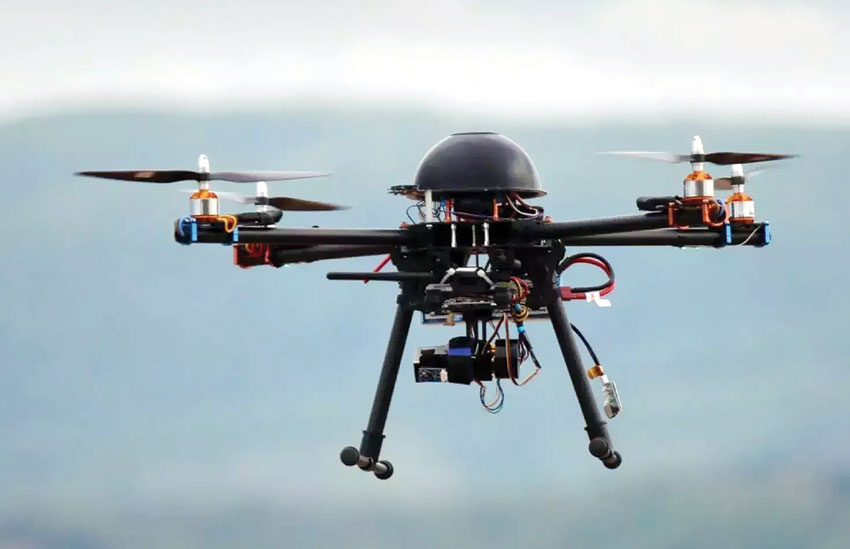
Drones are everywhere. The entire airspace is cluttered with these whining machines. Drones are loitering at the high, medium, low and tree top altitudes looking for their prey. These are also skimming the sea surface and lurking in the depths below. In the battle devastated Ukraine, drones are being assembled and produced in the basements, schools and blown off buildings to meet the growing demand at the heavily contested frontlines. Simplicity and duality of use of drones is the major cause of their proliferation.
The Unique Selling Proposition of drones is their simplicity and cost effectiveness. As a weapon, these are better than precision guided munitions in terms of range, lethality and of course precision of strike. A loitering munition costing a few hundred dollars can be a nemesis for a million dollar formidable battle tank, piece of artillery and such military hardware.
Ranges attained by these whining machines are simply awesome. From a few hundred meters in the Tactical Battle Area (TBA) the drones are traversing more than 1600 kilometers to strike a target. Likewise, these also demonstrate impressive endurance capability.
In terms of usage drones are versatile. These are reusable, but that calls for a higher degree of technological sophistication and operational and logistics infrastructure in the battlefield for their launch and retrieval. A majority of drones, therefore, are disposable. Low cost of production facilitates such ‘use and throw’ employment.
Drones can navigate just like any aircraft or missile or smart munitions. These are autonomous or controlled from a ground control centre. This ability makes these a contender for the top spot and weapon of choice against high value sophisticated munitions.
Drones have changed the rules of air defence. Irrespective of the global standing of a country in terms of its ability to defend its impregnable skies swarms of drones can breach the air defence to reach the target. Using low cost and locally manufactured drones, Ukraine has successfully hit many high value targets inside Russia including the seat of power, Moscow. Drones have made the frontlines as well as the hinterland equally vulnerable to air attacks, compelling nations to review their air defence strategies.
The TBA has become most vulnerable to the employment of drones. It has empowered a weak enemy over its adversary. Battlefield surveillance and domination through the third dimension has got a whole new meaning through the employment of drones in the TBA. It may be laughable but in the Russia-Ukraine War drones are being used in anti-personnel role also. A video of a Russian soldier begging mercy from a loitering drone is perhaps the most profound statement of things to come in future. First Person View (FPV) drones are causing havoc at the frontlines by engaging patrols, bunkers, tanks, artillery guns, vehicles and logistic echelons with deadly accuracy.
The fear of ‘top attack’ has forced tanks, guns and other armoured vehicles to carry canopy over them making the mockery of the age old dictum of acquiring low silhouette in the battlefield.
What India should learn from all these sudden developments? There is going to be a drone proliferation in our neighborhood. China has placed order with its local manufacturers for one million battlefield drones. Pakistan has acquired drones from China, Turkiye and even Iran. Bangladesh has also got some drones from Turkiye. Pakistan has been using drones (quad copters) against us for drugs and arms smuggling in Punjab and Jammu and Kashmir.
Menace of drones in the battlefield and hinterland is here to stay. It will proliferate exponentially. It expected to gather more technological sophistication and lethality in the coming years. It cannot be dealt with improvisation. It has made our hinterland which house critical infrastructures, and are bereft of air defence most vulnerable.
India should build up a credible organization for using drones as a weapon of choice against the enemy. As far as counter drone measures are concerned a dedicated air defence grid would be needed to ward off the swarms of drones which would also provide cover to the hostile missiles and aircrafts aimed at our hinterland. For us, undertaking a proactive, time bound and technically sound counter drone project is the necessity of the time.

By Colonel Utkarsh Singh Rathore
(Colonel Utkarsh Singh Rathore is an infantry officer and a defence and security analyst.)
(The content of this article reflects the views of writers and contributors, not necessarily those of the publisher and editor. All disputes are subject to the exclusive jurisdiction of competent courts and forums in Delhi/New Delhi only)





















Leave Your Comment