


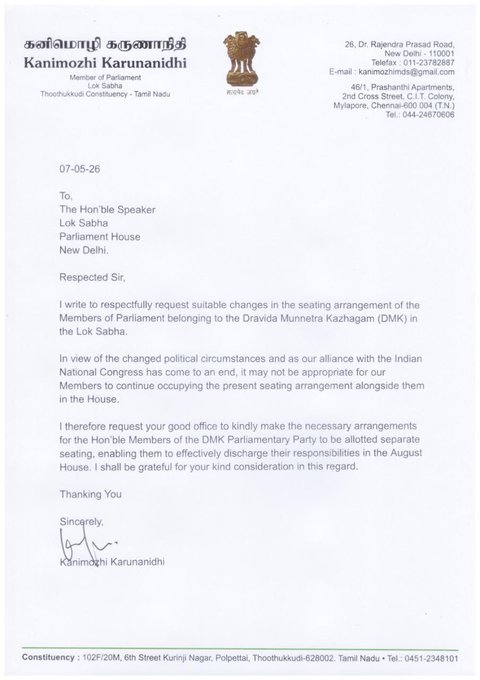
A fresh political realignment in Tamil Nadu has now echoed inside Parliament, with the Kanimozhi Karunanidhi formally requesting a change in the seating arrangement of Dravida Munnetra Kazhagam (DMK) MPs in the Lok Sabha following the collapse of the party’s long-standing alliance with the Indian National Congress.
In a letter addressed to Lok Sabha Speaker Om Birla, Kanimozhi stated that the “changed political circumstances” made it inappropriate for DMK members to continue sharing seating space alongside Congress MPs in the House. The request comes just days after the Congress officially ended its nearly two-decade alliance with the DMK-led Secular Progressive Alliance (SPA) in Tamil Nadu.
Kanimozhi urged the Speaker to arrange separate seating for DMK parliamentarians so that they could “effectively discharge their responsibilities” in the Lok Sabha. Though the request may appear procedural, it carries strong political symbolism, underlining the widening distance between two parties that had once been among the strongest allies in southern India.
The break between the Congress and the DMK marks one of the most significant political shifts in Tamil Nadu in recent years. The Congress decided to back actor-turned-politician Vijay and his newly emerging political platform, Tamilaga Vettri Kazhagam, for the upcoming political battles in the state. The Congress justified its decision by describing the move as an effort to unite secular and constitutional forces against what it termed “communal politics.”
The DMK, however, reacted sharply. Senior leaders accused the Congress of abandoning long-standing allies for short-term political calculations. Party representatives argued that despite the DMK accommodating Congress within the alliance — including supporting its representation in the Rajya Sabha and allocating assembly seats — the national party chose to shift sides at a politically sensitive moment.
The collapse of the alliance is particularly notable because the DMK and Congress have shared a close electoral partnership for nearly twenty years, especially in Lok Sabha elections. Together, they formed a formidable anti-BJP bloc in Tamil Nadu and played a key role in shaping opposition politics at the national level. The separation therefore signals not only a state-level rearrangement but also a broader reshaping of opposition politics ahead of future parliamentary contests.
Political observers believe the seating request in Parliament is intended to send a clear public message: the DMK now wants to project itself as an independent political force rather than as part of a Congress-led opposition grouping. Seating arrangements in legislatures often reflect political alignments, and changes in seating are closely watched as indicators of shifting alliances and parliamentary equations.
The Congress decision to align with Vijay’s TVK has also intensified speculation about the emergence of a new opposition space in Tamil Nadu politics. Vijay, one of Tamil cinema’s biggest stars, has increasingly positioned himself as a challenger to both the DMK and the BJP, appealing particularly to younger voters and urban constituencies.
For the DMK, the Congress exit may complicate coalition arithmetic but also offers an opportunity to consolidate its own identity without accommodating national allies. For Congress, the gamble on Vijay reflects an attempt to reinvent its relevance in a state where it has struggled to maintain an independent political base.
As Parliament prepares for future sessions, even the seating arrangement inside the Lok Sabha may now serve as a visible reminder of the changing political equations in Tamil Nadu and the evolving dynamics within India’s opposition landscape.



















Leave Your Comment