


Dr. Sandili Maharaj-Ramdial
At the outset I will like to assert that the emphasis in historical studies has been overshadowed by economic and political analysis whereas the psychological analysis is not only missing but intentionally ignored too. Understanding the psyche and practice of attacks and discrimination to dominate and subjugate Hindus, and in retaliation the psyche of resistance of the oppressed to free oneself is essential to have an accurate picture, not just of the historical past of human trafficking, but the trauma our present generation of People of Indian Origin face even today. Have the oppressive practices and discrimination stopped? Have conversions stopped or does the present generation receive better treatment from our motherland? Answers to such questions are to be found by not just using economic, social or political tools but by going to the root that generates human behaviour, which is the psyche.
In a small island, 7 miles off the coast of Venezuela in South America, lies the southernmost Caribbean twin islands of Trinidad and Tobago. The original inhabitants were the indigenous Amerindian tribes, who faced genocide at the hands of the Spanish conquistadors in the 15-16thth centuries. Their culture is now forever erased. The void of their presence was filled by another colonial power, Britain, who saw human life as a resource for their own material gain, and hence African slavery begun in Trinidad, bringing thousands across the Atlantic. But despite being the now majority ethnic group in the country, the Africans did not retain their ancestral culture, including language or religious beliefs. They were targeted for conversion by British as well as Spanish and even French colonists, following the fleeing of French aristocrats after the French Revolution, even to this part of the world.
But with the passing of the Emancipation Act for slavery in 1838, came the need to continue the economic benefits for Britain: on paper, granting emancipation but in practice, simply replacing one
ethnicity for another for their own personal profit. Due to the United Kingdom’s urgent need to break Indian unity which climaxed into the 1857 fight for Indian Independence and all subsequent efforts until 1947, the British contrived to remove Indians across north India to the West Indian region. With this begun a new form of discrimination towards Indians: this time far away from their ancestral homeland and with no familiar social support as they had always had in their motherland. But what kind of discrimination?
Some years ago, when I began my PhD, I was exploring the causal factors for the ailments and complaints manifested among my patients. While some complaints are universal, like depression, alcoholism, anxiety and domestic violence, the origins of these in any given person or society is not. Over the years in clinical practice, I noticed that patients were displaying tendencies linked to adjustment disorders, addictive traits and depression, with shared causal origin. I realized that the Analytical Psychology, Gestalt and Freudian models of therapy so popular in the West and in which I had been trained, were ill-suited to analyse and address the symptoms displayed in my patients. Something more culturally relevant was required and the patients themselves showed me that need.
They were visiting pundits and sadhus and sadhuwines: i.e. traditional Hindu healers. This offered them more social support and greater understanding as pundits often remained in a family for generations, and were more accessible and affordable. Most importantly, these traditional practitioners offered insight which patients hesitated to speak about openly in a clinic setting. The depression of one patient for example, was due to underemployment despite years of hard work and increasing qualifications. He
found that his applications for promotion were repeated sidelined because of he having both first and last names as Hindu. In Trinidad, it usually demonstrated someone was not converted and still a Hindu. His address was from a predominant Hindu area and he hadn’t participated in drinking with colleagues at work events. But he hesitated to speak of these things because in Trinidad he would be told he was racist. A pundit however would understand almost immediately and implicitly.
It meant that our society was continuing to oppress despite us being independent and even our voices were being silenced, just as during colonial rule. Domestic violence too, was a learnt response to stress: learnt from generations of men themselves physically beaten by overseers and taking it out so to speak on their wives, with sons witnessing it. Alcoholism was a negative coping mechanism from lives on the estate with no way to return to India during or even after the indentureship and independence eras.
Elderly patients too were dismayed that their children for whom they struggled and sacrificed, were now happy to convert and would not be performing their last rites according to tradition. It had larger repercussions too: Pitra Paksha or the yearly shraddha ceremony would no longer be practiced in those families, which was an insult for a culture which venerated elders and ancestors. Halloween was being celebrated, while Pitra Paksha was being forgotten, just like Carnival, instead of Shiv Ratri and new year fetes, instead of new year pujas.
There was so much linked to our past as the Indian community, which was being demonstrated here among patient complaints in the present. I felt it was an intrinsic duty to raise awareness of this, so at least patients in cultures outside of the Euro-American mainstream could get relevant and meaningful health care, and then I realized here was another form of discrimination against us. Our mental and physical health was still in the hands of the oppressors, not in our own. Medical imperialism existed by degrading our own traditional health systems and practitioners and we suffered as a result. Our cures, from ailments given by the oppressors, could only be through they themselves apparently.
The bigger shock though came when I went to Suriname to present these findings. Another regional former planation colony, with an Indian diaspora population as Trinidad’s, I was astonished that half the audience raised an uproar denying the clinical observations. I was told that we Indians were now superheroes of a sort, and had no link with a dirty, weak, backward past. No one displayed psychological disorders and if I wanted to validate my findings that epigenetics, and trans generational haunting ie that our historical ancestral experiences, shape us even today, that I should indulge more in past life regressions with patients. That would be acceptable evidence, not the lived experiences of people in this life itself.
Oddly enough, the ones who opposed so vehemently, were the ones in positions of academic authority and other socio-economic positions. Living in ivory towers for years, they projected association with the still practicing Hindu majority, though barely ever associating with them. The stigma, ostracization, discrimination and iconoclasm they were themselves perpetuating was now another tool of oppression, this time, towards their own.
But my field is psychology, so the more they denied, the more they actually/acutely reinforced the findings of other researchers on the shame of the colonized or colored people. They wanted to distance themselves so much from being Hindu and Indian, and praise the culture of the West which they had imbibed, that they emphasized how they did indeed recognize that Hindus in our own countries, were targets of discrimination and second class treatment even in the present.
But the dynamics didn’t stop there. Even more revealingly, was the other half of the audience: those who were not from the political or academic world. The ones who came up quietly to me afterwards, apologizing for the antagonistic outbursts from the others. They shared their own stories with me. Stories which resonated and repeated the ones I had already been hearing from patients in Tdad. Stories telling of the difficulty in finding employment pq of one’s religion. Stories of having to change their
children’s religion on forms before exams, to ensure their entrance into elite schools for a better education. Stories of needing to migrate to the Netherlands, the US or UK, for better opportunities. Stories of anxiety and depression in schools and workplaces pq of one’s religion, statements made of one’s appearance, name, food and the higher levels of violent crime directed towards them. And the addiction to drinking in an attempt to deal with stress, and the accompanying physiological diseases of cardiac ailments and diabetes as a result.
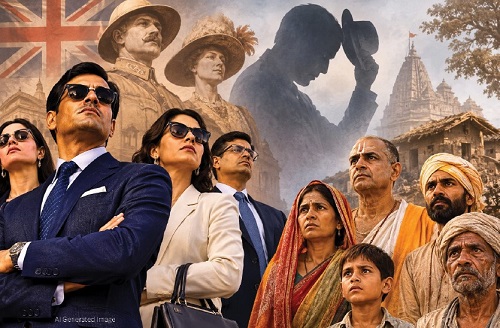
The only person who stood up at that time to defend the research that yes, colonial rule was oppressive, not benevolent, was Prof Kapil Kumar. An academician from India, the country which faced the worst and longest trauma at the hands of the British. How could we, Indians who were living outside India, praise the very system, which cast us outside India to begin with? And instead of justifying that it was a blessing in disguise because of all the backwardness, superstition and dirt of India, why didn’t any of these top regional academicians ever ask their own grandparents, our own elders, when you say India was poor that is why you left, why didn’t you bother to ask them why was India poor? Why was your family poor? Where was the most basic follow up question in so called oral history research? So who were our oppressors now? The ones who tore us from our homeland or those who insisted our homeland deserved being torn away from?
Was it just the former colonial powers who had practiced malicious or unjust treatment? Wasn’t this subversive Institutionalized oppression within our midst?
Was Authoritarian oppression just a top down approach then, of foreign rulers towards us with the destruction of life and land as their legacy in India, kidnapping to replace the loss of free slave labour, the separation of families in India and on plantations; the inhumane and barbaric treatment meted out in colonies, the prohibition of cremation, marriage recognition rights, inheritance rights, education, medical care and familiar food, or was it the so called independent governments who had simply continued this neo colonial legacy of Socioeconomic, political, legal, cultural oppression? Who was it? And was it just those 2 groups?
Oppression may be overt or covert, and here was a third level. The ones among us who had mirrored themselves as the newest successors in the image of the colonial rulers and whose psyche had now also adopted the disdain for those of us who had not adopted the attitude, ,religion or lifestyle of those rulers or their handpicked independent era substitute rulers. This third group was displaying the shame of the colonized people. The desire to distance themselves from India and Hinduism, from Brahmins by boat not birth, and supposed rampant casteism and pain and poverty, highlighting selectively instead only their perceived self-made success.
What is the repercussion of this? Social oppression by our own who are antagonistic in supporting members of their own former community. While others support the businesses or employ their own community members, this group was actively rejecting those who were qualified or in need, simply to project secularism or neutrality, to reinforce to themselves that they had indeed made the right decision in their conversion, either openly or by lifestyle. They benefitted from privilege, which they didn’t want
to share. This played into the hands of the racial oppression already in use by the indentured and independent era governments. So were these people our own who were now extending class discrimination and religious intolerance to us? These who had benefitted economically and wanted to emphasize there existed a defining line between us and them?
For the first time, I heard of the viraha songs of India. Where we, those missing our motherland, were also being missed, and that too for generations. Why didn’t we know this? Not just because of the colonial powers who refused our return home, and intercepted letters from both sides, but by India as well. A country who in 1947 under Jawaharlal Nehru, had refused to acknowledge and accept PIO’s as Indian citizens. We had been cast off for good. India herself under Her guise of Independence, didn’t seek our own. So India too was our oppressor.
This role they nursed for 75 years. It wasn’t just their establishment’s dismissal of our existence and the persecution we faced in places like Uganda, Guyana, or Fiji, and the subvert ones in Trinidad,
Suriname…. It was also the attitude of the Indians themselves. The ones we saw as long lost family, eager to see us as we were to see them. Their hostility, jibes and alienation of us, whether in India, in third party countries such as the US or UK or Canada where our diaspora communities as both PIOs and NRIs came into contact, or even in our own countries where they lived as expats, were largely identified by distance and disdain. A repeated scorn for our UP and Bihari ancestry; our lost of language, our skin colour, the lack of servants and the perception that we are the descendants of slaves. So the oppressors kept changing forms, but never left: Like Raktabij.
So from multi-layered colonial oppressors, those who denied us via institutionalized doctrines, to the economic oppression started by them in India, maintained on the colonies and perpetuated by neo colonial governments, and our own who have become the new oppressors, and to India, we need to identify what we want to achieve and why.
The final bastion of oppressors though are we ourselves: unsure now of our role and identity. Should our children and grandchildren carry traditional names or attend our temples or abandon them and become more secular? Should they fast and observe vrats or adopt the values of the West? In that case, if they seek to join other religious groups, even extremist ones out of the void we have provided for them, a lack of tradition, culture and self-awareness, we have no one but ourselves to blame. Did our ancestors stand firm for 1000 years only for us to throw away their sacrifice now, because we simply didn’t feel like being Hindu? Did the invaders win then? And the colonizers?
Is it recognition and acceptance from India or from the lands in which we currently live that we seek? Is it from NRI’s when we travel or live in yet other countries? Is it from local governments or is it from within that we need a sense of peace that we too have a right to existence and our identity without that
long-internalized sense of shame and inferiority. Whatever our decision, we may never see the results of it, but if we do seek to maintain our religion and values, then it is for us to simply do our duty to maintain this dharma of right action, and to leave the results up to God. After all it has been 1000 years of persistent fighting for this same culture, with India only now seeing her greatness uncovered in a millenium.
(The content of this article reflects the views of writer and contributor, not necessarily those of the publisher and editor. All disputes are subject to the exclusive jurisdiction of competent courts and forums in Delhi/New Delhi only)





















Leave Your Comment