



Dr. Amar Patnaik
The foundational vocabulary of modern Indian nationalism was forged in the crucible of anti-colonial resistance, yet its legacy remains one of the most intensely contested domains of the subcontinent’s political history. At the absolute vortex of this debate sits 'Vande Mataram'—a composition that transformed overnight from a localized literary hymn into the explosive emotional fuel of the Swadeshi movement. However, the trajectory of the song under the stewardship of the Indian National Congress (INC) reveals a profound historic blunder in its misguided effortto reconcile the potent, faith-coded symbolism (in eulogy of Mother India) of the song with the demands of a section of Muslim leaders with a very fundamentalistic view of the song.
For decades, critics from conservative and nationalist quarters have argued that the Congress party's structural modifications and eventual dilution of the song's public performance amounted to a systematic denigration of a sacred national symbol. This perspective suggests that by adjusting the anthem to appease minority apprehensions, the then Congress’s political leadership fractured the emotional cohesion of the freedom struggle for a unified and strong Bharat with Nation First Credo and validated communal alienation among Indian Muslims. It not only dampened nationalistic feelings among Muslims then, but also sowed the seeds of fraction and fracture in our broader nationalism and patriotic credo post independence. What started then permeated the freedom struggle, the making of the constitution and overall governance thereafter since Congress Party formed the national government right after independence and continued for almost 30 years at a stretch and for another 30 year in different spells. Conversely, some so-called secular and pluralistic historians interpret these same policies as a display of sophisticated, essential statecraft, arguing that an unyielding enforcement of the song’s complete text would have institutionalized majorities and completely ruptured the secular baseline of the emerging republic. However, these intellectuals fail to explain how a Bharat First ideology under which all religious beliefs become secondary, could have harmed emergence of India as a strong unified monolithic behemoth of nation that broke free from the shackles of foreign domination through a unique weapon of non-violence. To understand how this symbol transformed from a rallying cry into a point of profound political divergence, one must examine its complex origins, its theological friction points, and the radical counter-blueprints proposed by the then contemporary leaders.
The Genesis: Literature, Censorship, and Spiritualized Patriotism
To dissect the political vulnerability of 'Vande Mataram,' one must return to its unique literary and historical matrix. Composed by Bankim Chandra Chattopadhyay in the 1870s and later embedded within his monumental 1882 novel Anandamath, the Vande Mataram (I bow to Mother) was never conceived as a neutral, modern civic anthem. Instead, it was an explicit exercise in spiritualized patriotism, introducing the groundbreaking and radical concept of the nation personified as the Supreme Mother Deity. Within the chapters of Anandamath, set against the grim historical backdrop of the 1770 Bengal Famine and the Sanyasi Rebellion, Bankim Chandra presented a visual and theological evolution of the motherland: the past glory of the mother as she was, the degraded present state of the mother as she is, and the triumphant, armed future state of the mother as she will be, explicitly conflated with the Hindu goddesses Durga and Lakshmi. Bankim Chandra was a Hindu; he could not have written about equivalent (doubt if they exist) Muslim or Christian Goddesses ! However, it is very important to note that even Muslim poets and writers of that times glorified, if not deified, India, Bharat or Hindustan in their own ways, in conformity with their religious sensitivities, but never allowing these narrow considerations to cast a shadow on the broader nationalistic credo.
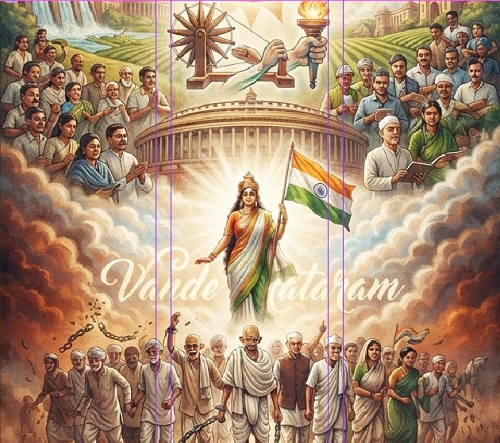
This literary framework provided early Indian revolutionaries with an immense, transcendent emotional force. Service to the nation was no longer framed as a mere political negotiation with British authorities; it was elevated to the status of an absolute, uncompromised religious duty requiring monastic vows, the renunciation of family ties, and the dismantling of caste hierarchies in service of the Divine Mother, irrespective of caste creed and even religious beliefs. Historians point out that during the 1905 Swadeshi movement against the partition of Bengal, the slogan and the song became a unifying anthem for all freedom fighters, transcending religious lines. In these early decades, prominent Muslim leaders and the general public sang the song alongside their Hindu compatriots as a challenge to British colonial rule. It was viewed fundamentally as a patriotic salute to the geography and fertility of the motherland.
However, this spiritualization was vitiated by some Muslim leaders by pointing out to a structural limitation. The novel’s plot depicted a rebellion directed against the corrupt, decaying forces of a Muslim Nawab of the Mughal era, before escalating into a confrontation with the British East India Company. While literary scholars have long argued that Bankim used the anti-Nawab setting as a brilliant, tactical narrative shield to evade severe British colonial with censorship, this historical imagery was diluted and denigrated by the Congress Party and several of its leaders, bathed in a false tense of secularism, by doing nothing to nip these divisive religious biogotric thoughts in the bud. The resulting legacy left the song permanently vulnerable to communal weaponization, making its subsequent transition into a universal national credo extraordinarily difficult.
The Congress Party’s Dilemma and the Flawed 1937 Compromise
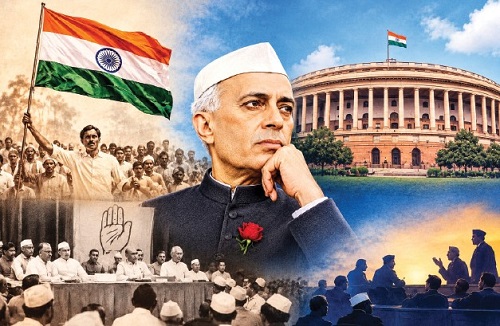
As the Indian National Congress evolved from an elite debating society into a mass-based, multi-religious coalition during the early decades of the 20th century, 'Vande Mataram' transitioned from an asset into an administrative and ideological dilemma for the Congress Party. The song had been an integral feature of Congress identity since 1896, when
Rabindranath Tagore performed a self-composed musical rendition at the party's annual session. Yet, by the late 1930s, the All-India Muslim League, under the re-energized leadership of Muhammad Ali Jinnah, systematically identified the song as a primary instrument of what they termed a majoritarian 'Hindu Raj.'
The party began a pattern of appeasement to communal forces, which ultimately weakened the core of Indian nationalism.
This two-stanza strategy was designed by Congress as a sophisticated compromise. The opening verses focused entirely on the natural bounty of the earth—its flowing rivers, abundant orchards, and cool breezes—completely omitting the later, so-called overtly religious stanzas. However, this policy failed catastrophically as an instrument of unification. Rather than bridging the widening communal chasm, the compromise alienated both blocks. To the Muslim League, the edit was viewed as an insincere, superficial political maneuver that failed to sever the song from its exclusionary literary origin in Anandamath. To Hindu nationalists, the modification was condemned as an act of profound political capitulation and minority appeasement, arguing that the leadership had compromised the integrity of the freedom movement's most sacred anthem. This was another glowing example of Congress’s myopic vision of India as a unified cultural identity rather than religious identity. This cultural identity should have been projected to have subsumed all overly fundamentalstic religious connotations in its credo, in a spirit of India First or Nation First.
The Congress Flawed Perspective : Misplaced Pragmatism and counter- nationalistic narrative-setting
The Indian National Congress and supportive historians offer a different rationale for the 1937 decision. They view the accommodation not as a denigration of the song, but as an act of essential statesmanship aimed at maintaining an inclusive, pluralistic coalition against British imperialism. Their perspective rests on the following points:
However, honoring the monumental role that Vande Mataram played in the freedom movement, India's first President, Dr. Rajendra Prasad, declared on January 24, 1950, that Vande Mataram would hold an equal status and share equal honor with the national anthem.
In contemporary Indian discourse, the legacy of the song remains a flashpoint. The current government of Bharatiya Janata Party has rightly elevated the status of the song by mandating singing of all the stanzas of the song, which is the full composition of the song, at official levels, viewing it as an uncompromised symbol of national pride. Meanwhile, the Congress party maintains its adherence to the 1937 resolution for its internal events, couching its Muslim appeasement policy as a testament to India's composite culture and pluralistic framework. But because of this historic blunder by the Congress Party and continued refusal to rectify/correct its stance over time, the country has lost forever a part of its its nationalistic credo and philosophy.
(The writer is a Former Member of Parliament, Rajya Sabha from Odisha.)
(The content of this article reflects the views of writer and contributor, not necessarily those of the publisher and editor. All disputes are subject to the exclusive jurisdiction of competent courts and forums in Delhi/New Delhi only)




















Leave Your Comment