


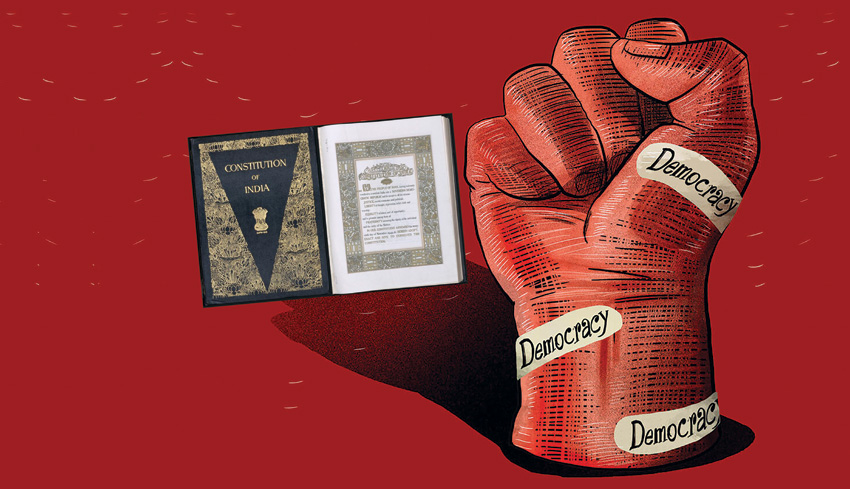
The Constitution of India was drafted by the Constituent Assembly which was elected in 1946 by the members of the provincial assemblies. It took about three years to complete this monumental task. Dr Rajendra Prasad served as the President of the Constituent Assembly and Dr. Bhim Rao Ambedkar, the Chairman of the Drafting Committee. The Constitution was adopted by the constituent assembly on 26th November 1949 and came into effect on 26th January 1950. It provides for a Parliamentary form of government which is federal in structure with certain unitary features. It is the supreme legal document of India with the framework that demarcates fundamental political code, structure, procedures, powers, and duties of government institutions and sets of fundamental rights, directive principles and duties of citizens. It is the largest written national Constitution of the world. It has a Preamble and 448 articles in 25 parts with 12 schedules and five appendices. It has been amended 106 times by now.
The Constitution replaced the government of India Act 1935 and the Dominion of India became the Republic of India. It declares India as the Sovereign, Socialist, Secular, and democratic republic, assuring its citizens justice, equality, liberty, and endeavors to promote fraternity. The original Constitution is hand written by the artists from Shantiniketan including B. R.Sinha and Nandlal Bose with calligrapher Prem Bihari Narain Raizada. Following the unanimous decision, various paintings and drawings depicting saints, gurus, and mythological characters including Sri Ram, Sita ji, Laxman ji, Sri Krishna, Guru Govind Sing ji, and Rani Laxmibai are featured in the constitution to express unique message and purpose of India’s heritage and legacy.
In the landmark Keshavananda Bharti vs State of Kerala case, the 13-judge constitution bench of the Supreme Court in 1973 ruled by 7-6 majority that while the Parliament holds broad legislative powers, it cannot alter the basic structure or fundamental features of the Constitution.
42nd Amendment Act, 1976, was enacted during emergency by the Congress government headed by Indira Gandhi. It introduced extensive changes to the Constitution in the history of free India and remains as the most controversial amendment. It attempted to reduce the powers of the judiciary, amended the Preamble, and moved the political system towards parliamentary supremacy. It curtailed democratic rights in the country and gave sweeping powers to the Prime Minister’s Office. Owing to its size, it is nicknamed as the ‘Mini Constitution. The subsequent Janata Party government headed by Morarji Desai brought about 43rd and 44th amendments to restore pre 1976 position to some extent.
Shah Bano Begum, from Indore was divorced by her husband in 1978, she filed a criminal suit in the Supreme Court in which she won the right to alimony (Rs 179.20 per month) from her husband, in 1985. This decision sparked controversy among some Muslim groups who described the judgement against the Islamic Law and they mounted pressure on the government for the verdict’s nullification. The Congress government headed by Rajiv Gandhi passed The Muslim Women (Protection of Rights on Divorce) Act, 1986 to nullify the Supreme Court judgement on Shah Bano Case. This move was widely criticized as regressive and anti- women.
Article 356 of the Constitution empowers the Union government to take direct control of the state machinery, if its government is unable to function properly. Since the adoption of the Constitution in 1950, the Union governments have invoked this article 132 times to dissolve state governments and imposed President’s rule. Congress governments used it 90 times and Indira Gandhi alone did it 50 times.
In 2024 Lok Sabha elections, the narratives of Congress ‘Samvidhan Bachao’ (Save the Constitution) and ‘this government will abolish reservations in employment and education’ were used to target the current regime, accusing it of undermining constitutional principles. This campaign influenced the voters and the party increased its seats to 99. But the same fake narratives did not work in the Maharashtra assembly elections and the Congress lost badly. The Congress’ own historical decisions such as defeating Dr. Ambedkar, the chief architect of the Constitution, twice in 1952 and 1954 Lok Sabha elections, imposing emergency in 1975 which is the darkest chapter of independent India, nullifying Supreme Court judgement in Shah Bano case in 1986, grossly misusing article 356 to dismiss the state governments has drawn widespread criticism. The Congress must prioritize pressing issues like poverty, inflation, and unemployment, rather than leveraging the Constitution for political gains. The Constitution was created by the constituent assembly and not by the parliament and was adopted by its members with a declaration in the Preamble. Parliament cannot override the Constitution. Congress, the grand old party must raise the issues related to common man and play the role of constructive opposition. Constitution does not become more significant by holding its copy in hand, as it is not merely a piece of a paper but a living document. The Constitution crafted by the veterans like Dr. Rajendra Prasad, Pt. Nehru, Maulana Azad, Sardar Patel, Dr. Ambedkar, and many more has been a guiding framework for India for 75 years and will continue to safeguard the democratic ideals and aspirations of the nation for generations to come. All political parties must attempt to uphold the constitutional values and make India a vibrant democracy without making any discrimination based on caste and religion. The constitution is supreme and immortal document and will always remain so in India.

By Manoj Dubey
Principal (Retd.)
Delhi Public Schools
(The content of this article reflects the views of writers and contributors, not necessarily those of the publisher and editor. All disputes are subject to the exclusive jurisdiction of competent courts and forums in Delhi/New Delhi only)




















Comments (3)
N
Wonderfully written article which is well researched. Our Constitution has stood strong over the years despite political upheavals from time to time. People have full faith in this "LIVING DOCUMENT" (QUOTE UNQUOTE). Thankfully Art. 356 has not been invoked since 2014. Flashing the red book at all places undermines the authority of the beating heart of our nation. Kudos to Mr. Dubey for this writeup.
S
The beautiful description of construction since1936 onwards article is good .
H
Wonderful views expressed by Mr. Manoj Dubey in this article on the journey of Constitution of India. In fact, the Government led by Congress party in the Centre, which ruled more than fifty years, has badly misused it's powers in their own interests. The architects of Constitution never had a hope about this misuse. Over the period and particularly in the present context, the opposition leadership has fallen in the hands of unmatured hands. They are playing a negative role which is very dangerous to health of democracy.