


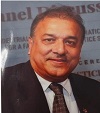
Lt Col (Dr) Atul Tyagi
“Closures/stoppages can be restrained in a democracy when they are unlawful, coercive or disproportionately interfere with the rights and safety of others. Peaceful dissent, however, must remain protected.”
Democracy is not a license to achieve whimsical aspirations. It is not an instrument to ask for removal / resignation of democratically elected government. It paves way only for lawful, fair and verifiable process and of accepting the same process when the electoral result is not what one desires. Elections are just one feature of a democracy out of a multitude of dimensions. It signifies & demonstrates constitutional morality, the rule of law, institutional independence, freedom of expression, accountability and respect for dissent. It contains constitutional responsibility, public participation and accountability. When democracy turns stale, insipid & does not appear moving on coherently on the tracks, it must be re democratised, not by pulling down the magnificent edifice but by strengthening its foundations.
Delhi occupies about 1/2,216th of India’s area (Area of India: 3,287,263 km²) so what happens here impacts rest of the state accordingly. However, it must not be lost sight of that Delhi is the capital of India & the occurrences here carry far reaching impacts elsewhere.
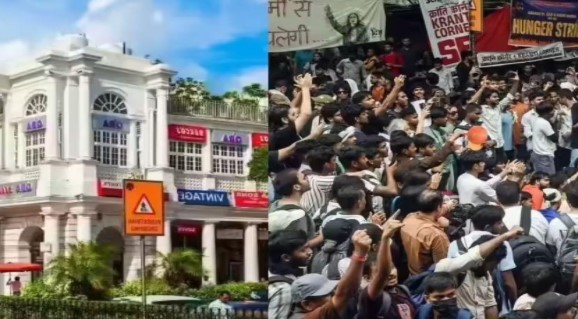
Cockroach party initiated a so called peaceful protest over a specific issue of NEET exams paper leak from 26 June 2206 to 03 July 2026 when the National Test Agency was scrapped, the Minster of Education resigned & the NEET exams were reconducted. The protesters now wished to march towards the Parliament. On 13 Oct 2026, they tried entering Jantar Mantar surreptitiously where prohibitory orders were invoked in view of most ugly, reprehensible & vile conduct demonstrated by boorish assembly of some affected & largely unaffected lot with NEET, largely arranged with money, pizzas & burgers. The new dictionary of lewd abuses was introduced by some young girls who left element of sensitivity & decorum at home when they were found hurling choicest directly piercing the holy soul of the PM’s mother. Cockroach party founder Deepke signed a bond for not indulging in any activity which may cause law & order issue for the next one year. yet within three days, his penchant for hoisting & unfurling national flag at the pivot of Connaught place forced him to receive lime light which all these new demonstrators crave for. He filled up second bond without any guilt. Prior to that Senior advocate Prashant Bhushan publicly declared about likely blood shed & regime change. Student activist Neha Bora, meanwhile, confirmed that she was much inspired from mobocracy seen in Bangladesh & thanked Bangladesh's Gen Z movement for showing the way to young protesters in India. The Kerala Congress account subsequently posted a message on X referring to the CJI, demanding his resignation and stating that the party would find a replacement. Rahul Gandhi publicly urged the CEC to turn approver and resign, alleging wrongdoing in the electoral process particularly in SIR. Rahul Gandhi further marched towards the Supreme Court & planned to present a memorandum to the CJI covering aspects not within his direct domain. Exultant seeing the crowd, he exposed his plan to seek resignation of the PM & HM after Gyanesh Kumar was forced out of office. The Apex Court took note of Opposition leader attempting to pressure the highest court surreptitiously & issued due notices. He even compared his protest marches with Shiva’s Tandavs which as per him, go on without any plan & structure. He further announced that every day some thing or the other shall be resorted to. A Senior advocate Dushyant Dave, writing about SIR, invoked Article 326 of the Constitution and criticised the exclusion of a very large number of electors. His article described SIR as a form of exclusion and questioned the removal of approximately 13 crore names from electoral rolls. Sagarika Ghose invoked Ramdhari Singh Dinkar's celebrated line, “सिंहासन खाली करो कि जनता आती है”—a powerful expression of popular sovereignty. Well, the country has witnessed a new dimension of political militancy seemingly borne out of frustration, no go ahead situation, issueless & abysmally disintegrated opposite camp in the country. In recent times. From NEET to villages, to Election process, SIR, Dictatorial ways of government & then hurling of national flag, the entire protest movement, wandered directionless & aimless from one end to another. The Opposition camp named INDIA consists of political parties upping the ante against each other in form of electoral battles in states yet it is difficult to differentiate spokespersons of these political outfits as they speak in unison against the ruling political party. With that the political spectrum is completely in a disarray & disrepair.
Issues
Issue no 1 How should electoral rolls be revised? What is precise alleged illegality in SIR? What evidence supports the allegation?
The Supreme Court addressed this question in Association for Democratic Reforms v. Election Commission of India, decided on 27 May 2026. It upheld the legality of the challenged SIR exercise in Bihar under Article 324 of the Constitution read with Section 21(3) of the Representation of the People Act, 1950.
“The EC's power to supervise electoral rolls flows from Article 324 of the Constitution, read with the Representation of the People Act, 1950, and the Registration of Electors Rules, 1960.”
SIR conducted in states after states with involvement of lakhs of state employees doing yeoman’s services to conduct elaborate transparent exercise over and above their primary government job. The election commission provided ample time & opportunity to people to get the records straight. Recently ordered SSR further provides opportunity to get omission rectified. However, it is impossible for the dead to rise up from their places of immortality & more so for the foreign nationals particularly form Bangladesh & Burma to raise their voice of dissent & expose their illegal stay. Foreign citizenship has distinct legal ill consequences for electoral eligibility. Equally, the matter of chagrin is for those who carry duplicate voter cards. Mere provision of Adult suffrage does not cover whole constitutional envisaging. An electoral roll must be both inclusive & accurate; exclusionary, to provide it authenticity & correctness. Inclusion of every eligible citizen is essential but it is the responsibility of affected citizens to initiate the necessary steps to get himself enrolled. Removal of ineligible persons is equally important step. It is not the case that every historical entry shall persist on the electoral roll for ever regardless of the issues like being dead, absent from constituency, duplicate votes, being foreigner. One ought to be Indian first & one should not be afraid to come before verifying process. Instead of helping those, these pessimistic political outfits choose to allege unsubstantiated. They may march up to the SC but hesitate to produce evidence of irregularity, if any, before the Apex Court.
“Neither the allegation of mass disenfranchisement nor the defence of the process as fault free be accepted without evidence. Electoral scrutiny be avoided to be equated with disenfranchisement.”
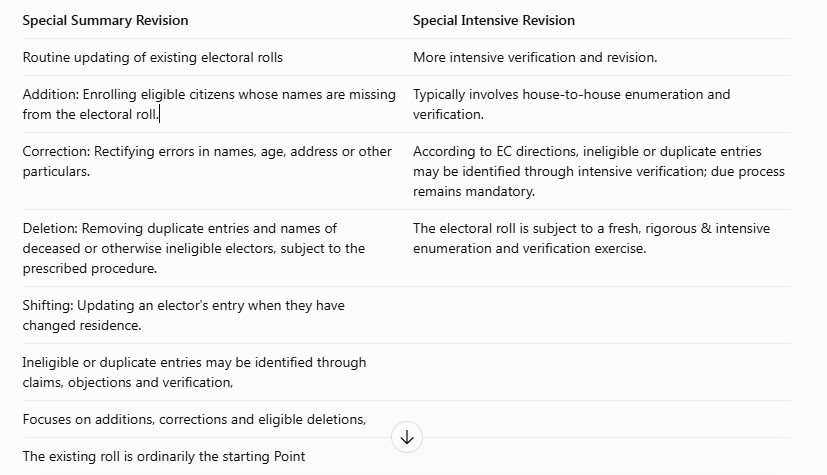
The election commission is constitutional body but it is accountable & its decisions & conduct are open to judicial review. The fact that the Booth level officers stood as front line of India’s electoral process backed by Assistant Electoral Registration Officers (AEROs) & Electoral Registration Officers(EROs) speaks volumes about the gigantic marathon exercise in the length & breadth of India. From the EC to political parties, the complete hierarchy existed however if the affected citizen did not come forward following due process, the system cannot be blamed. The electoral roll ought to have been cleansed of any error either by addition or deletion. A sound revision may be passed through following test:
The Supreme court cleared SIR in Bihar, recognizing the EC’s authority to conduct intensive revision while stressing upon the opportunity & administrative convenience were to be accorded to those whose names were to be deleted.
Issue no 2 Who determines the legitimacy of an elected government?
“The democracy is Government of the people, by the people, for the people,”
The people of India bestow democratic authority, the constitution oversees it & competent institutions adjudicate any ambiguity/ dispute. The opposition parties, activists, or protesters are not competent to declare electorally constituted Government as illegitimate & propose its removal from the road itself. The statutory process & judicial mechanism are available remedies. Can constitutional authorities be forced to resign by issuing dictates from the roads like the same may be happening in banana countries?
Issue no 3
“Question every exercise of power, prove every serious allegation, remedy established wrong but preserve the constitutional process.”
A democracy protects dissent & legitimacy both. Democracy is not the right of one political side to delegitimise the other side as it wills. It envisages an accounted for government, a responsible opposition & an institution committed to the rule of law. The constitutional authority can be castigated but with evidence. The authority needs to be impartial, transparent & accountable. The EC has come out with SSR process with draft publication, claims & objections which can be facilitated by the political parties through their ground agents instead of letting the process end & then clamour pointing out at left outs. The free & fair election process is feasible only if the stakeholders are awake & responsible for their role.
Issue no 4
“Criticism of constitutional institutions is legitimate in a democracy; falsehood, intimidation & rejection of lawful authority is another matter.”
The demand of resignation of the CEC as part of wish list is a constitutional right however Article 324 (5) & 124(4) act as shield for the CEC from the removal. The process of removal is through impeachment, a process applicable for the Justice of the higher Courts. The democratic set up of the country does not permit a rampant call from the roads for the resignation of a constitutional functionary. Institutional distrust is no remedy; evidence, due process & constitutional accountability are the essential ingredients for the removal of the CEC. Blocking entrances, threatening people or forcibly obstructing access may attract legal consequences depending on the facts, applicable law and the ingredients of any offence. approaching a court through a lawful petition is different from expecting the Chief Justice to grant a political demand through a personal meeting. The CJI does not possess a personal power to remove the CEC on the basis of a memorandum or protest.
Issue no 5
“The constitution protects dissent; it does not confer immunity for unlawful conduct.”
The maintenance of public order is expressly recognized ground of restrictions in Article 19(2), Constitution of India. The ground was inserted by the first amendment in constitution in 1951 as a measure to meet the situation which had arisen due to the SC ‘s order in Public order covers public safety & peace & tranquillity. The State must neither permit a group to hold the public hostage nor use public order as a pretext to suppress legitimate dissent. The balance between the public order & freedom of movement can be worked out by following a few guidelines as follows:
a. Designating suitable places for peaceful demonstrations.
b. Preventing intimidation, forced shop closures and obstruction of public roads.
c. Preserving access to hospitals, courts, schools and essential transport.
d. Taking proportionate action against identifiable unlawful conduct. Restrictions.
e. A peaceful protest communicates a demand; a coercive shutdown imposes that demand on people who may not support it. The first engages the freedom of dissent; the second may violate the freedoms of others.
f. The right to protest is protected, subject to lawful restrictions. The right to compel others to participate in a bandh does not exist.
h. Depending on the circumstances, the law may authorise dispersal, detention, arrest or other preventive measures.
i. Peaceful demonstration or protest is constitutionally protected, subject to lawful application.
The constitutional position in India
The Constitution protects dissent, but it does not confer an unlimited right to paralyse public life.
Constitutional Provision Significance
Article 19 does not require the
State to remain passive when
public peace is threatened; equally,
it does not allow the State to equate
every protest with a threat to public
order.
Article 19(1)(a) Protects freedom of speech and expression,
Article 19(1)(b) Protects the right to assemble peacefully without arms.
Article 19(1)(c) Protects the right to form associations and unions.
Article 19(2) Permits reasonable restrictions on speech on specified constitutional grounds.
Article 19(3) Permits reasonable restrictions on peaceful
assembly in the interests of the sovereignty and integrity of India and public order.
Article 19(6) Permits reasonable restrictions on the freedom to practise a profession or carry on an occupation, trade or business.
Article 21 Protects life and personal liberty, including interests implicated when access to emergency medical care or essential services is obstructed.
The leading authority is Communist Party of India (M) v. Bharat Kumar, (1998) 1 SCC 201.
The Supreme Court upheld the Kerala High Court's conclusion that:
a. A bandh cannot lawfully be called or enforced where it interferes with the fundamental freedoms of other citizens.
b. A political party's right to protest does not override the fundamental rights of the public.
c. A general strike must be distinguished from a coercively enforced bandh.
d. The State must neither permit a group to hold the public hostage nor use public order as a pretext to suppress legitimate dissent.
Closures and stoppages can be restrained in a democracy when they are unlawful, coercive or disproportionately interfere with the rights and safety of others. Peaceful dissent, however, must remain protected. In a constitutional democracy, no individual, union, political party or government possesses an unrestricted right to impose its will upon the public. Institutional flaws if exist, can be erased only by exposing them in rational & established manner through democratic means as enshrined in the books. Mass mobilisation on assumptive turf is no medicine to meet volatile protracted electoral limbos, if any. The multitude of actors, groups- the political & social, are swayed with varied like to start with NEET paper leak, resignations of political leadership, resignation of CEC, resignation of the PM & HM, scrapping of SIR process, freedom to hoist national flag, Court not safeguarding constitutive rules of democracy. The right to vote is not expressly enumerated as a Fundamental Right under Part III of the Constitution of India. It is a statutory right operating within a constitutional framework. The right is to be secured & facilitated under constitutional scheme instead under the democratic set up as a result of participatory role of responsible citizen. Criticism is integral to democracy; it does not envisage destruction of institutions. A democracy borne out of constitution rests on three complementary principles; Accountability, institutional independence & constitutional supremacy. A protest that picks up errors of judgement pertaining to a particular institution selectively without cogent & credible evidence threatens the edifice of democracy.
“The survival of democracy depends not merely upon who wins elections, but upon whether the winner remains bound by the Constitution, whether the opposition remains free to question, whether institutions remain capable of scrutiny, and whether citizens remain willing to defend their own rights.”
[ The article is inked by Lt Col (Dr) Atul Tyagi, Practicing Advocate, Professor of Practice & Author. The article is conceptualized in the light of recent protests initiated by Cockroach Janta Party( CJP), its directionless & loss of purpose & credibility.]
(The content of this article reflects the views of writer and contributor, not necessarily those of the publisher and editor. All disputes are subject to the exclusive jurisdiction of competent courts and forums in Delhi/New Delhi only)




















Leave Your Comment