


The political landscape of the state from 1977 to 2011 was dominated by the Left Front, primarily led by the Communist Party of India (Marxist) (CPI-M). This era began after India’s Emergency ended, a period that saw public dissatisfaction with the Congress government help the Left Front rise to power. Under leaders like Jyoti Basu (1977–2000) and later Buddhadeb Bhattacharjee (2000–2011), the Left Front established one of the world’s longest-lasting democratically elected communist governments. The early years of Left rule focused on land reforms, particularly “Operation Barga,” which strengthened sharecroppers' rights and improved rural livelihoods. Decentralisation through Panchayati Raj institutions also increased grassroots democracy. However, by the late 1990s and 2000s, the Left Front faced criticism for industrial stagnation, unemployment, and governance fatigue. A major turning point came with the industrialisation drive under Buddhadeb Bhattacharjee, which led to controversial land acquisition efforts in places like Singur and Nandigram. Violent protests and public backlash weakened the Left’s support base, particularly among farmers. This political vacuum was filled by the All India Trinamool Congress (TMC), led by Mamata Banerjee. After years of grassroots mobilisation and anti-Left campaigns, Banerjee achieved a historic victory in the 2011 state elections, ending 34 years of Left rule. She has remained the dominant political figure in West Bengal, winning consecutive elections in 2016 and 2021.
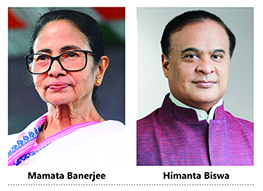
In recent years, the political landscape has become more competitive with the rise of the Bharatiya Janata Party (BJP) as a major opposition force. The BJP significantly expanded its presence in the state, especially during the 2019 general elections and the 2021 assembly elections, positioning itself as the main challenger to the TMC. Meanwhile, the Left Front and the Indian National Congress have experienced a decline in influence and are struggling to regain their previous political relevance. The state has a unicameral legislature, comprising 294 members. West Bengal elects 42 members to the Lok Sabha and 16 to the Rajya Sabha.
The elections for the next assembly will be held on 23rd and 29th April 2026. Mamta Banerjee’s governance has focused on welfare schemes such as Kanyashree, Sabuj Sathi, and Swasthya Sathi, aimed at improving social indicators and consolidating support among women and marginalised communities. However, her tenure has also faced criticism over allegations of corruption and political violence, concerns about law and order, limited industrial growth, strained relations with the central government, and governance challenges. In the upcoming elections, the opposition will raise the welfare-versus-development issue, emphasising job creation and industrial growth. Identity politics, including religion, minority outreach, border security, and voter list revision (SIR), will be part of the campaign.
The Bharatiya Janata Party has become the main rival to the TMC. Its prospects are better than in previous decades because of increased grassroots support and a unified vote base. Shubendu Adhikari, who shifted from TMC to BJP, is a strong leader in West Bengal but is not as popular as Mamta Banerjee.
Political discourse in West Bengal today is characterised by fierce electoral competition, identity politics, and debates over governance, development, and federal relations. Despite challenges, the state continues to play a vital role in India’s democratic fabric, known for its high political awareness and active participation. West Bengal’s political journey over the past fifty years has shifted from extended Leftist rule to regional party dominance, with emerging national-level competition shaping its future path.
Assam
The political history of Assam over the past 50 years has been shaped by movements around identity, migration, insurgency, and changing party dominance. In the late 1970s and early 1980s, Assam experienced a major mass movement led by the All Assam Students' Union (AASU) against illegal immigration, mainly from Bangladesh. This movement resulted in the signing of the Assam Accord between AASU leaders and the central government. Afterwards, the Asom Gana Parishad (AGP) came to power in 1985, marking the rise of regional politics. However, the state also faced insurgency, especially from the United Liberation Front of Asom (ULFA), which sought independence. The 1990s saw political instability, President’s Rule, and counter-insurgency efforts. During this time, the Indian National Congress regained dominance under leaders like Tarun Gogoi, who served as Chief Minister from 2001 to 2016 and brought relative stability and economic progress. A significant political change happened in 2016 when the Bharatiya Janata Party formed its first government in Assam, ending Congress's long-standing dominance. Leaders such as Sarbananda Sonowal and later Himanta Biswa Sarma played crucial roles in broadening the BJP’s support base.
Recent politics has been shaped by debates over identity and citizenship, especially after the implementation of the National Register of Citizens (NRC) and the Citizenship Amendment Act (CAA), which sparked protests across the state. Himanta Biswa Sarma has served as the Chief Minister of Assam since 2021. Known for his strong administrative style and political strategy. Sarma began his political career with the Indian National Congress, where he was a close associate of former Chief Minister Tarun Gogoi. He held important ministerial portfolios and was considered a powerful leader in the state. He left Congress in 2015 and joined the Bharatiya Janata Party (BJP).
After joining the BJP, Sarma became a key architect of the party’s expansion in Northeast India. He played an essential role in forming the BJP-led government in Assam in 2016 under Sarbananda Sonowal and later succeeded him as Chief Minister.
His tenure has also been characterised by firm stances on issues such as illegal immigration, the implementation of the National Register of Citizens (NRC), and the Citizenship Amendment Act (CAA). While supporters praise his decisive leadership and governance, critics express concerns about communal polarisation and controversial statements. Himanta Biswa Sarma remains one of the most influential political figures in Northeast India today. The state has 14 Lok Sabha and 7 Rajya Sabha seats in Parliament. The Assam Legislative Assembly is unicameral, comprising 126 members.
The elections to form the next Assam assembly will be held on 9th April 2026. One of the most significant issues remains illegal immigration and identity politics, a long-standing concern in Assam’s politics. Debates around land rights, eviction drives, and cultural identity continue to influence voter sentiment. Citizenship-related issues, including the National Register of Citizens (NRC) and Citizenship Amendment Act (CAA), remain politically sensitive and polarising. Economic concerns such as unemployment, rising prices, and lack of industrial growth are also major electoral factors, especially among youth. Welfare politics is another key theme. Schemes like direct financial aid to women have strengthened the ruling government’s support base. Additionally, peace and security have gained importance after recent agreements with insurgent groups, which the government highlights as a major achievement. Congress in the state faces internal conflict; recently, two senior Congress leaders have joined the BJP.
Keralam
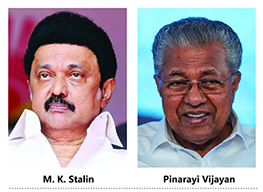
Kerala, recently renamed Keralam, has been characterised by stability, high political awareness, and a distinctive pattern of alternating governments between two major coalitions: the Left Democratic Front (LDF) and the United Democratic Front (UDF). Since the late 1970s, politics in Kerala has primarily revolved around these two alliances. The LDF, led by the Communist Party of India (Marxist), embodies leftist and socialist ideologies, while the UDF, led by the Indian National Congress, advocates centrist and liberal policies. Power has typically shifted between these groups every five years, reflecting a politically aware electorate. Influential leaders such as E. K. Nayanar, Oommen Chandy, and V. S. Achuthanandan have shaped the state's trajectory. Recently, Pinarayi Vijayan of the CPI(M) made history by leading the LDF to consecutive victories in 2016 and 2021, breaking the traditional cycle of alternation.
Kerala’s politics has focused on welfare, social justice, education, and healthcare, contributing to its high human development indicators. Land reforms, literacy campaigns, and decentralisation policies have been key milestones. However, issues such as unemployment, migration to Gulf countries, and political violence between party cadres have also been significant concerns. Kerala’s political history over the past five decades reflects a mature democracy characterised by ideological competition, coalition governance, and strong public participation. The state elects 20 members to the Lok Sabha and 8 to the Rajya Sabha. The Kerala assembly has 140 seats.
The voters of the state will exercise their right to elect the next assembly on 9th April 2026. One major issue is anti-incumbency against the ruling Left Democratic Front (LDF), which has been in power for two consecutive terms. While Chief Minister Pinarayi Vijayan seeks a historic third term, sections of voters show fatigue with a decade-long rule. Governance and development remain central. The ruling LDF emphasises welfare schemes, infrastructure, and crisis management, while the United Democratic Front (UDF) raises concerns about unemployment, rising prices, and alleged administrative lapses. Issues such as Sabarimala, corruption allegations, and land decisions have also sparked debate. The UDF faces leadership conflicts and a lack of a clear chief ministerial candidate, which may weaken its prospects. The rise of the Bharatiya Janata Party (BJP) and NDA is also significant. Although historically weak in Kerala, it is trying to expand its base through strong candidates and recent local-level gains.
Tamil Nadu
The political history of Tamil Nadu has been dominated by Dravidian politics, mainly led by two major parties: the Dravida Munnetra Kazhagam (DMK) and the All India Anna Dravida Munnetra Kazhagam (AIADMK). These parties originated from the Dravidian movement, which stressed social justice, regional pride, and opposition to the imposition of Hindi. From the late 1960s onward, the DMK under M. Karunanidhi and the AIADMK founded by M. G. Ramachandran alternated in power. MGR’s tenure (1977–1987) signalled the rise of welfare politics with subsidised food schemes and populist measures that became a hallmark of Tamil Nadu governance.
After MGR’s death, J. Jayalalithaa became a dominant leader of the AIADMK, while Karunanidhi continued to lead the DMK. The rivalry between these two leaders shaped state politics for decades, with frequent shifts in power. Both governments focused on welfare schemes, infrastructure development, and social justice policies. Since 2016, following the deaths of Jayalalithaa and Karunanidhi, Tamil Nadu politics entered a transitional phase. The AIADMK faced internal challenges, while the DMK, led by M. K. Stalin, regained strength and returned to power in 2021. Tamil Nadu elects 39 members to the Lok Sabha and 18 to the Rajya Sabha. The state assembly elects 234 members.
Tamil Nadu will go to the polls on 23rd April 2026. The election is expected to be highly competitive, influenced by governance issues, leadership dynamics, and alliance politics.
A key issue will be anti-incumbency against the ruling Dravida Munnetra Kazhagam (DMK) government led by M. K. Stalin. While the government highlights achievements in welfare schemes, social justice, and infrastructure, the opposition raises concerns over unemployment, law and order, and allegations of corruption.
Leadership and political vacuum also play a crucial role. After the deaths of J. Jayalalithaa and M. Karunanidhi, Tamil Nadu politics has shifted to a new generation. Stalin has consolidated his leadership, while the All India Anna Dravida Munnetra Kazhagam (AIADMK) continues to grapple with internal factionalism and leadership struggles, which are affecting its electoral strength.
The role of the Bharatiya Janata Party (BJP) is another key factor. The BJP is working to expand its presence in the state through aggressive campaigning, alliance-building, and a focus on national issues, though Tamil Nadu’s strong regional identity remains a challenge. Alliance politics will be crucial. The DMK-led front, including the Indian National Congress and Left parties, seems relatively stable. In contrast, the AIADMK's alliances and its relationship with the BJP will influence opposition unity.
National parties like the Indian National Congress and Bharatiya Janata Party have had limited direct influence, usually playing supporting roles in alliances. Tamil Nadu’s political history reflects strong regional identity, charismatic leadership, and a consistent focus on welfare-oriented governance, making it one of India’s most politically distinct states.
Conclusion
In West Bengal, Mamata Banerjee is a grassroots leader who has won the previous three elections comfortably. There does not appear to be anti-incumbency against her. The BJP is not having any leader to challenge her, even though the party has a strong organisation in the state. The TMC, led by Mamata Banerjee, seems to have an edge over the BJP. Congress and the left parties are nowhere to be seen. In Assam, Hemanta Biswa Sarma, a popular leader with a mass base, is likely to continue as the chief minister. Congress has a base, but internal conflicts and a lack of clarity on leadership are major concerns for the party. In Kerala, the election is highly competitive. The LDF aims for a rare third consecutive victory; the UDF sees it as a chance to stage a comeback, and the BJP hopes to expand its footprint. The outcome will depend on voter perception of governance versus the desire for political change. In Tamil Nadu, the DMK enters the contest with an advantage due to its organisational strength and incumbency. However, anti-incumbency, opposition consolidation, and voter concerns over economic issues could make the contest closer. These elections will test whether Tamil Nadu continues its preference for Dravidian dominance or witnesses a gradual shift in its political landscape. The results of these elections will be declared on 4th May 2026. It will be in the national interest if the political parties keep a balance between welfare and development.
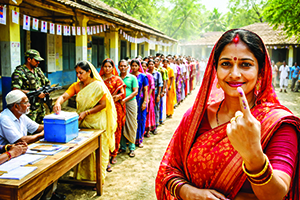
It is believed that voters in these states will turn out in large numbers to elect efficient, stable governments. The state governments play a crucial role in helping India become a developed nation by promoting growth at the grassroots level. The states can boost economic development by improving the ease of doing business, attracting investments, and supporting MSMEs and startups. Strong industrial policies and infrastructure—roads, power, and logistics—create jobs and increase productivity. Investment in human capital is essential. States must strengthen school education, healthcare systems, and skill development programs to build a healthy and skilled workforce capable of competing globally.
The effective implementation of welfare schemes promotes inclusive growth. Using digital governance for targeted delivery can reduce leakages and help marginalised communities. States are encouraged to foster innovation and sustainability by supporting renewable energy, smart cities, and digital services, aligning with national goals. Cooperative federalism is essential. By working closely with the central government and other states, sharing best practices, and maintaining fiscal discipline, states can boost overall national progress.
In sum, proactive, efficient, and transparent governance at the state level is vital for transforming India into a developed country.

Manoj Dubey
(The content of this article reflects the views of writer and contributor, not necessarily those of the publisher and editor. All disputes are subject to the exclusive jurisdiction of competent courts and forums in Delhi/New Delhi only)

















Leave Your Comment