


Amid mounting political tensions over the proposed delimitation exercise, Union Law and Justice Minister Arjun Ram Meghwal on Thursday sought to reassure the nation that no state would suffer a loss of representation, countering Opposition claims of a looming “north-south divide.”
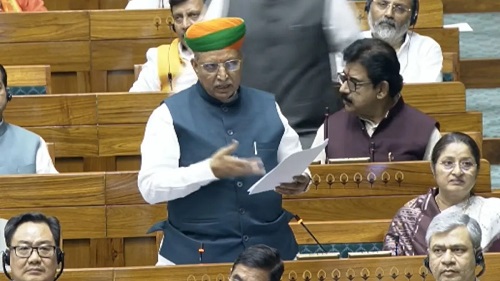
Introducing the Constitution (131st Amendment) Bill and the Delimitation Bill, 2026 in the Lok Sabha, Meghwal announced a significant expansion of parliamentary representation. He stated that the total number of Lok Sabha seats would increase by 50 per cent—from the current strength to 815 seats—once the delimitation exercise is completed. Of these, 272 seats will be reserved for women, fulfilling the one-third quota mandated under the women’s reservation law.
The minister emphasized that the implementation of the Nari Shakti Vandan Adhiniyam would not come at the cost of any state or demographic group. “Neither states nor men will face any reduction in their representation,” Meghwal said, stressing that the increase in seats ensures equitable expansion rather than redistribution.
He further clarified that within the women’s quota, there would be sub-reservations for Scheduled Castes (SC) and Scheduled Tribes (ST), ensuring inclusive representation across social categories. The provisions of the women’s reservation law, passed in 2023, are set to be implemented following the next census and the subsequent delimitation process.
However, the Opposition remained unconvinced. Leaders raised concerns that population-based delimitation could disproportionately benefit northern states, potentially reducing the relative representation of southern states that have successfully controlled population growth.
Leading the charge, Congress leader K. C. Venugopal argued that the government should have incorporated these structural changes at the time of passing the women’s reservation law in 2023. He reiterated that the Opposition supports women’s reservation in principle but objects to what it sees as procedural and political shortcomings.
Echoing similar concerns, Samajwadi Party chief Akhilesh Yadav accused the government of rushing the legislative process. He stressed that a comprehensive census must precede any delimitation exercise to ensure fairness and accuracy.
Responding to the criticism, Union Home Minister Amit Shah stated that preparations for the Census 2027 are already underway, dismissing claims of undue haste. He also took aim at proposals for religion-based reservation, calling them “unconstitutional.”
The debate grew heated at times, prompting intervention from Lok Sabha Speaker Om Birla to restore order and allow proceedings to continue.
At the heart of the debate lies a critical question: how to balance equitable representation with demographic realities in a diverse country like India. While the government maintains that increasing the total number of seats will prevent any region from losing out, the Opposition fears that relative political influence may still shift.
As discussions continue, the proposed delimitation exercise is shaping up to be one of the most consequential political and constitutional debates in recent years, with far-reaching implications for federal balance, representation, and electoral politics in India.


















Leave Your Comment