


Delhi’s traffic challenge is no longer simply about building more roads; it is increasingly about making better use of the roads already available. With around 71 lakh active registered vehicles and traffic growth continuing to put pressure on existing infrastructure, the Centre’s approval of a ₹1,789.52-crore Intelligent Traffic Management System (ITMS) marks a significant shift towards technology-driven urban mobility. The project seeks to replace largely static traffic management with a system that can respond in real time to congestion, accidents, violations and emergency movement.
The Cabinet Committee on Economic Affairs, chaired by Prime Minister Narendra Modi, has approved the implementation of the Intelligent Traffic Management System by Delhi Police at an estimated cost of ₹1,789.52 crore, including taxes. The project will cover 42 identified traffic corridors and is scheduled to be implemented in three phases over 24 months, followed by five years of operation and maintenance.
The significance of the project lies not merely in the deployment of cameras, sensors or automated signals, but in the attempt to create an integrated traffic-management ecosystem for the national capital. Delhi already has an extensive road network, but the rapid increase in vehicles has placed growing pressure on its capacity. The central question, therefore, is how efficiently existing infrastructure can be utilised.
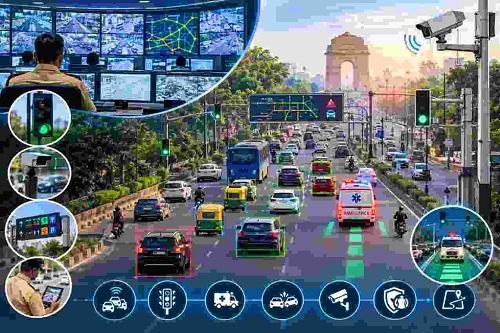
The proposed ITMS is designed to address precisely this gap. Instead of relying predominantly on fixed signal timings and manual intervention, traffic management will increasingly be based on real-time information. Adaptive Traffic Control Systems will be capable of altering signal timings according to prevailing traffic conditions and coordinating signals across identified corridors.
This could have a direct impact on one of Delhi's most persistent traffic problems: unnecessary stoppages. A signal plan that works during one period of the day may become inefficient when traffic volumes change because of office hours, school timings, accidents, road closures or weather conditions. Adaptive signalling seeks to make the system responsive rather than static.
The project will cover 1,092 Adaptive Traffic Control System locations and 1,029 enforcement locations. This scale indicates that the initiative is intended as a city-level transformation rather than a limited pilot project.
Another important component is emergency response. Ambulances and other emergency vehicles can lose crucial time at congested intersections. The proposed system will facilitate priority movement and green corridors, allowing traffic signals to be coordinated to provide faster passage. In practical terms, the value of such technology will ultimately be measured not only in reduced travel time but also in whether emergency vehicles can reach hospitals or incident sites more quickly.
The system also seeks to change how Delhi responds to accidents and congestion. Real-time detection of slow-moving traffic, traffic build-up and road incidents can give Delhi Police an opportunity to intervene before a local disruption develops into a major corridor-wide bottleneck. Diversions and traffic-management measures can then be deployed based on live conditions rather than delayed information.
For commuters, the proposed Variable Message Sign boards and digital platforms could make traffic information more accessible. Information relating to congestion, diversions, parking availability and road conditions can help motorists alter their routes before reaching a bottleneck. The proposed sharing of information with navigation service providers could further integrate official traffic intelligence into everyday travel decisions.
Perhaps the most visible change, however, could come through automated enforcement.
The ITMS is expected to strengthen technology-based detection of red-light and stop-line violations, speeding, wrong-way driving, failure to wear helmets or seat belts, illegal parking and the use of mobile phones while driving. AI-based analytics are also proposed for identifying stolen, hot-listed and blacklisted vehicles, repeat offenders and vehicles potentially connected with hit-and-run cases.
This represents a broader transition from enforcement that is heavily dependent on the physical presence of personnel to one supported by automated systems. Such a transition could improve consistency and coverage, particularly on busy roads where monitoring every violation manually is difficult.
At the same time, the effectiveness of automated enforcement will depend on the accuracy, reliability and operational discipline of the technology. A sophisticated system can improve enforcement only when detection, verification, issuance of penalties and grievance mechanisms work together efficiently. Data security and responsible handling of information will also be important because a city-wide traffic system will generate large volumes of vehicle and movement-related data.
The proposed Traffic Command and Control Centres are intended to bring traffic regulation, enforcement and information dissemination onto a common platform. These centres will be supported by a secure Data Centre and Disaster Recovery infrastructure. The use of open standards and APIs is significant because it can allow the system to integrate with future technologies rather than becoming locked into a closed architecture.
The implementation model also attempts to reduce the risk of a large technology project becoming operationally ineffective after installation. Delhi Police will select a Master System Integrator through competitive bidding, while C-DAC will provide technical support as Project Management Consultant. C-DAC's role will include technical scrutiny, monitoring, validation and acceptance during implementation and the subsequent operation and maintenance period.
The decision to make implementation performance-driven is another important feature. Each subsequent phase will be taken up only after the preceding phase is evaluated against prescribed testing, commissioning, acceptance and performance parameters. This phased approach can allow problems to be identified and corrected before the system is expanded further.
Ultimately, the ITMS is not a substitute for improvements in roads, public transport or urban planning. Technology cannot by itself eliminate congestion in a city where vehicle ownership and travel demand continue to grow. However, it can make existing infrastructure more responsive and improve the way limited road space is managed.
The larger significance of Delhi's ₹1,789.52-crore initiative, therefore, lies in the shift from managing traffic after problems emerge to anticipating and responding to them through real-time intelligence. If implemented effectively, the project could bring together signals, enforcement, emergency response, commuter information and command-and-control operations within one integrated framework.
For Delhi's commuters, the real test will be simple: fewer unnecessary stops, quicker emergency movement, faster response to incidents, more predictable journeys and more consistent enforcement. The ITMS provides the technological architecture for that objective; its ultimate impact will depend on how effectively that architecture is implemented and used on the ground.



















Leave Your Comment