


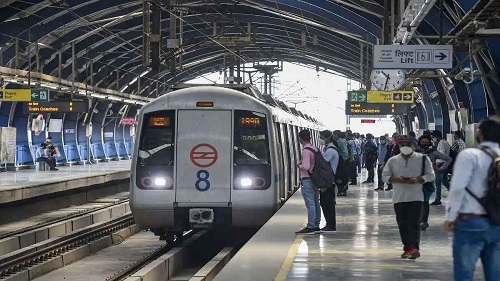
Delhi is preparing for heightened security measures as the police have asked the Delhi Metro Rail Corporation (DMRC) to consider closing entry and exit gates at 57 stations from Friday night, October 9, ahead of proposed protests at Jantar Mantar and other locations in the New Delhi district. The request, which also suggests reducing train frequency at the identified stations, reflects the administration’s effort to prevent crowd movement towards sensitive areas. However, the proposed restrictions raise questions about balancing public safety, the right to peaceful protest and the daily mobility of millions of commuters in the national capital.
The Delhi Police’s request to the DMRC to shut down 57 metro stations signals a significant security mobilisation ahead of the planned demonstrations on Saturday. According to a letter dated October 8, the Joint Commissioner of Police, Transport Range, asked DMRC Managing Director Vikas Kumar to issue necessary directions to officers and staff to implement the proposed measures.
The restrictions are proposed to begin at 9 pm on October 9 and may remain in force through October 10, depending on when the situation returns to normal. The police have cited the possibility of unruly crowd movement towards sensitive locations as the reason for seeking intervention in metro operations.
The proposal covers 57 stations spread across central, south, north, east and northeast Delhi. Among the prominent stations identified are Janpath, Patel Chowk, Central Secretariat, Rajiv Chowk, New Delhi, Mandi House, ITO, Delhi Gate, Khan Market, Supreme Court and Indraprastha. Other stations on the list include INA, Hauz Khas, Lajpat Nagar, Kashmere Gate, Karol Bagh, Jama Masjid, Vishwavidyalaya, Seelampur, Shahdara and Rohini West.
The proposed restrictions also extend to Lok Kalyan Marg, Jor Bagh, Jangpura, Ashram, Jamia Millia Islamia, Okhla Vihar, Civil Lines, GTB Nagar, Adarsh Nagar, Jahangir Puri, Welcome, Yamuna Vihar and Rithala. INA station on both metro lines has also been included.
The decision to seek restrictions across such a large number of stations highlights the challenges of managing demonstrations in a densely populated capital. Metro stations provide convenient access to major government offices, commercial centres, public gathering points and politically significant locations. During large protests, these transport hubs can become focal points for the movement of demonstrators and other members of the public.
From the police perspective, controlling access to selected stations may help prevent sudden crowd surges, reduce congestion near sensitive locations and facilitate the deployment of security personnel. Reducing train frequency could also be intended to manage passenger movement at particular points, although its effectiveness would depend on the scale, location and timing of the gatherings.
Nevertheless, a security alert does not automatically mean that every proposed restriction is necessary for the entire period. The effectiveness of such measures depends on timely intelligence, coordination between the police and the DMRC, and regular assessments of ground conditions. A targeted and flexible approach could help minimise disruption while addressing genuine security concerns.
The proposed restrictions could affect more than those intending to participate in the protests. Office workers, students, traders, tourists and people travelling for medical or personal reasons may also face inconvenience if station gates are closed or train services become less frequent.
The geographical spread of the identified stations makes the potential impact particularly important. Several of them serve as major interchange points or provide access to central Delhi and other busy neighbourhoods. Even where a station remains operational, changes in train frequency or restricted access could lead to longer journeys, crowded platforms and increased pressure on alternative routes.
For a city heavily dependent on public transport, advance communication is therefore essential. Passengers need clear information about which gates or stations are affected, the duration of restrictions, alternative travel arrangements and the resumption of normal services. The DMRC and police must ensure that advisories reach commuters before they begin their journeys.
The proposed measures also bring into focus the difficult balance between maintaining public order and protecting the democratic right to peaceful assembly. Protests are an established feature of democratic politics, allowing citizens and political parties to express disagreement, demand accountability and draw attention to public issues.
At the same time, the authorities have a responsibility to protect public infrastructure, prevent violence and ensure that demonstrations do not endanger other citizens. These responsibilities are not necessarily contradictory. Effective policing should seek to facilitate peaceful demonstrations while taking proportionate action against credible security threats.
Restrictions on public transport should consequently be based on a clear assessment of risk, applied only as necessary and reviewed as circumstances change. Communication between protest organisers, the police and transport authorities can also help reduce uncertainty and prevent avoidable confrontation.






















Leave Your Comment