


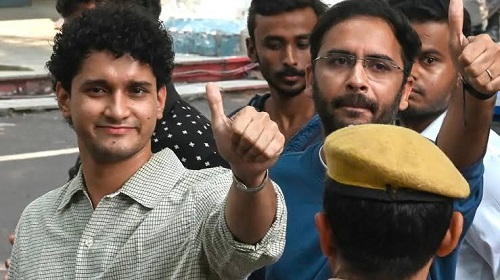
The Delhi High Court on Wednesday examined the legal grounds for extending the judicial custody of Cockroach Janta Party (CJP) leaders Saurav Das and Ashutosh Ranka, raising questions about their alleged violation of bond conditions and the authorities' response to their conduct. During the hearing, Justice Subramonium Prasad also remarked that the two leaders, aged 27 and 31, respectively, did not belong to the Gen Z age group. While acknowledging the right to protest, the court stressed that the circumstances, intentions and conduct of protesters can become relevant when authorities apprehend a possible breach of peace.
The legal battle over the detention of Cockroach Janta Party (CJP) leaders Saurav Das and Ashutosh Ranka took a significant turn on Wednesday, as the Delhi High Court questioned both their conduct and the procedure followed by authorities in extending their judicial custody. The hearing brought into focus the balance between an individual's right to protest, the responsibility to comply with legally imposed conditions and the safeguards that must govern preventive action.
Justice Subramonium Prasad, while hearing the duo's plea on an urgent basis, asked pointed questions concerning the alleged violation of the bond conditions imposed on them. The court also examined the legal framework under the Bharatiya Nagarik Suraksha Sanhita (BNSS), which prescribes procedures for dealing with breaches of bonds.
The observations indicated that the issue was not limited to the circumstances surrounding the protest but also involved the manner in which the authorities exercised their powers. In cases of alleged bond violations, the law provides for specified steps, which may include forfeiture of the amount furnished by a surety and an opportunity for the person concerned to explain why further action should not be taken.
The court's scrutiny of these provisions is significant because preventive measures affecting personal liberty must be supported by the procedure established under the law. An allegation that a person has breached a bond does not, by itself, remove the need to follow the prescribed legal process.
During the hearing, the high court observed that Das and Ranka had been shown leniency by the authorities. It also asked about their ages, noting that Das was 27 and Ranka 31, and remarked that they did not belong to the Gen Z category.
The reference to their ages came amid a broader discussion about the people participating in protests and the circumstances in which preventive action might become necessary. The court indicated that when there is a possibility of a breach of peace, questions about the identities, intentions and activities of those involved may assume relevance.
At the same time, the court acknowledged that citizens have the right to protest. This recognition is central to the democratic framework, in which peaceful demonstrations provide a means of expressing disagreement with government decisions and public institutions.
However, the exercise of that right can also bring questions about compliance with lawful restrictions and the conduct of participants. The legal distinction between peaceful dissent and conduct that authorities reasonably believe could disturb public order is therefore important in cases of preventive detention.
The court's observations should be understood in the context of the hearing and the allegations before it, rather than as a final determination of the legality of the protesters' actions or the validity of their continued custody.
The high court also addressed the political dimension of protests, observing that if the objective is to change a government, the democratic route is through elections. Its remarks underscored the distinction between demonstrating against a government and seeking to replace it through the electoral process.
In a constitutional democracy, public protests can serve as an important mechanism for questioning policies, demanding accountability and drawing attention to grievances. Elections, meanwhile, provide the formal means through which voters choose their representatives and determine which political formation should govern.
The two mechanisms are not necessarily in conflict. Peaceful demonstrations can influence public debate and bring issues into the political mainstream, while electoral contests determine the composition of elected governments. The court's observation placed particular emphasis on the need to examine the intentions and conduct of protesters when questions of public peace arise.
The larger challenge for authorities is to distinguish between legitimate political dissent and conduct that meets the legal threshold for preventive intervention. Such decisions require attention to the facts, the applicable law and the safeguards designed to protect individual liberty.

















Leave Your Comment