


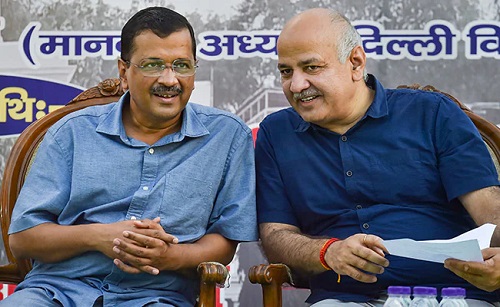
A Delhi court has discharged former Chief Minister Arvind Kejriwal and his deputy Manish Sisodia in the high-profile Delhi liquor policy case, dealing a major blow to the Central Bureau of Investigation's prosecution and closing a painful chapter for the Aam Aadmi Party. Special Judge Jitender Singh of Rouse Avenue Court ruled that the CBI had failed to establish even a prima facie case against any of the 23 accused, finding that the alleged conspiracy was built on conjecture rather than credible evidence.
The origins of the case lie in the AAP government's 2021-22 excise policy, which Kejriwal's administration had introduced with the stated aim of modernising Delhi's liquor trade and significantly boosting state revenue. Critics, however, alleged that the policy was designed to benefit a specific group of liquor businessmen, later referred to in CBI documents as the "South Group." When the controversy erupted, the Delhi government scrapped the policy. What followed was years of legal proceedings that consumed the political fortunes of the AAP's top leadership.
Kejriwal himself was arrested — a sitting Chief Minister dragged from his home and jailed, as he put it outside the court. Sisodia, widely regarded as the architect of Delhi's acclaimed education reforms, spent extended periods in custody. The case cast a long shadow over the AAP's performance in the subsequent Delhi assembly elections, which the party lost, with many analysts pointing directly to the reputational damage inflicted by the excise policy controversy.
The verdict was pointed in its criticism of the prosecution. Judge Singh ruled that there was "no overarching conspiracy or criminal intent" in the formulation of the excise policy, and that the alleged central conspiratorial roles of Kejriwal and Sisodia "could not be substantiated." The allegations, in the court's words, "failed judicial scrutiny."
The court was particularly scathing about the CBI's investigative methodology. The agency's heavy reliance on approver statements — where accused persons are pardoned in exchange for testimony against others — was described as an improper and constitutionally questionable practice. The judge observed that allowing such a method of building a case would violate constitutional principles, as it essentially enables investigators to fill gaps in evidence by manufacturing witnesses from within the accused pool.
Perhaps the most striking rebuke was the court's decision to recommend a departmental inquiry against CBI officials for naming a public servant, Kuldeep Singh, as accused number one in the case. It is rare for a court to take such a step against investigating officers, and it signals serious concern about the manner in which the case was built and conducted.
The court also zeroed in on the CBI's use of the term "South Group" to describe what investigators alleged was a nexus of politicians and liquor businessmen who shaped the policy. The judge questioned who coined the term and what purpose it served, drawing an analogy to a case in the United States that was dismissed partly because of the prejudicial use of a label to describe a group of accused. "I believe the term South Group should not have been used," the judge stated plainly. The CBI's response — that it was merely a common reference term — did not appear to satisfy the court.
Speaking to reporters outside the court, an emotional Kejriwal broke down as he addressed the verdict. "We always said that truth ultimately wins. I always used to say that the truth is with us. A sitting chief minister was dragged out of his home and thrown into jail. Mud was flung at us," he said. His words captured something beyond personal vindication — a sense of grievance that the legal machinery had been used, in his view, as a political instrument.
The verdict raises uncomfortable questions about the CBI's conduct in politically sensitive cases. Courts in India have increasingly scrutinised the use of economic offence laws and corruption statutes in cases involving opposition politicians, and this judgment adds to a body of judicial opinion urging investigative agencies to ground their cases in demonstrable evidence rather than narrative-building through approver statements and loosely defined conspiracies.
For the AAP, the acquittal comes too late to reverse the electoral damage. The party that once governed Delhi for a decade lost power earlier this year, and the liquor policy case was a significant factor in that defeat. Whether the verdict rehabilitates Kejriwal's image in the eyes of Delhi's voters — or whether the political cost has already been permanently paid — remains to be seen.
What the court has made clear, however, is that the case as presented by the CBI did not meet the threshold of law. That is a finding with consequences not just for the accused, but for the institution that prosecuted them.




















Leave Your Comment