


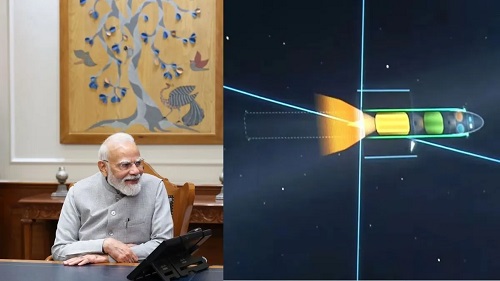
Prime Minister Narendra Modi on Saturday congratulated Skyroot Aerospace after the successful launch of Vikram-1, India's first privately developed orbital-class rocket, describing the milestone as a "defining moment in India’s space journey." The achievement marks a new chapter for India's rapidly expanding private space sector, with Vikram-1 successfully reaching orbit after lifting off from the Satish Dhawan Space Centre in Sriharikota.
In a post on X, the Prime Minister praised the Skyroot team for the landmark accomplishment. "This is a defining moment in India’s space journey. The growing participation of our private sector is opening new frontiers and accelerating innovation. This achievement will encourage countless youngsters to dream bigger and innovate fearlessly," he wrote, highlighting the growing role of private enterprises in strengthening India's ambitions in the global space industry.
Skyroot Aerospace's Vikram-1 lifted off at 12:05 pm on July 18 from Sriharikota as part of Mission Aagaman. Shortly after the launch, the Hyderabad-based startup confirmed the mission's success.
"Hello space, we have arrived! Vikram-1's Test Flight-1 has completed its mission. The first ever Indian private sector launch has been successfully completed," the company posted on X.
The company later announced that the rocket had successfully completed its final burn and deployed its payloads into an orbit of approximately 450 kilometres, making India the third country in the world with private orbital launch capability.
The achievement represents a significant milestone for India's commercial space ecosystem, demonstrating the country's growing ability to develop advanced launch vehicles outside the government sector.
The Vikram-1 rocket has been named in honour of Dr Vikram Sarabhai, widely regarded as the father of India's space programme. Designed and developed entirely by Skyroot Aerospace, the three-stage launch vehicle is capable of carrying up to 350 kilograms of payload into Low Earth Orbit (LEO).
For its maiden orbital mission, Vikram-1 targeted an altitude of around 450 km with a 60-degree orbital inclination, showcasing the rocket's capability to deploy small satellites into precise orbits.
The vehicle has been specifically developed to cater to the growing global demand for launching small satellites, a segment witnessing rapid expansion due to increasing deployment of communication, Earth observation and internet satellite constellations.
The successful launch also reflects the transformation of India's space sector following policy reforms that encouraged private participation. While the Indian Space Research Organisation (ISRO) continues to operate launch vehicles such as the Small Satellite Launch Vehicle (SSLV), private companies are increasingly building indigenous launch systems to complement national capabilities.
Apart from Skyroot Aerospace, startups like Agnikul Cosmos are also developing their own launch vehicles, creating a competitive and innovation-driven ecosystem for commercial space missions.
The demand for small satellite launches has surged globally with mega constellations such as Starlink and OneWeb, which require frequent launches to deploy hundreds of satellites into low Earth orbit. India's emerging private launch providers are expected to play a crucial role in serving this expanding international market.
The success of Mission Aagaman extends beyond a single rocket launch. It signals the arrival of a vibrant private space industry where startups, scientists, investors, policymakers and entrepreneurs are working together to build India's future in space.
With Vikram-1 successfully reaching orbit, India has demonstrated that its private sector is ready to contribute alongside ISRO in advancing space exploration and commercial launch services. The milestone is expected to accelerate innovation, attract greater investment and inspire a new generation of engineers and entrepreneurs to pursue ambitious space technologies.
As Prime Minister Modi noted, the achievement is not only a technological breakthrough but also an inspiration for countless young Indians to dream bigger and innovate fearlessly, reinforcing India's position as an emerging global space power.





















Leave Your Comment