


In a historic move set to redefine India's aerial combat capabilities, the Defence Acquisition Council (DAC) chaired by Defence Minister Rajnath Singh has cleared the proposal to acquire 114 Rafale fighter jets from France's Dassault Aviation. The mega-deal, estimated to be worth a staggering ₹3.25 lakh crore, marks one of the largest defence procurement initiatives in India's history.
The decision, which also includes the approval for six P8I aircraft for the Indian Navy, comes at a strategically significant moment—just weeks before French President Emmanuel Macron's scheduled visit to India later this month. Defence sources indicate that the final contracts are likely to be signed during the French leader's visit, cementing what has emerged as one of India's most enduring defence partnerships.
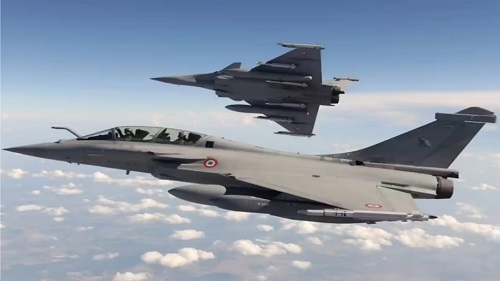
The Indian Air Force currently operates 36 Rafale jets, inducted in two batches between 2020 and 2021. The first five aircraft touched down at Air Force Station Ambala in July 2020, marking the beginning of a new era for the IAF. Today, the fleet is organised into two formidable squadrons: No 17 ‘Golden Archers’ based in Ambala, Haryana, and No 101 ‘Falcons’ stationed at Hasimara, West Bengal. The latter formally inducted the Rafale in July 2021.
With 114 additional aircraft on the horizon, the IAF will expand its Rafale strength nearly fivefold. This quantum jump is expected to provide critical depth to India's air defence architecture, particularly along the contested borders with China and Pakistan.
The Rafale procurement is not merely a numerical expansion—it represents a strategic recalibration. The 2016 Inter-Governmental Agreement for 36 Rafales was widely seen as a stop-gap arrangement following the collapse of the earlier Medium Multi-Role Combat Aircraft (MMRCA) negotiations. The current deal, by contrast, envisages not just aircraft acquisition but significant technology transfer and indigenous manufacturing.
Under the 'Make in India' defence procurement framework, a substantial portion of these 114 aircraft is expected to be manufactured in India through an industrial partnership between Dassault Aviation and an Indian private sector entity. This aligns with the Indian Air Force's long-standing requirement for 40 squadrons—a figure it has struggled to maintain, currently operating around 30 squadrons against sanctioned strength.
Simultaneously, the DAC's approval for six P8I Poseidon maritime surveillance aircraft underscores India's focus on bolstering Indian Ocean Region dominance. The P8I, already a proven asset in the Navy's inventory, provides anti-submarine warfare capabilities and maritime reconnaissance that are crucial given China's increasing naval forays into the region.
President Macron's impending visit provides the ideal political backdrop for what will be India's most expensive defence contract since the Brahmos and S-400 Triumf acquisitions. France has emerged as one of India's most reliable defence partners, notably during the 1999 Kargil conflict when Paris continued spares supply despite international sanctions following India's nuclear tests.
The relationship has since deepened through joint exercises, technology sharing, and a convergence of strategic interests in the Indo-Pacific. The Rafale deal will further institutionalise this partnership, potentially opening doors for collaboration in submarine technologies, space, and artificial intelligence-driven warfare systems.
While the ₹3.25 lakh crore valuation has inevitably sparked discussions on defence modernisation costs, analysts argue that the life-cycle value, including maintenance, weapons package, and technology transfer, justifies the investment. Each Rafale is armed with Meteor beyond-visual-range air-to-air missiles, SCALP cruise missiles, and advanced electronic warfare suites—capabilities that China's J-20 and Pakistan's Block-52 F-16s find difficult to counter.
Moreover, with the indigenous Advanced Medium Combat Aircraft (AMCA) still a decade away from induction, the Rafale remains the IAF's most potent stop-gap while also serving as a technology bridge for India's next-generation fighter programmes.
As Defence Minister Rajnath Singh pushes for accelerated procurement under the Atmanirbhar Bharat rubric, the Rafale deal signals that while self-reliance remains the ultimate goal, strategic exigencies demand immediate capability enhancement. The contract is expected to include stringent delivery timelines, customised India-specific enhancements, and robust maintenance and spares support clauses—lessons learned from earlier procurement pitfalls.
With the Himalayas witnessing increased military infrastructure creation on the northern front and the Indian Ocean becoming a theatre of great power competition, the Rafale acquisition is not merely a deal—it is a statement of intent. India is no longer content with being a net security consumer; it is building the aerospace arsenal of a regional power with global aspirations.



















Leave Your Comment