


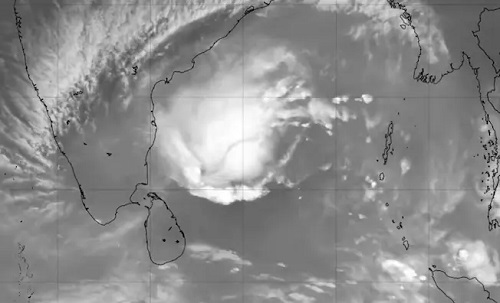
The Bay of Bengal is witnessing the development of a powerful cyclonic system, with Cyclonic Storm Akvan expected to intensify into a very severe cyclonic storm before making landfall along the Andhra Pradesh coast on November 20. With wind speeds likely to touch 130 kmph and gusts reaching 145 kmph, the approaching storm poses a significant threat to coastal areas. Authorities and residents in the region will need to remain alert as the weather system gathers strength and moves towards the eastern coastline.
The Cyclonic Storm Akvan has remained stationary over the central parts of the South and adjoining West-Central Bay of Bengal for the past nine hours, positioned approximately 610 km east of Chennai. The enormous weather system is also located around 630 km northeast of Trincomalee in Sri Lanka, 670 km southeast of Visakhapatnam in Andhra Pradesh and nearly 790 km south of Gopalpur in Odisha. Its extensive geographical spread indicates the scale of the developing weather disturbance, which is expected to become increasingly intense over the next few days.
According to the forecast, Akvan is likely to resume its north-northwestward movement by Tuesday evening and strengthen further into a severe cyclonic storm on November 19. The system is then expected to gain considerable intensity, potentially developing into a very severe cyclonic storm by around noon on November 20. This progression could make it a major weather event for the Andhra Pradesh coastline, particularly its central and southern coastal districts.
The most critical phase is expected when the cyclone approaches land. Akvan is forecast to cross the Andhra Pradesh and Yanam coasts between Nellore and Tuni around November 20, bringing powerful winds with sustained speeds of 120–130 kmph and gusts reaching 145 kmph. Such wind conditions could pose risks to coastal settlements, infrastructure, electricity networks, trees and transportation. Fishing and other maritime activities may also face serious disruption as the cyclone approaches.
Meanwhile, the weather system is expected to influence conditions in neighbouring Tamil Nadu. Light to moderate rainfall has been forecast across parts of North Tamil Nadu, with heavy rainfall likely at isolated locations until November 19. Although the principal landfall is projected along the Andhra Pradesh coast, the cyclone's wide circulation could influence weather conditions across a broader stretch of the eastern coastline.
With Akvan expected to intensify rapidly, the coming 48–72 hours will be crucial in determining the extent of its impact. The accuracy of its projected track, landfall location and intensity will remain important factors in assessing the threat. Coastal communities must closely follow official weather bulletins and take necessary precautions as the Bay of Bengal prepares for another powerful cyclonic system.






















Leave Your Comment