


In India, the ideological amalgamation often referred to as “Left-Liberal” represents a contradictory coalition that shapes much of the country’s political and social discourse. This group, often labeled as Leftist, Liberal, Secular, or even in extreme cases as “Urban Naxals” or the “Tukde-Tukde Gang,” attempts to blend the opposing principles of liberalism and leftism. Liberalism, with its emphasis on individual freedom, clashes with the collective control and state-centric ideology of leftism. Despite this inherent contradiction, these ideologies are selectively fused to serve specific narratives, particularly those targeting Hinduism, which is often painted as regressive or oppressive in their discourse.
The ideological contradictions of the Left-Liberal coalition are not merely academic; they manifest in their deliberate narrative-setting strategies. While liberal principles should ideally champion inclusivity and freedom, in practice, they are selectively applied to support leftist goals. This is most evident in their critique of Hinduism, which they view through a Marxist lens as an instrument of societal oppression. Hinduism’s contributions to philosophy, science, and governance are minimized, while its caste-based hierarchies are amplified as its defining feature. At the same time, left-liberals avoid similar scrutiny of other religions, reinforcing their anti-Hindu bias. This cherry-picking of ideological tenets enables the coalition to delegitimize Hindu cultural and religious expressions while claiming the moral high ground of pluralism and secularism.
Central to the Left-Liberal project is their dominance in academia, media, and cultural institutions. In Indian academia, this influence has allowed them to distort historical narratives. The Aryan Invasion Theory, for example, is propagated to undermine Hinduism’s indigenous roots, sowing divisions within Indian society. Hindu resistance to foreign invasions, led by figures like Shivaji and Maharana Pratap, is downplayed, while invaders such as the Mughals are romanticized as symbols of tolerance. The Bhakti movement, which challenged social hierarchies within Hinduism, receives little attention, as it contradicts their portrayal of Hinduism as a monolithic structure of oppression.
Media and popular culture further amplify the left-liberal narrative. Hindu festivals like Diwali and Holi are criticized for their environmental impact, while other religious celebrations escape similar scrutiny. Bollywood and streaming platforms routinely portray Hindu traditions and priests as corrupt or oppressive while avoiding critical portrayals of other religions. This selective outrage fosters a perception of Hinduism as inherently problematic, alienating it from its cultural and spiritual context. Protests and dissent movements, such as the Shaheen Bagh protests or the farmers’ agitation, are strategically amplified in the media, often sidelining factual nuances to bolster the narrative of a “communal” Hindu majority oppressing minorities.
The linguistic tactics employed by the Left-Liberal coalition also play a significant role in shaping perceptions. Terms like “Hindutva terror” and “saffronization” are strategically coined and popularized to delegitimize Hindu cultural resurgence. Events like the Godhra train burning and the subsequent riots are selectively framed to portray Hindus as aggressors while minimizing the atrocities committed against them. This reframing not only distorts the truth but also reinforces the perception of Hindus as intolerant and violent.
Institutional influence further solidifies the left-liberal grip on Indian society. Policies and legal interpretations often reflect their biases, as seen in the disproportionate control of Hindu temples by the state while other religious institutions enjoy autonomy. Judicial interventions frequently prioritize minority rights while sidelining legitimate Hindu grievances, such as the prolonged resolution of the Ram Janmabhoomi dispute. These double standards perpetuate the narrative of Hindu privilege, ignoring the systemic inequities faced by the majority community.
The anti-Hindu bias of the Left-Liberal ecosystem is evident in their dismissal of Hindu cultural revivalism as communalism. Movements aimed at reclaiming temples or celebrating traditional practices are labeled as “Hindutva,” conflating cultural pride with religious extremism. Caste divisions within Hindu society are exploited to weaken its unity, with Dalit movements often directed against Hinduism itself rather than addressing broader societal issues. At the same time, Hindu deities and practices are routinely mocked in the name of artistic freedom, a liberty conspicuously absent in depictions of other religions. This selective application of freedom of expression highlights the inherent hypocrisy of the Left-Liberal stance.
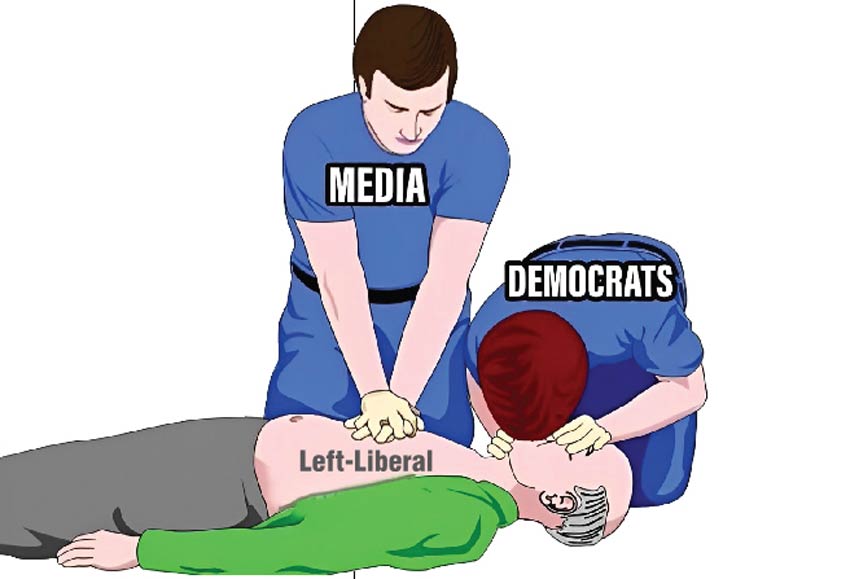
Despite its contradictions, the Left-Liberal ecosystem continues to thrive by positioning itself as the defender of minorities and the oppressed. This “victim” narrative allows them to claim moral superiority and deflect criticism by labeling dissenters as communal or regressive. Their alignment with global organizations and media outlets further amplifies their narrative, portraying India’s Hindu-majority government as a threat to secularism on international platforms. By focusing on controlling cultural and intellectual institutions, they shape the collective psyche, ensuring that their biases are internalized by future generations.
Challenging the Left-Liberal narrative requires reclaiming intellectual spaces and fostering balanced discourse. Indian history and culture must be presented in their entirety, celebrating Hinduism’s contributions while addressing its flaws without undue vilification. Media and cultural platforms must promote fair critiques of all religions, fostering genuine secularism. The Hindu ethos of pluralism and self-critique provides a robust framework for resisting the Left-Liberal onslaught. By addressing internal divisions and countering external distortions, Hindu society can rise above the ideological manipulations of the Left-Liberal coalition and reclaim its rightful place in India’s socio-cultural fabric.
Scoring a Self-Goal: The Peril of Creating a Narrative Against Bharat
In the contemporary landscape of Bharat (India), unity has always been our greatest strength. From the independence movement to economic liberalization and cultural revival, a united Bharat has overcome countless challenges. However, an alarming trend threatens this unity today—a section of society, knowingly or unknowingly, is engaged in creating a narrative that undermines Bharat’s sovereignty, culture, and values. By painting a distorted picture of the nation on both domestic and international platforms, this section inadvertently scores a self-goal, damaging the country’s image and cohesion. This divisive narrative, if unchecked, could unravel the progress we have painstakingly achieved. Now, more than ever, unity is the need of the hour.
The Anatomy of the Narrative Against Bharat
The narrative against Bharat often stems from a combination of ideological bias, misinformation, and deliberate misrepresentation. While dissent and critique are essential in a democracy, the line is crossed when these critiques are weaponized to weaken the fabric of the nation.
1. Perpetuating an Anti-Civilizational Bias
A significant portion of this narrative stems from a deep-seated bias against Bharat’s civilizational roots. The rich heritage of Sanatana Dharma, which emphasizes pluralism, spirituality, and inclusivity, is often misrepresented as regressive or oppressive. Ancient texts, traditions, and practices are cherry-picked to portray Hinduism as inherently flawed, ignoring its contributions to philosophy, science, and global culture.
This bias manifests in how festivals are critiqued, rituals mocked, and cultural icons diminished. For instance, celebrating Diwali or Holi is often viewed through an environmental lens, while other festivals escape similar scrutiny. By selectively targeting Hindu traditions, this section alienates a large part of Bharat’s populace and feeds into an anti-national narrative.
2. Discrediting National Achievements
Bharat’s achievements on the global stage—whether in technology, defense, or diplomacy—are often dismissed or downplayed. For example, the successful lunar missions by ISRO, the burgeoning startup ecosystem, and advancements in healthcare and infrastructure are overshadowed by critiques focusing on relatively minor shortcomings.
The consistent portrayal of Bharat as a country riddled with poverty, caste oppression, and communal tensions ignores the strides made in improving socio-economic indicators. This narrative not only demoralizes citizens but also paints a negative image of Bharat to the international community, impacting investments and partnerships.
3. Amplifying Internal Divisions
Bharat’s diversity, once its greatest strength, is increasingly being weaponized. By highlighting caste, religion, and regional differences, certain sections create an impression of a fractured society. These divisions are amplified through selective reporting, academic distortions, and social media campaigns that portray Bharat as a deeply divided nation.
For instance, caste-based activism often shifts from addressing inequalities to outright condemnation of Hinduism, ignoring efforts within the system to reform and improve. Similarly, communal clashes, while rare, are disproportionately highlighted, fostering mistrust among communities. These tactics serve to fragment society, weakening the collective strength of Bharat.
4. Seeking Validation from Foreign Platforms
A concerning aspect of this narrative is its reliance on international platforms to critique Bharat. Reports by global organizations, often influenced by biased sources, are cited to support claims of oppression, inequality, or intolerance.
This tendency to “air dirty laundry” on foreign soil not only tarnishes Bharat’s image but also undermines its sovereignty. External powers leverage such narratives to question Bharat’s policies, whether on Kashmir, human rights, or economic reforms. This external validation creates a feedback loop, reinforcing the divisive discourse domestically.
The Impact of Scoring a Self-Goal
The consequences of perpetuating such narratives are far-reaching and deeply damaging.
1. Erosion of National Unity
When sections of society continually portray Bharat in a negative light, it fosters disillusionment among citizens. The trust that binds a diverse population begins to erode, creating fertile ground for polarization. This disunity weakens Bharat’s ability to address external threats, whether economic, geopolitical, or cultural.
2. Global Reputation at Stake
Bharat’s rising stature on the world stage is built on its image as a stable, pluralistic, and forward-looking nation. A self-imposed narrative of dysfunction jeopardizes this reputation, affecting foreign investments, strategic partnerships, and tourism. Nations hesitant to engage with Bharat might cite these internal criticisms as justification for their decisions.
3. Hindrance to Development Goals
The narrative of division diverts attention and resources away from pressing development goals. Instead of focusing on infrastructure, healthcare, and education, governments and civil society are forced to counter propaganda, delaying critical reforms.
4. Vulnerability to External Manipulation
A fractured Bharat is easier to manipulate by external forces. Divisive narratives provide fodder for hostile nations to interfere in internal matters, destabilize the economy, and weaken Bharat’s geopolitical standing.
United We Stand: The Path Forward
To counter this self-destructive trend, Bharat must reaffirm its unity and resilience. Unity does not imply uniformity; it means embracing diversity while remaining steadfast in collective progress. Here’s how Bharat can achieve this:
1. Promoting a Balanced Narrative
Media, academia, and policymakers must present a balanced view of Bharat—one that celebrates achievements while acknowledging challenges. This requires reclaiming intellectual spaces dominated by biased voices and fostering a culture of constructive criticism. For example, highlighting ISRO’s achievements alongside discussions on environmental sustainability creates a holistic narrative that inspires and informs.
2. Strengthening Civilizational Confidence
Bharat must take pride in its civilizational heritage, countering distorted portrayals with facts and context. Public education campaigns, cultural programs, and digital platforms can play a pivotal role in showcasing the pluralistic and progressive aspects of Sanatana Dharma. Encouraging citizens to learn about their history and traditions can foster a sense of pride and belonging.
3. Encouraging Dialogue and Reconciliation
Internal divisions must be addressed through dialogue, not antagonism. Initiatives that bring together communities to address caste, religious, or regional differences can help build trust. For instance, promoting interfaith dialogues or community-driven development projects fosters collaboration over conflict.
4. Leveraging Technology for Unity
Digital platforms can be powerful tools for uniting citizens. From campaigns promoting national achievements to countering misinformation, technology can be harnessed to foster a sense of collective purpose. Programs like “Digital India” and “Ek Bharat, Shreshtha Bharat” demonstrate the potential of technology in bridging divides.
5. Reclaiming Global Discourse
Bharat must engage with international platforms proactively, presenting its achievements and countering biased narratives. A strong diaspora, active diplomacy, and robust communication strategies can help Bharat project an accurate image to the world.

By NILABH KRISHNA
(The content of this article reflects the views of writers and contributors, not necessarily those of the publisher and editor. All disputes are subject to the exclusive jurisdiction of competent courts and forums in Delhi/New Delhi only)




















Leave Your Comment