


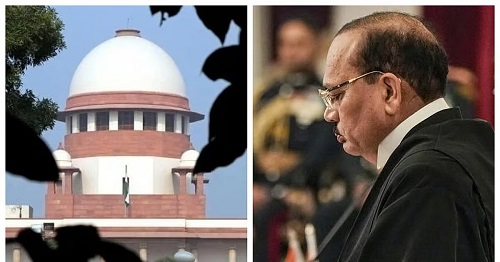
The Supreme Court on Friday took serious note of a controversial social media post by the Kerala Pradesh Congress Committee (KPCC) targeting Chief Justice of India (CJI) Surya Kant and issued a contempt notice to the party's office-bearers. Emphasising the supremacy of the Constitution and the independence of the judiciary, the apex court made it clear that no individual, institution or political organisation can claim to be above constitutional authority. The court warned that any attempt to undermine its authority would be dealt with firmly, signalling that political criticism cannot be allowed to cross the boundaries of constitutional propriety.
The matter was heard by a bench comprising Justices Aravind Kumar and Vipul M Pancholi. In its order, the bench underscored that judicial independence is a fundamental constitutional guarantee and cannot be subjected to political considerations or convenience. "The Constitution is supreme. No individual, no institution or political organisation stands above it," the court observed, adding that the independence of the judiciary is a guarantee owed to the Republic and its people. The bench further stated that any attempt to undermine the authority of the court must be dealt with an iron hand.
To examine the legal implications of the controversial post, the Supreme Court appointed a senior advocate as amicus curiae, or friend of the court, to assist it in determining whether the matter attracts criminal or civil contempt proceedings. The court also sought the assistance of Attorney General R Venkataramani before proceeding further. The appointment is expected to help the bench assess the nature and gravity of the alleged conduct and its implications under the law of contempt.
The controversy originated from a social media post published by the KPCC criticising CJI Surya Kant over a remark made during a Supreme Court hearing on petitions seeking an inquiry into alleged excesses by Delhi Police during the Cockroach Janta Party (CJP) protests in the national capital. The remark triggered a political reaction, with the Kerala Congress unit posting content directed at the Chief Justice.
The post drew widespread criticism from sections of the legal fraternity. Both the Supreme Court Bar Association (SCBA) and the Supreme Court Advocates-on-Record Association (SCOARA) condemned the demand for the CJI's resignation, expressing concern over attempts to target the head of the judiciary. The associations maintained that the dignity and independence of the institution must be protected.
Following the backlash, the KPCC deleted the controversial post and issued an apology. The party also announced that the person responsible for publishing the content had been removed from their position. However, the subsequent apology and deletion have not brought the matter to a close, as the Supreme Court has decided to examine whether the conduct constitutes contempt.
The proceedings carry significance beyond the immediate political controversy. They raise important questions about the limits of political expression, institutional accountability and the protection of judicial independence in a constitutional democracy. While political parties have the right to question judicial observations and express disagreement with court proceedings, the Supreme Court's intervention underscores that such criticism must remain within the framework of law and constitutional responsibility. The court's next steps will determine whether the KPCC post warrants formal contempt action.




















Leave Your Comment