


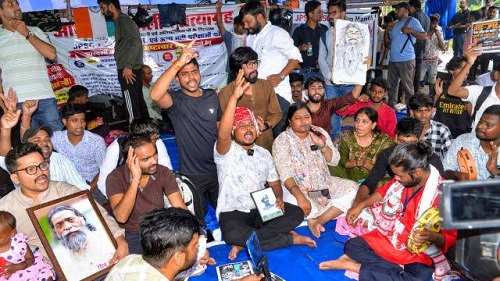
The Congress on Monday found itself in a political dilemma over the ongoing protest by students in Jharkhand against alleged irregularities in recruitment examinations, with the party facing criticism for maintaining silence on an issue that has drawn comparisons with its sustained campaign against the NEET (UG) examination controversy.
None of the Congress's top leaders, including Leader of Opposition in the Lok Sabha Rahul Gandhi and party leader Priyanka Gandhi Vadra, has publicly commented on the Jharkhand students' agitation or demanded accountability over the alleged irregularities. The silence has provided an opportunity for the Bharatiya Janata Party (BJP) to accuse the Congress of adopting a selective approach to issues concerning students and competitive examinations.
The BJP has linked the Congress's silence to its alliance with the Jharkhand Mukti Morcha (JMM), which is part of the ruling alliance in the state. Union Minister Giriraj Singh attacked the Congress, accusing it of being selective in raising issues related to examination irregularities.
"On Jharkhand, Punjab and Karnataka, they (Congress) are silent. Rahul goes and stirs 'hungama' in Prayagraj. The people of the nation are seeing all this," Singh told news agency ANI. He also accused the Congress of being an "enemy of democracy" and questioned its silence over alleged paper leaks and examination irregularities in states where opposition parties are in power.
BJP national general secretary Tarun Chugh also targeted Rahul Gandhi, alleging that the Congress leader had no time to listen to protesting students in Jharkhand because his party is part of the ruling alliance in the state.
Chugh said the Congress had actively sought to associate itself with student protests in Delhi but was now maintaining silence over a similar agitation in Jharkhand.
"Even Rahul Gandhi ji does not have time to listen to them now because the government is yours in Jharkhand. This is a double standard," Chugh said, adding that the state government should accept the demands raised by the students.
The controversy comes at a time when the Congress has repeatedly attacked the Centre over alleged irregularities and paper leaks in national-level examinations, particularly NEET (UG). The party has demanded accountability from the Union government and raised the issue in Parliament and outside it.
However, the absence of a similar high-profile response to the Jharkhand agitation has allowed the BJP to question the Congress's political consistency.
The ruling JMM, meanwhile, has sought to defend the state government's handling of the issue. The party has said that around 98 per cent of the students' demands have already been accepted, a claim that has also been acknowledged by the protesters.
JMM Rajya Sabha MP Mahua Maji said the matter was being investigated by the state CID and that the government had directed that the case be resolved within 90 days through a fast-track court process.
Maji also argued that the government could not cancel the examination on its own at this stage without a direction from the court. She pointed to alleged irregularities in the first and second Jharkhand Public Service Commission (JPSC) examinations conducted during the BJP's tenure, claiming that those examinations too had faced allegations of paper leaks and widespread malpractice.
The Jharkhand controversy has therefore assumed a broader political dimension, with the BJP accusing the Congress of applying different standards depending on which party is in power. The Congress, which has yet to respond to the allegations, now faces the challenge of explaining its position on examination irregularities in a state where its political alliance partner is part of the government.
For the protesting students, however, the central issue remains the alleged irregularities in recruitment examinations and the demand for a transparent investigation and corrective action. With the CID probe underway and the government promising a time-bound resolution, the coming weeks are likely to determine whether the issue is resolved administratively or develops into a larger political confrontation.



















Leave Your Comment