


In a significant political development, the Congress party has decided not to be part of the newly-formed Jammu and Kashmir government, despite its alliance with Chief Minister-elect Omar Abdullah's National Conference (NC) during the September-October elections. Sources revealed on Wednesday morning that the Congress has opted to provide outside support to the NC-led government instead of accepting an offer of one ministerial position in the incoming administration.
This decision marks a pivotal moment in the political landscape of Jammu and Kashmir, as Omar Abdullah, leader of the NC, prepares to take the oath as the first elected Chief Minister of the Union Territory in a decade. Less than an hour after Congress' decision was reported, Abdullah confirmed that the NC was still "in talks" with the Congress over the nature of its support, suggesting that further discussions may shape the dynamics of the alliance.
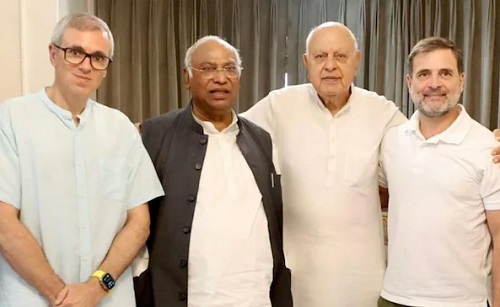
Nevertheless, Congress’ top brass, including party president Mallikarjun Kharge, Rahul Gandhi (Leader of the Opposition in the Lok Sabha), and Priyanka Gandhi Vadra, are expected to attend the swearing-in ceremony. The event is also anticipated to feature the induction of eight new ministers into the Abdullah government.
Several prominent figures from the opposition INDIA bloc, such as Samajwadi Party's Akhilesh Yadav, West Bengal Chief Minister Mamata Banerjee, and DMK leader MK Stalin, have received invitations to the ceremony. Congress allies in the upcoming Maharashtra elections, Uddhav Thackeray and Sharad Pawar, are also expected to attend.
Omar Abdullah's return to the political forefront comes after a remarkable victory in the recent Jammu and Kashmir Assembly elections, where the NC secured 42 of the 90 elected seats. This victory firmly established the NC as the dominant political force in the region, with Abdullah successfully contesting both the Budgam and Ganderbal constituencies, despite a recent setback in the Lok Sabha race for the Baramulla seat.
A key priority for Abdullah's administration will be the restoration of Jammu and Kashmir's statehood, which was revoked in August 2019 following the abrogation of Article 370. Speaking to ANI, Abdullah highlighted his focus on bringing hope to the people of Jammu and Kashmir, stating, "We have to give people hope... that this is their government, and they will be heard. They were not heard for the past five-six years."
While the NC emerged victorious, the Congress' performance in the election was underwhelming, securing only six seats—half of what it won in the 2014 elections. The party’s underperformance, coupled with the NC’s strong showing, resulted in the National Conference taking the lead in the alliance and naming Omar Abdullah as the Chief Minister.
The Congress' decision to stay out of the government, while offering support from the outside, may also be influenced by concerns over its broader electoral strategy and relationships with regional allies. Criticism has emerged from within the INDIA bloc, with Uddhav Thackeray’s Shiv Sena faction pointing to the Congress' inability to collaborate effectively with regional parties as a factor in its electoral setbacks.
In a sharply worded editorial in Saamana, the Sena criticized the Congress for turning "a winning innings into a defeat" and for failing to manage state leaders effectively, referring specifically to internal discord in Haryana, where the Congress lost to the BJP. Thackeray’s faction highlighted the reluctance of Congress' Haryana leader Bhupinder Hooda to collaborate with the Aam Aadmi Party (AAP), which some blame for the defeat in the state.
Similarly, the Trinamool Congress' Saket Gokhale also expressed frustration with the Congress' approach to seat-sharing within the INDIA bloc, urging the party to "learn" from the Haryana results.
Despite the setbacks, the Congress leadership, led by Mallikarjun Kharge and Rahul Gandhi, has pledged to review the results and address internal challenges. Last week, senior Congress leaders met in Delhi to discuss issues such as factionalism in Haryana and concerns about the Election Commission’s conduct during the polls.
With crucial elections in Maharashtra and Jharkhand on the horizon, Congress is expected to recalibrate its strategy, with party president Kharge already holding talks with Maharashtra’s Chief Minister Hemant Soren.
As Jammu and Kashmir prepares for a new chapter under Omar Abdullah’s leadership, the political dynamics within the region and the Congress’ role as an outside supporter of the government will continue to shape the Union Territory’s future. The NC’s agenda, particularly regarding the restoration of statehood, will be closely watched as the region seeks political stability and governance after years of uncertainty.






















Leave Your Comment