



Manoj Dubey
Climate Change
Climate change refers to long-term shifts in Earth's temperature, rainfall, and weather patterns. While natural factors such as volcanic eruptions and changes in solar radiation influence climate, the primary cause today is human activity. The burning of fossil fuels, deforestation, industrial emissions, intensive agriculture, and rapid urbanisation have increased greenhouse gases such as carbon dioxide and methane, leading to global warming. Climate change has become a major global challenge. Rising temperatures are causing more frequent heatwaves, droughts, floods, cyclones, wildfires, and glacial melting. Sea levels are rising, threatening coastal communities and ecosystems. Agriculture, biodiversity, water resources, and public health are increasingly at risk, while many plant and animal species face habitat loss and possible extinction.
India is highly vulnerable because of its diverse geography and large population. The country has experienced more intense heatwaves, irregular monsoons, glacial retreat in the Himalayas, floods, droughts, and stronger cyclones along its coasts. These changes affect food production, drinking water availability, livelihoods, and economic growth, while increasing the spread of climate-related diseases and displacement of vulnerable communities.
Addressing climate change requires reducing greenhouse gas emissions, protecting forests, adopting renewable energy, improving water conservation, and strengthening climate-resilient infrastructure through international cooperation and sustainable development.
Floods and Drought
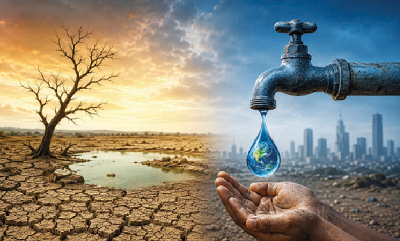
Floods and droughts are two of India's most serious natural disasters, often occurring in different regions during the same year due to the uneven distribution of monsoon rainfall. States such as Assam, Bihar, Uttar Pradesh, and parts of Kerala frequently experience floods, while Rajasthan, Maharashtra, Karnataka, Telangana, and parts of central India often face drought conditions.
Floods are caused by intense rainfall, overflowing rivers, cyclones, poor urban drainage, deforestation, and encroachment on floodplains. They lead to loss of life, damage to crops, infrastructure, and property, disruption of livelihoods, and outbreaks of water-borne diseases.
Droughts result from deficient rainfall, over-extraction of groundwater, deforestation, climate change, and inefficient water management. They reduce agricultural output, cause drinking water shortages, increase farmers' distress, and adversely affect livestock and rural incomes.
Water Crisis
India is facing a growing water crisis despite receiving substantial annual rainfall. Rapid population growth, urbanisation, industrialisation, and rising agricultural demand have put immense pressure on the country's water resources. Excessive groundwater extraction, inefficient irrigation, river and lake pollution, deforestation, and poor water management have worsened the situation. Climate change has further intensified the problem by causing erratic monsoons, prolonged droughts, floods, and rising temperatures, reducing the availability of reliable freshwater.
Water Conservation
India should adopt an integrated water management policy that focuses on water conservation, groundwater recharge, and flood control. Large-scale construction of check dams, percolation tanks, farm ponds, and rainwater harvesting structures should be encouraged in both rural and urban areas. Desilting and restoration of rivers, lakes, ponds, and wetlands must be undertaken regularly to improve water storage capacity. Afforestation in catchment areas and watershed development should be promoted to reduce soil erosion, increase groundwater recharge, and moderate flood flows. Floodplains should be protected from encroachment, and scientific river basin planning should guide development. Modern flood forecasting, early warning systems, and improved drainage infrastructure should be strengthened to reduce damage during heavy rainfall.
The government should encourage micro-irrigation techniques such as drip and sprinkler systems, promote water-efficient crops, and regulate excessive groundwater extraction through effective laws. Industries should be required to recycle and reuse water, while urban local bodies should implement wastewater treatment and reuse. Public participation is essential. Awareness campaigns, incentives for water conservation, and community management of local water bodies should be expanded. Climate-resilient infrastructure and coordinated planning among the Union, states, and local governments are also necessary. Together, these measures can improve water security, reduce the impact of floods, and ensure sustainable water management for future generations.
Check Dams
Check dams are small barriers built across streams and seasonal rivers to conserve water. They slow the flow of rainwater, allowing it to seep into the ground and recharge groundwater. This improves the water table, revives wells, and ensures water availability during dry seasons. Check dams also reduce soil erosion, control floods, and increase moisture for agriculture, leading to higher crop yields. I have stayed in the Saurashtra region of Gujarat and experienced how they support livestock, biodiversity, and rural livelihoods while reducing dependence on deep borewells. Being cost-effective, eco-friendly, and community-managed, check dams are an important solution for addressing water scarcity and strengthening climate resilience across India.
Conclusion
Global warming is intensifying, and groundwater levels are falling. In India, agriculture still depends significantly on the monsoon, even as irrigation has expanded over time. Even today, the Indian monsoon remains the single most important factor influencing agricultural production because nearly half of the country's cultivated land is rain-fed.
The Interlinking of Rivers (ILR) proposal is one of India's largest water management plans. It aims to connect surplus river basins with water-deficit basins through a network of dams, reservoirs, canals, and pumping systems. The objective is to transfer excess water during the monsoon to drought-prone regions, improving water security across the country.
Planting trees on barren or degraded land is one of the most effective natural ways to conserve water. Thus, afforestation not only conserves water but also enhances biodiversity, improves soil health, mitigates climate change, and strengthens long-term water security. Expanding forest cover is therefore a vital component of sustainable water resource management in India and worldwide.
A balance between development and water conservation requires scientific planning, efficient water use, protection of natural ecosystems, and active public participation. Sustainable development ensures that economic growth meets present needs without compromising water resources for future generations.
With a coastline of over 7,500 km, India can benefit from desalination, which can play an important role in improving water security, particularly for coastal cities and industries. Desalination should be viewed as one component of a broader water-management strategy. It should be combined with rainwater harvesting, groundwater recharge, watershed development, wastewater recycling, efficient irrigation, protection of rivers and wetlands, and improved water-use efficiency. Together, these measures can provide a more sustainable and resilient solution to India's long-term water challenges.
(The content of this article reflects the views of writer and contributor, not necessarily those of the publisher and editor. All disputes are subject to the exclusive jurisdiction of competent courts and forums in Delhi/New Delhi only)




















Leave Your Comment