



Rakesh kumar
The floods that devastate north-eastern India and many other parts of the country every year, along with recurring droughts elsewhere, destroy assets worth hundreds of thousands of crores of rupees. The grief, suffering, and loss of human lives cannot be measured. The tragedy is even greater because India, one of the world’s oldest continuous civilizations, enabled communities to live in harmony with nature.
During my childhood in East Delhi, Mathura, and Haridwar, I witnessed the abundance of nature firsthand. Almost every home had a tree, and even modest huts were surrounded by greenery. Trees provided shade, swings for children, firewood from fallen twigs, and nesting places for birds. Village chaupals served as gathering places where people met, talked, and strengthened community bonds.
Sparrows, Red-wattled Lapwings (locally known as Titahari), kingfishers, crows, eagles, owls, butterflies, and bumblebees were a common sight. Local ponds and wetlands were full of life, and the calls of birds formed the soundtrack of everyday living. The Yamuna and the Hindon rivers occupied large floodplains around East Delhi. We often swam in the Yamuna, both in Delhi and in Mathura. The river was home to fish and freshwater turtles, and watching turtles bask in the sun remains one of my fondest childhood memories. Groundwater was plentiful; a hand pump could yield water after digging only four or five yards.
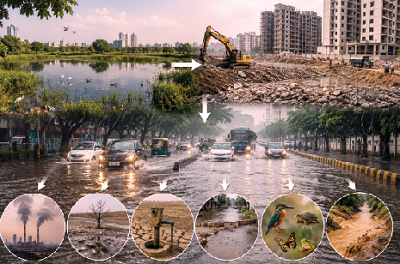
Then came rapid urbanisation. Roads, residential colonies, and institutions were built with little regard for natural drainage channels, floodplains, wetlands, or green cover. The needs of other living species were largely ignored. Untreated and partially treated sewage continued to flow into the sacred Yamuna, turning a once-living river into one struggling for survival. Today, while cities increasingly depend on water brought from distant sources such as the Upper Ganga Canal system and other supply networks, many of these same places experience severe flooding during the monsoon because rainwater has nowhere to drain naturally.
Across the country, numerous ponds, lakes, wetlands, and natural water bodies have been encroached upon or filled for construction. As a result, rainwater is forced onto roads instead of being absorbed into the ground, leading to urban flooding while simultaneously washing away fertile topsoil into rivers. Similar short-sighted development has contributed to worsening air pollution, loss of biodiversity, groundwater depletion, and many other environmental challenges.
The situation is not beyond repair. Restoring rivers, wetlands, lakes, forests, and urban green spaces, protecting floodplains, improving sewage treatment, enforcing environmental regulations, and planning development in harmony with nature are no longer optional—they are essential. Sustainable development does not mean choosing between economic growth and environmental conservation; it means ensuring that both can coexist for the benefit of present and future generations.
From Despair to Hope: Stories of Environmental Restoration.
Despite the scale of environmental degradation, there is reason for hope. Across India, dedicated social workers, local communities, and non-governmental organisations have shown that nature has an extraordinary ability to heal—provided we give it the opportunity.
I was fortunate to meet S. N. Subbarao, who inspired many young people. He taught us the importance of rainwater harvesting, tree plantation, and soil conservation—not merely as environmental activities but as essential responsibilities towards future generations. His work in the ravines of Chambal demonstrated how sustained community effort could arrest land degradation, reduce soil erosion, and gradually restore forests and ecological balance.
Rajendra Singh, widely known as the “Waterman of India” (Jal Purush). A pioneering water conservationist from Rajasthan, he transformed drought-stricken landscapes through simple, community-driven solutions. Rather than relying solely on expensive engineering projects, he revived traditional wisdom and mobilised local people to reclaim their water resources:
Environmental restoration does not always require extraordinary technology. It requires committed citizens, scientific understanding, traditional knowledge, and the collective will to work with nature rather than against it. When people restore forests, conserve water, and protect ecosystems, nature often responds with astonishing resilience
I, as an individual, could do water harvesting in all offices where I worked. In the Mumbai office we used to buy water from Feb to May. I invited the technical team from the central water commission to recycle sewer water. To my surprise they informed me that Mumbai has enough rainfall and the problem can be solved by rain water management. They also informed that the rocks have cracks and no formal infrastructure is needed. If we can allow the water to accumulate it will automatically seep in. The gardening staff happily created 8 pits to do the needful. The water table improved. We created seven more gardens and still water was available. With a little more effort and 42 varieties of non domestic birds, 19 types of butterflies were enjoying this gift of nature.
India’s Timeless Wisdom of Water Conservation.
Anupam Mishra, a man with purpose, devoted his life to researching the art and science of creating and maintaining traditional water bodies—known as talab, sarovar, lake, and by many other names across Indian languages. Readers may be surprised to learn that, according to his research, India was creating nearly 15,000 new talabs every year before the British took control of forests and water resources.
His celebrated book, Aaj Bhi Khare Hain Talab (“The Ponds Still Stand”), is a practical guide to building and restoring water bodies without spending a fortune. In a remarkable gesture, the author made the book available online as a free download.
India’s water bodies were built not only by kings and wealthy patrons but also by saints, ordinary villagers, and the poor. Almost every village had four or five ponds, which were collectively created and maintained by local communities.
Munshi Premchand’s famous story, Thakur Ka Kuan, describes the plight of a poor family whose own well had become unusable after an animal fell into it, forcing them to seek water from the Thakur’s well. However, the story does not discuss how British rule took away local communities’ authority to repair, clean, and manage water bodies. Traditionally, such dependence on a single well was uncommon because different communities maintained their own water sources. The larger historical truth is that the so-called upper castes were themselves dependent on the working classes for constructing, repairing, and maintaining these vital water bodies.
While individuals and NGOs have shown what is possible through dedication and community action then why government intervention is still needed?
Climate change cannot be tackled without government support. Free markets fail to account for environmental damage, clean air and a stable climate are public goods, and individual efforts alone cannot deliver the large-scale coordination required.
Market Failures and Externalities
Market Failures and Externalities
Public Goods and the Free-Rider Problem
Public Goods and the Free-Rider Problem
inesses make others to bear the cost of climate action while enjoying the benefits. Governments address this through laws, taxes, and regulations that ensure shared responsibility.
Scale and Long-Term Coordination
Frequent flood in Assam is a live example:
The recurring floods in Assam should serve as a wake-up call to accelerate climate adaptation. While engineering measures such as embankments remain important, they are no longer sufficient on their own. Nature-based solutions must become a central part of Assam’s flood management strategy, complementing conventional infrastructure and strengthening resilience against floods of all magnitudes.
Implementing these solutions will not be easy, as rivers and ecosystems do not follow administrative boundaries. Effective management of the Brahmaputra requires a basin-wide approach, demanding close cooperation among Assam, Arunachal Pradesh, Meghalaya, and other neighbouring states. Their priorities and interests may differ, but these challenges are not insurmountable. Although Arunachal Pradesh and Meghalaya are less prone to flooding because of their hilly terrain, they face severe risks from extreme rainfall, landslides, and mudslides. This shared vulnerability makes regional collaboration essential. By developing a common strategy based on nature-based solutions, these states can sustainably address floods, landslides, and mudslides while building long-term climate resilience.
The impact of a check dam can be extraordinary. Let’s explore how ground-level efforts have transformed the landscape.
The Gabbar Hills, near Ambaji in Gujarat’s Banaskantha district on the Gujarat–Rajasthan border at the foothills of the Mount Abu range, demonstrate how check dams can transform an entire landscape. Once an arid region marked by rapid rainwater runoff and severe groundwater depletion, the area has been revitalised through integrated water harvesting and watershed management.
Ecological and Water Transformation
Improved environmental stability laid the foundation for the Gujarat Government’s ₹1,632 crore Ambaji Master Plan, transforming the region into a sustainable pilgrimage destination.
Agricultural Transformation
The spread of check dams and percolation tanks along the Banaskantha–Mount Abu foothills has revolutionised agriculture. Once dependent on uncertain monsoon rains and limited to a single crop, farmers now benefit from reliable groundwater recharge.
Building on this ecological revival, the Gujarat Government launched the ₹1,632 crore Ambaji Shakti Corridor Master Plan, designed to manage visitor growth over the next 25 years while preserving the restored landscape.
The way forward.
This article is not an attempt to preach. It is a humble appeal to hear Mother Nature’s cry before it grows too loud to ignore. If we fail to act today, we risk inviting Lord Shiva to perform his cosmic Tandav—not as the preserver of balance, but as the ultimate destroyer.
India has set an ambitious goal of achieving net-zero carbon emissions by 2070. Providing clean drinking water to every citizen, restoring our rivers, and addressing the many challenges of climate change will require the participation of every Indian.
Water will be the defining resource of the twenty-first century, shaping the nation’s health, economy, agriculture, and future. The success of initiatives such as voluntarily surrendering LPG subsidies, Swachh Bharat, Beti Bachao, Beti Padhao, the widespread adoption of UPI, and the significant reduction in Maoist violence demonstrates that when the Government of India commits itself to a national mission, remarkable transformation is possible.
The time has come for Prime Minister Narendra Modi to inspire the nation once again. His Mann Ki Baat reaches millions, and his government has rightly recognised many environmental champions with Padma Shri and higher civilian honours. The stage is set. Let every Indian be empowered to create and restore ponds, lakes, wetlands, and other water bodies, while governments at every level become active partners in these efforts. Just as India has pursued the goal of Ease of Doing Business, it is now time to embrace a new national mission—Ease of Protecting Mother Nature, or better still, Ease of Thriving with Mother Nature.
(The content of this article reflects the views of writer and contributor, not necessarily those of the publisher and editor. All disputes are subject to the exclusive jurisdiction of competent courts and forums in Delhi/New Delhi only)






















Leave Your Comment