


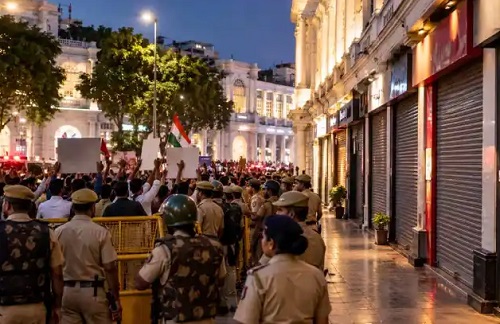
Repeated protests in the national capital are increasingly raising questions about the cost of political agitation for ordinary citizens, particularly traders, shopkeepers and workers who depend on uninterrupted commercial activity for their livelihoods. As the Cockroach Janta Party (CJP) prepares for its ‘Lehra Do Tiranga’ march, businesses in Khan Market and Connaught Place are reporting mounting losses, declining customer footfall and growing uncertainty during the crucial festival season.
The right to peaceful protest is an essential democratic freedom, but it cannot become a justification for repeatedly disrupting the lives of people who have little to do with the political demands being raised. The latest concerns from Delhi’s prominent shopping districts highlight the need for political groups, including the CJP, to recognise that demonstrations carry economic and social consequences beyond the immediate site of agitation.
The Khan Market Association has approached the Supreme Court seeking intervention over the impact of repeated protests, while traders in Connaught Place have complained that security restrictions, barricades and fears of restricted access are keeping customers away. The closure of Central Park on October 16 and 17, ahead of the CJP’s proposed march, has further heightened apprehensions among businesses operating in and around the commercial district.
The reported scale of the losses makes the issue particularly serious. According to the Khan Market Association, businesses in the area are suffering losses of around Rs 50 crore a day amid the decline in customer visits. Some establishments reportedly face daily rents of up to Rs 3 lakh, placing enormous pressure on traders when sales fall sharply. These figures reflect the association’s claims, but they underline the urgency of addressing the concerns of those bearing the economic burden.
Connaught Place presents a similar picture. Traders have reported a decline of 20–25 per cent in sales, with some establishments describing business activity as having fallen to only a fraction of normal levels. Shopkeepers fear that the perception of blocked roads, barricaded entrances and possible confrontations is discouraging people from visiting the area, even when individual shops remain open.
The consequences extend well beyond business owners. Employees depend on daily commercial activity for their salaries, while smaller establishments must meet rent, electricity bills, maintenance costs and other operating expenses regardless of their earnings. When protests repeatedly disrupt customer movement, workers and small traders—who have no role in the political dispute—often become the first victims of the resulting uncertainty.
The CJP’s proposed ‘Lehra Do Tiranga’ march must therefore be viewed not merely through the political message its organisers wish to convey, but also through its potential impact on the public. A demonstration may attract attention to a cause, but when repeated agitation discourages customers, threatens earnings and places workers’ jobs under pressure, its costs are borne by people who may have no connection with the controversy.
Political activism cannot be treated as an unrestricted licence to inconvenience everyone else. The freedom to assemble and express dissent must coexist with the rights of citizens to conduct business, earn a living and move through the city without unnecessary disruption. Organisers have a responsibility to plan demonstrations in ways that minimise inconvenience, while the authorities must maintain public order without imposing avoidable restrictions on commercial areas.
Ultimately, the strength of a democracy lies not only in protecting the right to protest but also in ensuring that this freedom is exercised responsibly. If political organisations expect the public to take their demands seriously, they must also demonstrate sensitivity towards those whose livelihoods are affected by their actions. In a city already balancing security requirements and commercial activity, the CJP and other protest organisers must recognise a fundamental principle: political visibility cannot come at the cost of ordinary citizens’ livelihoods.






















Leave Your Comment