



Sarat C. Das
For a long time, the environmental conversation around business was dominated by one familiar word: recycling. Put the bottle in the correct bin. Recycle the packaging. Separate paper from plastic. Send electronic equipment to a recycling facility. Recover whatever materials can be recovered. All of this matters. Recycling reduces pressure on landfills, recovers useful materials, and signals that consumers and companies are paying attention. But recycling, by itself, does not make a business circular. That is becoming one of the most important ideas in modern sustainability. A company can manufacture millions of products, sell them, encourage customers to dispose of them, and then proudly announce that part of the resulting waste is recycled. The waste problem may be reduced, but the underlying business model has not necessarily changed.
The circular economy asks a more difficult question: why did the waste have to be created in the first place? And then it asks several more. Can a product last longer? Can it be repaired? Can components be replaced rather than the whole product? Can the manufacturer take the product back? Can materials remain in productive use for longer? Can a company sell access rather than ownership? Can production systems use waste from one process as an input for another? These questions move sustainability away from the waste bin and into the boardroom. They also create opportunities for innovative circular economy strategies, new revenue models and new forms of competitive advantage. This is why business models for sustainability are becoming increasingly important in management education. Circularity is not simply an environmental issue. It involves product design, procurement, finance, marketing, logistics, technology, consumer behaviour and corporate strategy.
For students pursuing a Global MBA in Spain, this provides an especially interesting field of study. Spain’s businesses operate within a European market where sustainability, resource efficiency and circularity are increasingly connected with industrial competitiveness and regulation. For institutions such as C3S Business School, the subject offers an opportunity to connect sustainability with mainstream management education. Hiren Raval, chief executive officer of C3S Business School in Barcelona, offers this editorial perspective: “The circular economy asks businesses to think about the entire life of a product rather than only the moment when it is sold. That changes both sustainability thinking and business thinking.” That is the central idea of this article. The circular economy is not simply about recycling more. It is about designing business differently.
Recycling is important, but it generally happens relatively late in the product lifecycle. First, raw materials are extracted. Then they are processed. Then products are manufactured. Then they are transported. Then they are sold. Then consumers use them. And finally, after the product has reached the end of its useful life, recycling may recover some of its materials. The circular economy tries to intervene much earlier. Imagine a washing machine. A traditional business model may sell the washing machine, provide a warranty and eventually leave the customer to dispose of it. A circular business model might design the machine for easy repair, make individual components replaceable, offer maintenance, refurbish returned machines, and recover useful components at the end. The difference is significant. The second company is thinking about the product as a long-term asset rather than a one-time sale.
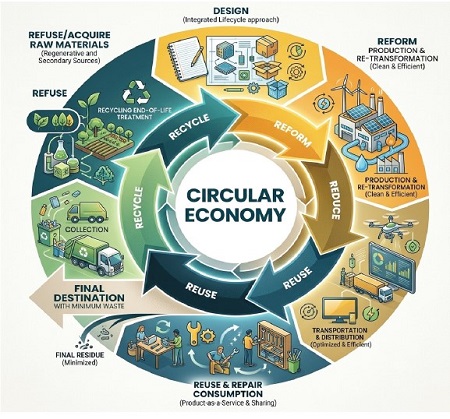
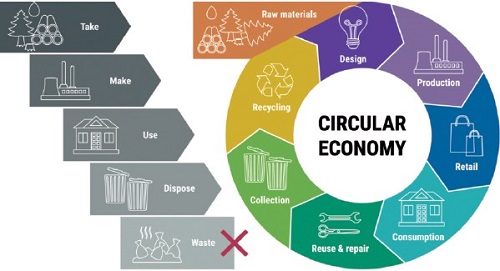
Recycling addresses what happens after consumption. Circularity asks what happens before, during, and after consumption, and how the entire system can be redesigned. That is why recycling should be seen as one element within a much larger system. A circular economy generally tries to keep products, components and materials at their highest possible value for as long as possible. This is the thinking behind many innovative circular economy strategies. The conventional economic model is often described as take, make, use, and dispose. It is linear. Raw materials enter the system. Products are manufactured. Consumers use them. Then products become waste. The circular model seeks something different: design, make, use, maintain, repair, reuse, refurbish, remanufacture, and recycle. The intention is to keep value circulating. That does not mean everything can be reused forever. Nor does it mean recycling disappears. Rather, recycling becomes one option within a hierarchy of strategies designed to retain the value of products and materials.
This is why circular supply chain models are so important. A conventional supply chain generally moves materials towards the customer. A circular supply chain has to think about the reverse journey as well. Where does the product go after use? Who collects it? Can it be repaired? Can it be refurbished? Can components be recovered? Can materials return to manufacturing? Suddenly logistics becomes part of sustainability. That creates an important opportunity for business models for sustainability. There is no single circular business model. Instead, there are several principles that organisations can combine. The first is to design out waste. The best waste may be the waste that never exists. Product designers can reduce unnecessary packaging, eliminate problematic materials and design products for durability and repair. The second is to keep products in use. The longer a product remains useful, the greater the value extracted from the resources used to produce it. The third is to extend product life. Repair, maintenance, refurbishment, and remanufacturing can all extend the useful life of products. The fourth is to recover materials. When a product can no longer be used, its materials may still have value. The fifth is to regenerate natural systems. Some circular models go beyond reducing harm and seek to restore natural resources and ecosystems. The sixth is to rethink ownership. Customers do not always need to own a product. They may need the service the product provides. This creates some of the most interesting innovative circular economy strategies.
One of the most interesting circular models is Product-as-a-Service. Instead of selling a physical product outright, a company provides access to the product or the service it delivers. Think about lighting. A customer may not actually need lamps. They need illumination. A company could therefore provide lighting as a service and remain responsible for maintaining, upgrading, and eventually recovering the equipment. The same principle can apply to machinery. A manufacturer may sell hours of equipment availability rather than the machine itself. This changes the incentives. If the manufacturer retains ownership, it has a reason to make the product durable, efficient and repairable. A disposable product becomes less attractive. A long-lasting product becomes economically valuable. Prof David Weir, Chief Patron of the Academy of Policy and Research and Professor of Intercultural Management at York Business School, York St John University, offers this editorial perspective: “Circular business models become particularly interesting when the commercial incentive of the company is aligned with keeping the product useful for longer.” This is one of the strongest arguments for business models for sustainability. Sustainability becomes part of the economics rather than something added afterwards.
Not every circular model needs to be revolutionary. Sometimes the simplest idea is extremely powerful: make things last longer. Repair businesses can extend the life of electronics, vehicles, appliances, furniture and industrial equipment. Refurbishment can turn used products into commercially valuable products again. Reuse can allow products to move between users rather than becoming waste after the first owner no longer needs them. These activities can create new markets. They can also create employment. A circular economy therefore has a social dimension as well. Instead of an economy organised primarily around producing and selling new products, it can create economic activity around maintenance, repair, upgrading, refurbishment and resource recovery. This is an important part of sustainable business practices in 2025, particularly for businesses looking beyond short-term consumption.
Another circular approach involves shared ownership or shared access. Why should ten people each own a product that they use only occasionally? Car-sharing is an obvious example. Other possibilities include shared tools, equipment, workspaces and specialised machinery. Digital platforms make these models easier to coordinate. But sharing is not automatically circular. The environmental benefit depends on whether sharing genuinely reduces the number of products required and how the service operates. This is where business analysis matters. Circularity should be measured rather than assumed. Remanufacturing goes further than simple refurbishment. A manufacturer may take used equipment, disassemble it, inspect components, replace worn parts, and rebuild the product to an appropriate performance standard. This can be particularly relevant to industrial equipment, automotive components and machinery. The advantage is that much of the original product’s embedded value can be retained. The company does not necessarily need to start from raw materials again. This creates opportunities for circular supply chain models in manufacturing. It also changes the relationship between the manufacturer and the customer. The customer becomes part of a longer product lifecycle.
Another fascinating circular model is industrial symbiosis. The basic idea is simple: one company’s waste can become another company’s input. A factory may produce a by-product that another business can use. Waste heat from one process could potentially be used elsewhere. Organic waste could become a resource for another production process. Water may be treated and reused. This approach transforms the idea of waste. Instead of asking how we dispose of this, the business asks who might find value in this. That is one of the most interesting forms of innovative circular economy strategies. It also encourages businesses to think beyond the boundaries of their own organisation. The circular economy is often presented as an environmental idea, but companies have commercial reasons to explore it as well. Lower material dependency matters.
The conventional model is often simple: company, product, customer. Then the relationship may largely end after the sale. Circular business models can create a continuing relationship between company and customer. The company may provide maintenance. The customer may return the product. The company may upgrade it. The customer may continue paying for access. This creates a longer relationship. Marketing therefore changes too. The company is no longer simply selling a product. It is selling durability, availability, performance or service. Professor Mani Tahriri of C3S Business School offers this editorial perspective: “Circularity can turn a one-time transaction into a continuing relationship. That can change how companies think about customer value.” This is particularly important for students studying business models for sustainability.
Circular economy sounds attractive. Implementing it is much harder. There are genuine obstacles. Consumer expectations are one. Many customers still prefer new products. A refurbished product can sometimes carry a stigma even when it performs well. Reverse logistics is another. Collecting products after use can be expensive. The forward supply chain is relatively straightforward. The reverse supply chain is often much more complicated. Product design matters. Products designed for disposal are not easily converted into circular products. Pricing is difficult. A durable product may cost more initially. Consumers may not always recognise the long-term value. Business-model conflict can arise. A company accustomed to selling more units may find it difficult to shift towards models based on longevity. Infrastructure is needed. Repair, reuse and recycling call upon appropriate facilities and networks. Data is essential. Organisations require information about products, materials and lifecycle performance spanning the entire spectrum. Regulation can either encourage circularity or create complications, depending on the market and product at large. These barriers mean that sustainable business practices in 2025 cannot simply be adopted through slogans. They require structural change.
One of the deeper questions surrounding the circular economy is whether businesses can continue growing while using fewer resources. This is where the conversation becomes philosophical as well as managerial. Traditional business success is often measured by units sold. Circular businesses may instead focus on revenue per customer, product utilisation, service revenue, product lifespan, resource productivity, material recovery and customer retention. A company that sells fewer machines but provides maintenance and service for a much larger installed base could potentially create a different type of growth. This is why circularity can challenge conventional thinking about business models for sustainability.
A conventional supply chain tends to move in one direction: raw material, manufacturer, distributor, customer. A circular supply chain model adds new loops. Customer to collection to repair to reuse. Customer to return to refurbishment to resale. Customer to recovery to component to new product. Factory A to by-product to Factory B. These loops create complexity. But they can also create value. This is why circular supply chain models are becoming an important topic in operations and sustainability education. For managers, the challenge is to determine which loops make economic and environmental sense. Not every product needs every loop. Circular transformation cannot be delegated entirely to the sustainability department. It requires leadership.
For C3S Business School in Spain, the circular economy fits naturally within wider conversations about international business, entrepreneurship, sustainability and innovation. Barcelona and the wider European business environment provide a useful context for examining how businesses respond to changing expectations around sustainability and resource efficiency. For students considering a top business school in Spain, it is worth asking whether sustainability is treated as a specialist subject or incorporated throughout management education. The same applies when students search for the best business school in Spain. The question should not only be which institution has the best reputation. It should also be which institution is preparing me for the business challenges that are actually emerging. A future manager will probably encounter sustainability regardless of their job title. That makes circular economy education increasingly relevant.
One of the most difficult parts of circularity is the customer. Businesses can redesign products. They can establish take-back systems. They can create repair networks. But customers have to participate. Some consumers may prefer new products. Others may be uncomfortable buying refurbished items. Some may value ownership more than access. Others may prefer subscriptions. Therefore, circular businesses need good marketing. They need to communicate value. A refurbished laptop should not be marketed simply as second-hand. It may be a professionally tested, upgraded, and warrantied product. A clothing company offering repair services needs to make repair desirable. A furniture company offering take-back services needs to make returning the product convenient. This is where circularity and customer experience intersect. One danger is that businesses may use the language of the circular economy without substantially changing their practices. A company can make sustainability claims while continuing to operate fundamentally as a linear business. Measurement therefore matters. Businesses can examine product lifespan, repair rates, reuse rates, refurbishment rates, material recovery, recycled content, resource intensity, return rates, waste reduction, product utilisation and circular revenue. The exact metrics will differ by industry. But measurement provides discipline. It also helps distinguish genuine sustainable business practices in 2025 from marketing claims.
The next stage of the circular economy is likely to involve more integration. AI may optimise resource use. IoT may monitor products. Digital platforms may coordinate repair and reuse. Blockchain or other traceability technologies may support selected supply-chain applications. Robotics may automate sorting and recovery. Advanced materials may make products easier to repair or recycle. Renewable energy may reduce the carbon intensity of manufacturing. This creates a powerful convergence between technology and sustainability. The circular economy is therefore not a return to an old-fashioned economy of repairing everything because people could not afford new products. It can be a technologically sophisticated economy. The objective is to use technology to keep value circulating more effectively. That is where innovative circular economy strategies become particularly interesting. Ultimately, the circular economy will become meaningful when companies discover that circularity can create competitive advantage. That might happen through lower costs, greater customer loyalty, new revenue streams, reduced resource dependency, improved resilience, new services, product differentiation, innovation, regulatory preparedness, and stronger relationships with customers and suppliers. The companies that succeed may not be those that simply recycle the most. They may be those that rethink how products are designed, sold, used, maintained and recovered. That is the deeper meaning of business models for sustainability.
Recycling will remain important. But recycling should not be the destination of the circular economy. It should be one part of a much larger journey. The real ambition is to reduce unnecessary resource consumption, design out waste, extend product life, keep materials productive, rethink ownership and create business models in which economic value and resource efficiency reinforce each other. That requires companies to think differently. It requires designers to think differently. It requires consumers to think differently. And it requires managers to think differently. The circular economy asks a surprisingly simple question: what if waste was treated as a design failure rather than an unavoidable consequence of doing business? That question can lead to new products, new services, new supply chains, new revenue models, and sometimes entirely new industries. For business students, the implications are significant. Sustainable business practices in 2025 should not be understood merely as a collection of environmental initiatives. They increasingly involve strategy and business-model innovation. Circular supply chain models should not be treated simply as reverse logistics. They can redefine relationships between manufacturers, suppliers, customers and service providers. Business models for sustainability should not exist on the margins of business education. They belong inside mainstream discussions of strategy, operations, finance and entrepreneurship.
(The content of this article reflects the views of writer and contributor, not necessarily those of the publisher and editor. All disputes are subject to the exclusive jurisdiction of competent courts and forums in Delhi/New Delhi only)




















Leave Your Comment